
Login
Join with us
Forgot Password
Password Reset
If you have not received the OTP, please check your spam or junk folder.
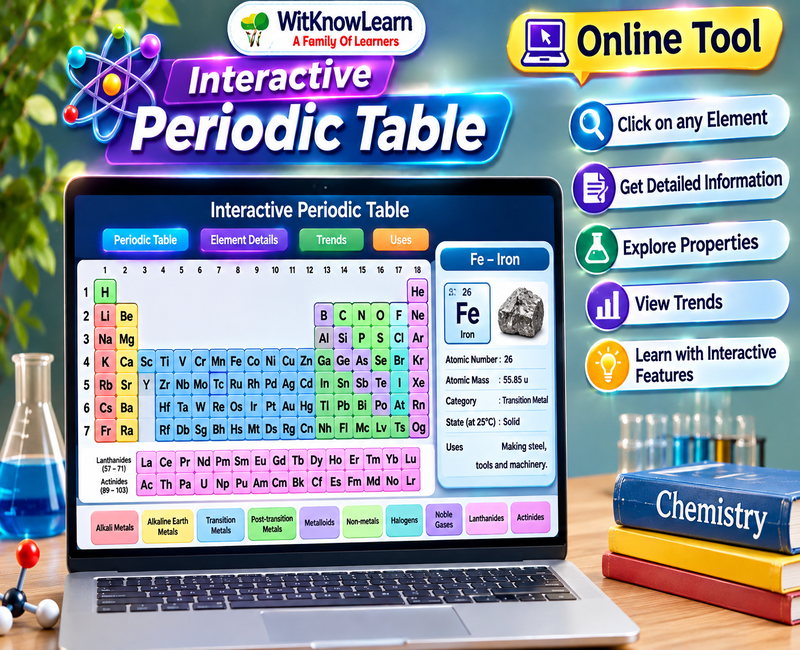
Click any element to see its properties, valency, electronic configuration and a 3D atom model, with audio in 9 languages.
Drag to rotate · Use + / − to zoom · Click any element
10 questions with a timer and streaks. Pick your class level and press Start!
This free 3D interactive periodic table by WitKnowLearn helps students of Class 9, 10, 11 and 12 learn all 118 elements by exploring them. You can rotate the table, turn it into a sphere or helix, or raise the elements as 3D bars by atomic mass or electronegativity to see trends. Click any element to open its card with atomic number, atomic mass, group, period, block, valency, electronic configuration, shell distribution (K, L, M, N), common oxidation states and a rotating 3D Bohr model of the atom.
Students around the world can switch the language to English, Spanish, French, German, Portuguese, Russian, Arabic, Chinese or Japanese and press Listen to hear the element's name and key facts read aloud.
Practise these chapters with our free CBSE / NCERT worksheets and notes:
More free tools: Online tools for students · All worksheets · All notes
Test yourself with grade-wise quizzes. Class 6–8 covers symbols, atomic numbers, states and element families. Class 9–10 covers shell distribution (K, L, M, N), valency, neutrons and an element's group and period. Class 11–12 covers electronic configuration (including exceptions such as Cr and Cu), s-, p-, d- and f-blocks, and electronegativity. Each quiz has 10 questions with a timer, streaks and stars. In the Find on the table game, you race to click the named element on the 3D table.
Valency is the combining capacity of an atom. Count the electrons in the outermost shell (valence electrons). If an atom has 1, 2, 3 or 4 valence electrons, its valency is the same number. If it has 5, 6, 7 or 8, its valency is 8 minus that number. For example, oxygen (2, 6) has valency 8 − 6 = 2, and sodium (2, 8, 1) has valency 1. Noble gases have a complete octet, so their valency is 0. Transition elements show variable valency.
There are 118 known elements in the modern periodic table, arranged in 7 periods (horizontal rows) and 18 groups (vertical columns) in increasing order of atomic number.
Valency is the combining capacity of an atom. For elements with 1 to 4 electrons in the outermost shell, valency equals the number of valence electrons. For elements with 5 to 8 valence electrons, valency is 8 minus the number of valence electrons. Noble gases have valency 0.
Electronic configuration is the distribution of an atom's electrons in its shells (K, L, M, N) and subshells (s, p, d, f). For example, sodium (atomic number 11) has the shell distribution 2, 8, 1 and the configuration 1s² 2s² 2p⁶ 3s¹.
The modern periodic law states that the properties of elements are a periodic function of their atomic numbers. It was proposed by Henry Moseley.
Yes. Choose a language from the language menu and press Listen. The tool reads the element's name and key facts aloud in English, Spanish, French, German, Portuguese, Russian, Arabic, Chinese or Japanese using your device's built-in voices.
| No. | Symbol | Element | Atomic mass (u) |
|---|---|---|---|
| 1 | H | Hydrogen | 1.008 |
| 2 | He | Helium | 4.0026 |
| 3 | Li | Lithium | 6.94 |
| 4 | Be | Beryllium | 9.0122 |
| 5 | B | Boron | 10.81 |
| 6 | C | Carbon | 12.011 |
| 7 | N | Nitrogen | 14.007 |
| 8 | O | Oxygen | 15.999 |
| 9 | F | Fluorine | 18.998 |
| 10 | Ne | Neon | 20.180 |
| 11 | Na | Sodium | 22.990 |
| 12 | Mg | Magnesium | 24.305 |
| 13 | Al | Aluminium | 26.982 |
| 14 | Si | Silicon | 28.085 |
| 15 | P | Phosphorus | 30.974 |
| 16 | S | Sulphur | 32.06 |
| 17 | Cl | Chlorine | 35.45 |
| 18 | Ar | Argon | 39.948 |
| 19 | K | Potassium | 39.098 |
| 20 | Ca | Calcium | 40.078 |
| 21 | Sc | Scandium | 44.956 |
| 22 | Ti | Titanium | 47.867 |
| 23 | V | Vanadium | 50.942 |
| 24 | Cr | Chromium | 51.996 |
| 25 | Mn | Manganese | 54.938 |
| 26 | Fe | Iron | 55.845 |
| 27 | Co | Cobalt | 58.933 |
| 28 | Ni | Nickel | 58.693 |
| 29 | Cu | Copper | 63.546 |
| 30 | Zn | Zinc | 65.38 |
| 31 | Ga | Gallium | 69.723 |
| 32 | Ge | Germanium | 72.630 |
| 33 | As | Arsenic | 74.922 |
| 34 | Se | Selenium | 78.971 |
| 35 | Br | Bromine | 79.904 |
| 36 | Kr | Krypton | 83.798 |
| 37 | Rb | Rubidium | 85.468 |
| 38 | Sr | Strontium | 87.62 |
| 39 | Y | Yttrium | 88.906 |
| 40 | Zr | Zirconium | 91.224 |
| 41 | Nb | Niobium | 92.906 |
| 42 | Mo | Molybdenum | 95.95 |
| 43 | Tc | Technetium | [98] |
| 44 | Ru | Ruthenium | 101.07 |
| 45 | Rh | Rhodium | 102.91 |
| 46 | Pd | Palladium | 106.42 |
| 47 | Ag | Silver | 107.87 |
| 48 | Cd | Cadmium | 112.41 |
| 49 | In | Indium | 114.82 |
| 50 | Sn | Tin | 118.71 |
| 51 | Sb | Antimony | 121.76 |
| 52 | Te | Tellurium | 127.60 |
| 53 | I | Iodine | 126.90 |
| 54 | Xe | Xenon | 131.29 |
| 55 | Cs | Caesium | 132.91 |
| 56 | Ba | Barium | 137.33 |
| 57 | La | Lanthanum | 138.91 |
| 58 | Ce | Cerium | 140.12 |
| 59 | Pr | Praseodymium | 140.91 |
| 60 | Nd | Neodymium | 144.24 |
| 61 | Pm | Promethium | [145] |
| 62 | Sm | Samarium | 150.36 |
| 63 | Eu | Europium | 151.96 |
| 64 | Gd | Gadolinium | 157.25 |
| 65 | Tb | Terbium | 158.93 |
| 66 | Dy | Dysprosium | 162.50 |
| 67 | Ho | Holmium | 164.93 |
| 68 | Er | Erbium | 167.26 |
| 69 | Tm | Thulium | 168.93 |
| 70 | Yb | Ytterbium | 173.05 |
| 71 | Lu | Lutetium | 174.97 |
| 72 | Hf | Hafnium | 178.49 |
| 73 | Ta | Tantalum | 180.95 |
| 74 | W | Tungsten | 183.84 |
| 75 | Re | Rhenium | 186.21 |
| 76 | Os | Osmium | 190.23 |
| 77 | Ir | Iridium | 192.22 |
| 78 | Pt | Platinum | 195.08 |
| 79 | Au | Gold | 196.97 |
| 80 | Hg | Mercury | 200.59 |
| 81 | Tl | Thallium | 204.38 |
| 82 | Pb | Lead | 207.2 |
| 83 | Bi | Bismuth | 208.98 |
| 84 | Po | Polonium | [209] |
| 85 | At | Astatine | [210] |
| 86 | Rn | Radon | [222] |
| 87 | Fr | Francium | [223] |
| 88 | Ra | Radium | [226] |
| 89 | Ac | Actinium | [227] |
| 90 | Th | Thorium | 232.04 |
| 91 | Pa | Protactinium | 231.04 |
| 92 | U | Uranium | 238.03 |
| 93 | Np | Neptunium | [237] |
| 94 | Pu | Plutonium | [244] |
| 95 | Am | Americium | [243] |
| 96 | Cm | Curium | [247] |
| 97 | Bk | Berkelium | [247] |
| 98 | Cf | Californium | [251] |
| 99 | Es | Einsteinium | [252] |
| 100 | Fm | Fermium | [257] |
| 101 | Md | Mendelevium | [258] |
| 102 | No | Nobelium | [259] |
| 103 | Lr | Lawrencium | [266] |
| 104 | Rf | Rutherfordium | [267] |
| 105 | Db | Dubnium | [268] |
| 106 | Sg | Seaborgium | [269] |
| 107 | Bh | Bohrium | [270] |
| 108 | Hs | Hassium | [269] |
| 109 | Mt | Meitnerium | [278] |
| 110 | Ds | Darmstadtium | [281] |
| 111 | Rg | Roentgenium | [282] |
| 112 | Cn | Copernicium | [285] |
| 113 | Nh | Nihonium | [286] |
| 114 | Fl | Flerovium | [289] |
| 115 | Mc | Moscovium | [290] |
| 116 | Lv | Livermorium | [293] |
| 117 | Ts | Tennessine | [294] |
| 118 | Og | Oganesson | [294] |
Made by WitKnowLearn, with free worksheets, notes and online tools for students.