
Login
Join with us
Forgot Password
Password Reset
If you have not received the OTP, please check your spam or junk folder.
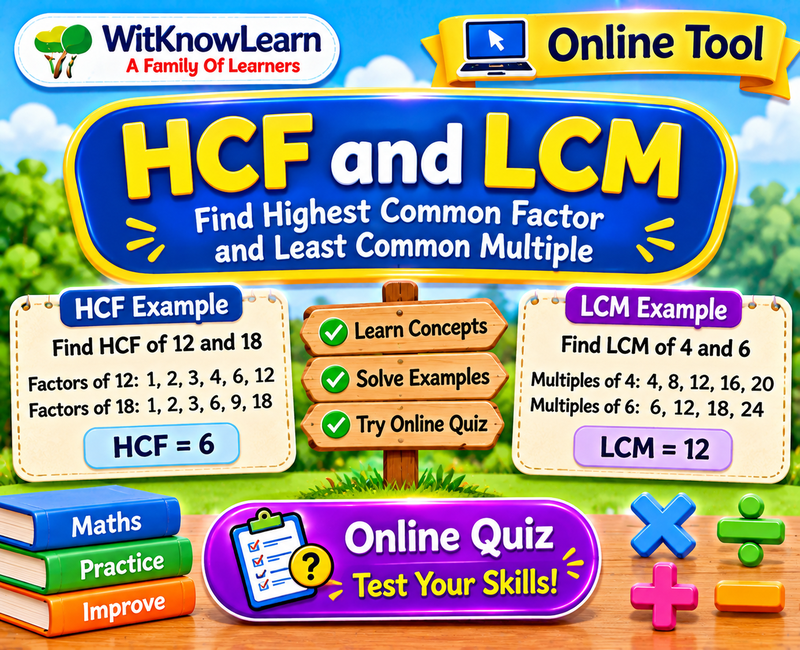
Find the HCF and LCM by factor tree, division method and Euclid's algorithm, with every step shown.
Score: 0 / 0
Practise HCF, LCM, factors and multiples with our free CBSE / NCERT worksheets and notes.
More: Online tools for students · All worksheets · All notes
This free HCF and LCM calculator finds the Highest Common Factor and Lowest Common Multiple of 2 to 15 numbers and shows full working in four ways: prime factorisation with factor trees, the division (ladder) method, Euclid's division algorithm and a verification step. It follows the methods taught in NCERT / CBSE Class 4, 5, 6 and Class 10 (Real Numbers), so students can check homework and learn each step. The Quiz & Games section has grade-wise MCQ quizzes (Class 4–5, 6–7 and 8–10) with word problems on bells and ribbons, plus a Balloon Pop game for common factors and multiples. Students around the world can switch the tool to English, Spanish, French, German, Portuguese, Russian, Arabic, Chinese or Japanese.
Find the HCF of the first two numbers, then find the HCF of that answer and the third number, and continue in the same way. You can also write every number as a product of primes and multiply the common primes, each with its smallest power.
Write the numbers in a row and divide by a prime that divides at least two of them. Bring down any number that is not divisible. Repeat until every number becomes 1. The LCM is the product of all the divisors.
Yes, but only for two numbers. For example, HCF(12, 18) × LCM(12, 18) = 6 × 36 = 216 = 12 × 18. The rule does not work for three or more numbers.
The HCF of co-prime numbers is 1, and the LCM of two co-prime numbers is their product.