
Login
Join with us
Forgot Password
Password Reset
If you have not received the OTP, please check your spam or junk folder.
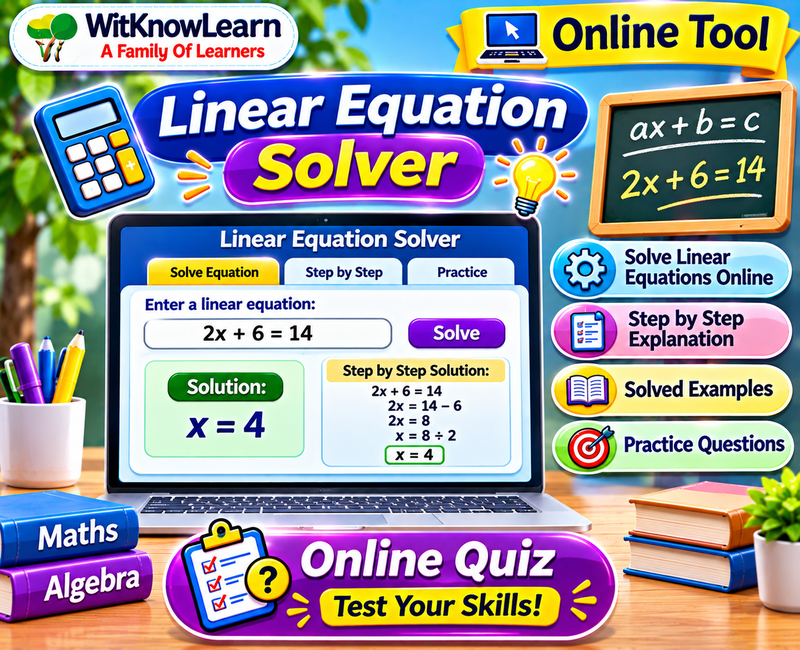
Type any linear equation and see every step: brackets, fractions, decimals, variables on both sides, and pairs of equations solved by substitution, elimination, cross-multiplication and graph.
Simple equations and word problems on finding a number. 10 questions with a timer, streaks and stars.
Practise these chapters with our free CBSE / NCERT worksheets and notes.
More: Online tools for students · All worksheets · All notes
This free linear equation solver online shows the complete working for any linear equation, just as it is written in a Class 7, 8, 9 or 10 notebook. For equations in one variable, it expands brackets, clears fractions using the LCM, moves variables and constants to opposite sides (transposition), divides by the coefficient and then checks the answer by substitution. It also works with decimals, negative numbers and special cases with no solution or infinitely many solutions.
For a pair of linear equations in two variables (Class 10), the solver shows four methods side by side: substitution, elimination, cross-multiplication and the graphical method with a plotted graph. It also checks the ratios a₁/a₂, b₁/b₂ and c₁/c₂ to tell whether the pair is consistent. The Quiz & Games section has grade-wise quizzes and the Balance It! game, where students solve equations by keeping both sides of a scale balanced.
Remove brackets and simplify each side. Clear fractions by multiplying both sides by the LCM of the denominators. Move the variable terms to one side and the numbers to the other side by doing the same operation on both sides. Finally, divide both sides by the coefficient of the variable, then check by substituting the answer back.
Transposition means moving a term from one side of the equation to the other side and changing its sign. For example, in x + 5 = 12, moving +5 to the right gives x = 12 − 5 = 7.
Multiply the equations by suitable numbers so that the coefficients of one variable become equal. Add or subtract the equations to eliminate that variable, solve for the other variable, and substitute back to find the first.
A pair a1x + b1y = c1 and a2x + b2y = c2 has no solution when a1/a2 = b1/b2 ≠ c1/c2. The lines are parallel and the pair is inconsistent. If all three ratios are equal, the lines coincide and there are infinitely many solutions.
Made by WitKnowLearn, with free worksheets, notes and online tools for students.