
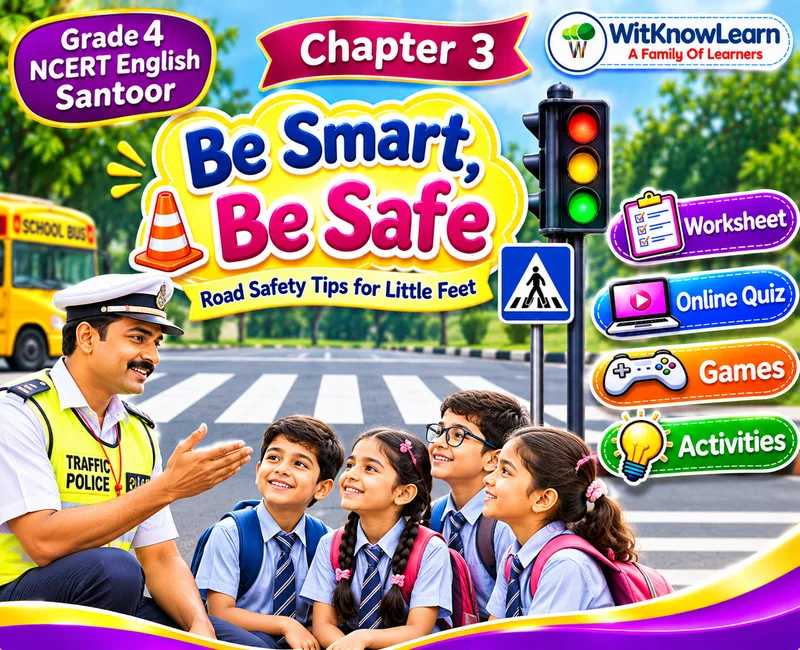
Be Smart Be Safe Class 4 Worksheet with Online Quiz & Games
Read the worksheet. Play the online quiz. Explore road messages through games and activities.
NCERT Santoor Chapter 3: read the Traffic Police letter, recognise useful symbols and learn countable and uncountable nouns. On WitKnowLearn you get the Be Smart Be Safe Class 4 online quiz, online activities and interactive games, word labs and a practice sheet, all on one page.
Flip the cards and try the Countability Check Lab. Then choose a Games, Labs or Challenges square on the board.
Be Smart Be Safe Class 4 Online Quiz
20 questions · tap an answer to move on · full review at the end
Be Smart Be Safe Activity Board
Read, solve and earn up to 3 stars in every activity.
Be Smart Be Safe Class 4 Activities
Earn up to 3 stars in every activity while exploring messages that help people move thoughtfully and safely. Be Smart, Be Safe is a letter-and-activities chapter. The Traffic Police of Bharat explain how children can stay aware near roads and use pedestrian facilities with an adult.
The chapter connects reading with real signs and clear instructions. Its language work focuses on countable and uncountable nouns. The difference is about how a word is used: some nouns name separate items, while others name an amount of a substance or an idea. A substance can still be measured, and containers or units can be counted.
Travel around the language board: read a message, explain a symbol, classify a noun and make a clear promise. Thoughtful reading helps us understand both a grammar clue and a safety instruction.
| Skill or word | Meaning | Useful reading clue |
|---|---|---|
| Instruction | A message telling someone what to do | Look for the action and condition |
| Countable | Used for separate items in this meaning | A singular item or a plural group |
| Uncountable | Used for an amount, substance or idea | A measure or quantity may describe it |
| Unit | An item or measure used to describe an amount | A container, portion or standard measure |
How to read a message and answer
- Identify the person, thing or action the message describes.
- Look for conditions such as when, where or before.
- Use the sentence’s meaning to choose an answer.
- Check that the explanation fits the whole message.
Three worked examples
A separate item
A ticket is countable. A traveller can hold one ticket or three tickets.
A substance and its measure
Sand is normally uncountable. We can describe two buckets of sand, counting the buckets rather than giving sand a regular plural.
A clear instruction
“Leave the doorway clear” means keep the entrance free of objects that block movement. The action and its purpose belong together.
This Be Smart Be Safe worksheet for Class 4 (NCERT Santoor Chapter 3) offers an online quiz, online activities and interactive games. The Be Smart Be Safe Class 4 quiz includes answers and explanations. The Be Smart Be Safe Class 4 activities combine visual symbols, noun sorting, short reading tasks and a letter-writing prompt.
English Be Smart Be Safe Class 4
Be Smart Be Safe Class 4 Chapter Guide
Be Smart, Be Safe is NCERT Class 4 English Santoor Chapter 3 in Unit 1: My Land. Its subtitle is Road safety tips for little feet. The learning objectives and explanations below are written for this page, not copied from the textbook.
Chapter introduction and summary
The Traffic Police write to children about busy roads and safer walking. The chapter presents six rules covering marked crossings, pedestrian signals, footpaths, adult help, reflective stickers and attention. It invites children to think about why these actions matter.
The later activities use symbols, classification, an unusual street picture and noun exercises. A recipe helps show the difference between a food substance and individual ingredients or containers. The chapter ends with a thank-you letter and a promise to follow road safety rules.
What is in this chapter?
- A letter with a greeting, message and closing.
- Six road safety rules and four new vocabulary words.
- Comprehension, true/false and multiple-choice questions.
- Public symbols and safe/unsafe classification.
- A picture with unusual or incorrect details to discuss.
- Countable and uncountable nouns, including food and road vocabulary.
- A banana milkshake recipe and a thank-you letter.
Learning objectives
- Identify the purpose and audience of a letter.
- Explain a safety instruction with its conditions.
- Recognise familiar public symbols.
- Classify nouns in ordinary sentence meanings.
- Distinguish a substance from a countable container or unit.
- Write a relevant thank-you message and promise.
Learning outcomes
Children can explain a rule, distinguish pedestrian and vehicle signals, use words such as a, some, much and many appropriately in simple contexts, form familiar plurals and write a short letter. Roadside actions should be practised with a trusted adult rather than by testing a game answer in traffic.
Be Smart Be Safe Class 4 resources on this page
| Resource | What it includes |
|---|---|
| Online quiz | 20 questions with a timer, question navigation and review |
| Learn cards | 6 illustrated reading and language reminders |
| Countability Check Lab | 3 labelled scenes with noun classification boxes |
| Games | 5 games using sorting, bubbles, memory, gaps and choices |
| Word labs | 5 tasks on units, a recipe, a letter, symbols and noun categories |
| Challenges | 5 tasks with 15 first-attempt marks in total |
| Practice sheet | 16 short-answer questions with live marking |
| Creative corner | A Safety Inspector board, discussion and letter writing |
Meaning Rules and Examples
| Point | Rule or reminder | Fresh example |
|---|---|---|
| Singular count noun | One separate item | A pencil |
| Plural count noun | More than one item | Four pencils |
| Uncountable material | Treated as an amount | Some chalk |
| Countable unit | The unit can be counted | Two pieces of chalk |
| Abstract noun | Some ideas are normally uncountable | Kindness matters |
Eight solved examples
- Choose a unit: We need two litres of paint. Paint names the material; litres are the measured units.
- Check a plural: One badge becomes several badges. The individual badges can be counted.
- Choose a quantity word: There is some butter on the plate. Butter names food as a substance here.
- Find the counted word: In three sheets of paper, sheets is the plural unit.
- Find a noun for an idea: Happiness can be uncountable. We do not ordinarily say three happinesses in a simple everyday sentence.
- Read an instruction: Keep this entrance free of bicycles. The instruction is to prevent a blockage.
- Recognise a letter part: A greeting tells us whom the writer is addressing.
- Explain a promise: I will wait patiently in the queue. This sentence names a future action the writer intends to follow.
The six road safety rules in context
- Use a marked crossing: with an adult, stop and check right, left and right again; cross only when safe.
- Follow pedestrian signals: a green vehicle light is not permission for a pedestrian to cross. Check for moving and turning vehicles.
- Walk on the footpath: keep away from moving vehicles and leave room for others.
- Hold an adult’s hand: especially while crossing or walking near the road.
- Use reflective stickers in the dark: they need light to reflect and can improve visibility.
- Stay alert: avoid playing or using distracting phones or headphones near traffic.
Symbols named in the chapter’s help box
Read a symbol together with its shape, colours and setting. The following meanings explain the chapter’s vocabulary.
| Label | Meaning |
|---|---|
| School ahead | Watch for a school and children nearby |
| No honking | Do not sound the vehicle horn |
| No littering | Do not drop rubbish in this place |
| Ladies restroom | Identifies the women’s restroom |
| Gents restroom | Identifies the men’s restroom |
| Wheelchair access symbol | Identifies an accessible facility or route |
| Right turn | Indicates a turn or direction to the right |
| No left turn | Prohibits turning left |
| Drive slow | Asks drivers to reduce speed |
| Danger ahead | Warns of a hazard ahead |
| U-turn | A turn to face the opposite direction; whether it is allowed depends on the displayed sign |
Common mistakes
| Confusion | Better understanding |
|---|---|
| Any green light means cross | Follow the pedestrian signal with an adult and check that traffic makes crossing safe |
| A marked crossing stops all vehicles automatically | Drivers may still be moving or turning; check before crossing |
| Reflective material creates light | It reflects light from another source |
| A substance and its container have the same grammar | The container or unit can be countable while the substance is uncountable |
| A humorous picture is a precise traffic diagram | Describe what is actually visible and distinguish odd details from proven hazards |
Use the chapter in daily life
Read public messages with a trusted adult. Notice why a ramp should remain clear and how a crossing is marked. At home, compare countable utensils with measured food ingredients. Explain a rule rather than only memorising its words.
Practice tips for home and school
Use classroom role-play and drawings for road scenarios. Real road crossings need adult guidance. Let children read an instruction, point to its condition and explain its reason. For noun work, keep the meaning clear; a food, a serving and a container can use different noun patterns.
Inspect Discuss and Write
Safety Inspector Board
Read eight fresh situation cards. Tap the six that describe a risk. Two describe sensible choices. Discuss a safer alternative for each risk with an adult.
Write to the Traffic Police
Thank the officers for their work. Explain one thing you learned and add two sensible promises. This open task is not included in the automatic score.
See one possible letter
Dear Traffic Police Officer,
Thank you for helping people use the roads safely. I understand that a pedestrian must follow the pedestrian signal and still check for moving vehicles. I will stay with a trusted adult near roads. I will keep my attention on the surroundings.
Yours sincerely,
A Class 4 learner
Recipe Detective
With an adult, read a simple recipe. List two countable utensils or containers and two ingredients used as amounts. Explain why the container and its contents may have different grammar. Use words other than those in the online lab.
See an example
A bowl and a knife are countable objects. Flour and oil can name ingredients used as amounts. Two bowls of flour counts the bowls, not a regular plural of flour.
Make a Clear Message Poster
Create a poster for a school entrance or a classroom walkway. Use a short instruction and a simple symbol. Explain whom your message is for and what action it asks for. Draw on paper or use the space below to plan your words.
More NCERT Santoor Class 4 Chapters
Explore the rest of the book as more chapter activities become available.
Frequently Asked Questions
What is Be Smart Be Safe in Class 4 English?
Be Smart, Be Safe is Chapter 3 of NCERT Santoor for Class 4, Unit 1: My Land. It begins with a letter from the Traffic Police of Bharat and teaches road safety and countable and uncountable nouns.
What are the chapter’s six main safety rules?
Use the zebra crossing, follow pedestrian signals, walk on footpaths, hold an adult’s hand, use reflective stickers in the dark and stay alert. Children should cross with an adult and only when it is safe.
Does a green light for vehicles mean pedestrians should cross?
No. Follow the pedestrian signal and the guidance of the responsible adult or traffic officer. Even with a green pedestrian signal, check for moving or turning vehicles and cross only when safe.
Why are reflective stickers useful?
They reflect light, such as headlights, and can help drivers notice a person. They do not create their own light or replace careful walking and adult supervision.
What are countable nouns?
Countable nouns name items that can be counted individually in the meaning being used. They may be singular or plural, such as a ticket and several tickets.
What are uncountable nouns?
Uncountable nouns name substances or ideas treated as amounts rather than individual items. They can still be measured using suitable units. Countability depends on context and meaning.
Why can milk be uncountable while bottles of milk are countable?
Milk names the liquid. Bottle names a container, so we can count bottles while describing the milk inside them. The same distinction works with other substances and units.
Does this page have Be Smart Be Safe Class 4 questions and answers?
Yes. The 20-question quiz gives a complete review with answers and reasons. The 16-question practice sheet includes live marking and Show answers. Open writing tasks include a model response.
Which class and book is this worksheet for?
The page follows NCERT Class 4 English Santoor Chapter 3 Be Smart, Be Safe, Unit 1: My Land, using the uploaded chapter as the main source.
What can children do on this page?
Children can try an online quiz, online activities and interactive games, six flip cards, the Countability Check Lab, five word labs, five challenges, a practice sheet and a Safety Inspector board.
Can children use the activities on a phone?
The layout adapts for smaller screens. Tile tasks work by tapping a tile then its box as well as dragging. Quiz controls include a timer, question numbers and Previous/Next buttons.
What is included on this page?
The page includes 20 quiz questions, six learning cards, a three-round hands-on lab, five games, five word labs, five challenges marked out of 15, a 16-question practice sheet, a chapter guide, symbols and creative writing tasks.
 Download


