Braille Class 4 Worksheet with Online Quiz & Games
Read the worksheet. Play the online quiz. Explore reading through touch and past actions.
NCERT Santoor Chapter 6: meet Louis Braille, discover a six-dot cell and build clear past continuous sentences. Try the Braille Class 4 online quiz, online activities and interactive games on WitKnowLearn.
Flip the cards and explore the Past Action Picture Lab. Choose a Games, Labs or Challenges square to continue.
Braille Class 4 Online Quiz
20 questions · full answer review and explanations
Braille Activity Board
Read, solve and earn up to 3 stars in every activity.
Braille Class 4 Activities
The Braille worksheet for Class 4 introduces a life story with an important invention at its centre. Louis Braille used his knowledge and persistence to develop a practical way to read through touch. His work shows how changing the format of information can help more people use it independently.
These online activities connect reading comprehension, vocabulary, basic English Braille letter patterns and past continuous tense. The alphabet explorer is a visual model of embossed dots. A screen image introduces the arrangement; real tactile reading uses a raised surface.
The language games focus on an action that was happening at a past time. Children choose was or were, form -ing words, compare captions and explain details from short passages. Texture words and beginning sound clusters add further vocabulary practice.
| Skill or idea | Meaning | Useful clue |
|---|---|---|
| Biography | Events from a person’s life | Who, where and when? |
| Tactile reading | Reading through touch | Feel raised patterns |
| Past continuous | An action in progress in the past | Was/were + -ing |
| Accessible format | Information in a form someone can use | Ask what works for the reader |
Four steps to a clear past caption
- Find the subject.
- Choose was or were.
- Add the -ing action.
- Check the past-time meaning.
Three worked examples
One person
The potter was shaping clay yesterday.
Several people
The musicians were tuning their instruments at six.
One listener
You were choosing a book when I arrived. You takes were even for one person.
Use this NCERT Santoor Chapter 6 worksheet with online quiz and online activities to practise Braille Class 4 questions and answers, chapter vocabulary and past continuous tense. Each quiz answer includes a reason, and the practice sheet offers live marking and answer reveal.
English Braille Class 4 Meaning Rules and Examples
Braille Class 4 Chapter Guide
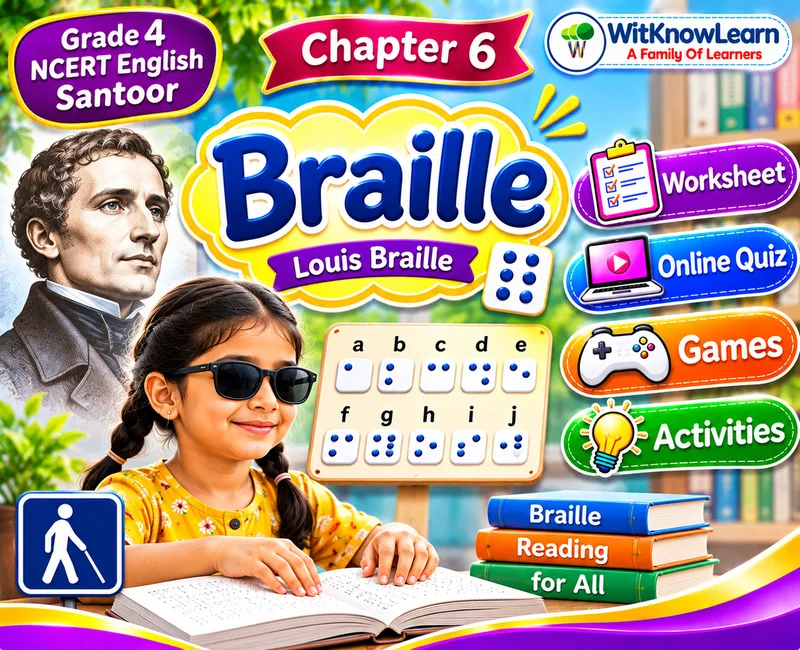
Braille is Chapter 6 of NCERT Class 4 English Santoor, Unit 2: My Beautiful World. It connects a biography, tactile reading, thoughtful assistance and the language of continuing past actions.
Chapter introduction and summary
The chapter describes Louis’s childhood in France and an accident with a sharp tool when he was three. Both eyes became affected, and he lost his sight. At ten, in 1819, he joined an institute in Paris. He encountered different materials used to learn letter shapes.
Captain Charles Barbier’s Night Writing used raised patterns for messages in darkness, but the system was difficult. Louis became interested in it as a teenager and simplified the idea. His work led to the Braille alphabet and greater access to reading.
The lesson explains that Braille can be read through touch and uses more space than ordinary print. It also invites sighted children to learn the alphabet. The closing activities encourage children to explore safe raised shapes and ask how a classmate with low vision can be supported.
Chapter coverage
- Reading: Louis’s early life, schooling and invention.
- Thinking: why Night Writing was difficult and how reading became easier.
- Speaking: describe an object’s shape, size and texture.
- Listening: compare beginnings such as sp and spl.
- Writing: letter patterns, eye protection and past continuous sentences.
- Picture story: Tarandeep, her grandmother and the helpful birds and squirrels.
- Doing and exploring: raised-shape models and accessible resources.
Learning objectives
- Retell key events in order and explain a cause.
- Understand raised dot patterns as a reading system.
- Locate the six positions in a basic reading cell.
- Choose was or were for a subject.
- Use complete -ing action forms.
- Describe an object with specific details.
- Discuss assistance by asking about another person’s preferences.
Learning outcomes
Children can summarise the biography, distinguish a visual model from tactile text, read a basic dot-position diagram, form a past continuous sentence and describe an object clearly. They can explain that access may involve a different format rather than a change in a person’s abilities.
Braille Class 4 resources on this page
| Resource | Includes |
|---|---|
| Online quiz | 20 questions with timer and complete review |
| Learning cards | 6 illustrated reminders |
| Past Action Picture Lab | 3 rounds with subject, helper and action boxes |
| Games and labs | 5 games and 5 language labs |
| Challenges | 5 tasks, 3 marks each, total 15 |
| Practice sheet | 16 answers with live marking |
| Explorer and writing | 26 basic letter patterns and personal response tasks |
Meaning Rules and Examples
| Point | Rule | Example |
|---|---|---|
| Past continuous | Subject + was/were + -ing | The tailor was measuring cloth. |
| Singular subject | Use was | The horse was trotting. |
| Plural subject | Use were | The horses were trotting. |
| You | Use were, singular or plural | You were resting. |
| Negative | Put not after the helper | She was not shouting. |
| Question | Put the helper before the subject | Were they visiting? |
Eight solved examples
- Change time: He is washing → He was washing. Change is to was.
- Plural change: They are rowing → They were rowing. The action form stays the same.
- Speaker: I am packing → I was packing.
- Listener: You are smiling → You were smiling.
- Drop final e: Bake becomes baking.
- Double a consonant: Hop becomes hopping.
- Read a cell: In reading view, dot 5 is in the middle of the right column.
- Describe texture: A ridged shell can feel rough; a polished pebble can feel smooth.
The six-dot reading cell
The numbers go down the columns: 1–2–3 on the left and 4–5–6 on the right. A letter pattern uses some of those positions. The explorer shows basic lowercase English letters only; a full Braille code also includes conventions for capitals, punctuation, numbers and other signs.
Understanding the picture story
Tarandeep offers food to squirrels and sparrows while her grandmother attends to drying clothes. When a strong wind starts, the animals sit on the clothes, helping to hold them in place. The story provides a setting for expressions such as was feeding and were sitting. Identify the subject before choosing the helper.
Common mistakes
| Mistake | Correction |
|---|---|
| You was reading | You were reading |
| The boys was drawing | The boys were drawing |
| She was write | She was writing |
| Dot numbers go across rows | Numbers run down each column |
| A screen drawing is embossed text | It is a visual model; embossed text has a raised surface |
| Everyone with low vision needs the same help | Ask about the person’s preferred format or support |
Use the ideas in daily life
Notice formats such as large print, tactile labels and spoken text. Keep shared walkways clear and communicate before offering physical assistance. Use past continuous when explaining what you were doing at a particular past time.
Words and sound clusters
A blacksmith works with metal; the chapter uses this word for Louis’s father. Invented means created something new. Simplified means made easier to understand or use. Compare the beginning sp in spin with spl in split. Say the complete words without adding an extra vowel between the opening consonants.
Explore Describe and Write
Basic English Braille Alphabet Explorer
Choose a letter to see its dot positions in reading view. This is a visual model of a basic lowercase letter, not a tactile screen or a full Braille translator.
Describe a Familiar Object
Choose a safe, familiar object and describe its shape, size and texture. You may explore it by touch while seated. Keep your eyes open if you prefer; this task does not reproduce the experience of blindness.
See a model response
The object is a small wooden block. It is shorter than my hand. Its faces are smooth and its edges feel straight.
Three Past-Time Captions
Imagine a busy classroom yesterday. Write one sentence about yourself, one about a single classmate and one about several classmates. Include a past-time clue.
See example captions
Yesterday at two, I was arranging cards. My friend was colouring a map. Other children were discussing their projects.
Make a Raised-Shape Card
Use soft clay or a line of craft material to make a simple raised circle or square on a card. Explore the outline with a fingertip. A shape model introduces touch, but it is not automatically correctly sized embossed Braille.
Considerate Classmate Plan
A classmate says a small-print handout is difficult to read. Write two helpful questions and one action that follows their answer.
See one possible plan
“Would you prefer an enlarged copy or a digital version?” “Where would you like to sit?” I would follow the classmate’s choice and check whether the new format works.
More NCERT Santoor Class 4 Chapters
Frequently Asked Questions
What is Braille in Class 4 English Santoor?
Braille is Chapter 6 of NCERT Class 4 English Santoor, Unit 2 My Beautiful World. It introduces Louis Braille and reading through touch, with vocabulary and past continuous practice.
Who was Louis Braille?
Louis Braille developed a practical reading and writing system based on raised dot patterns. The chapter follows his early life, schooling in Paris and interest in improving Night Writing.
How did Louis lose his eyesight in the chapter?
The textbook describes an accident with a sharp tool when he was three. One eye was injured, and the other eye later became affected too.
What was Night Writing?
It was a raised-pattern system developed by Captain Charles Barbier de la Serre for reading messages in darkness. The chapter says it was too complicated, and Louis simplified the idea.
How do people read embossed Braille?
They move their fingers over raised patterns. Each pattern carries meaning in the relevant Braille code. An ordinary picture of a cell is a visual model, not a tactile surface.
How are the six Braille dot positions numbered?
In the standard reading view, positions 1, 2 and 3 go down the left column. Positions 4, 5 and 6 go down the right column.
Is Braille a separate language?
Braille is a reading and writing system used for different languages. This page introduces basic English letter patterns, rather than every sign or rule in a complete Braille code.
Why can Braille books be thicker?
Embossed cells need room and cannot be crowded like small print. This means a Braille version can use more space and more pages than a regular printed version.
Can sighted people learn Braille?
Yes. The chapter explicitly invites sighted learners to learn it too. Visual pattern practice can introduce letters, while tactile reading requires raised material.
What is the past continuous tense?
It describes an action in progress at a past time. Use a subject, was or were, and an -ing action form: The painter was mixing colours.
When do we use was and were?
Use was with I, he, she, it and a singular noun. Use were with you, we, they and plural nouns. You takes were even for one listener.
What does this Braille worksheet page include?
It includes a 20-question online quiz with explanations, six learning cards, a three-round sentence lab, 15 games and activities, 16 practice questions, an interactive alphabet explorer, writing tasks and a chapter guide.
 Download