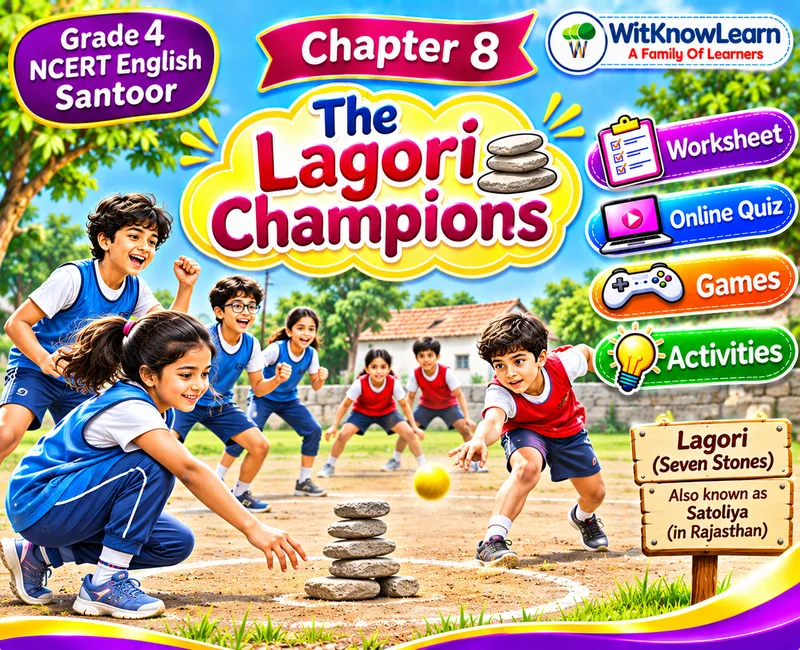
The Lagori Champions Class 4 Worksheet with Online Quiz & Games
Read the worksheet. Play the online quiz. Build words, sentences and a virtual seven-stone stack.
NCERT Santoor Chapter 8: follow the match, explore vocabulary and discover how a clear sentence tells or asks. WitKnowLearn brings The Lagori Champions worksheet, online quiz and interactive activities together on one page.
Flip the cards and try the Sentence Coach Lab. Choose a Games, Labs or Challenges square to continue.
The Lagori Champions Class 4 Online Quiz
20 questions · full answer review and explanations
The Lagori Champions Activity Board
Read, solve and earn up to 3 stars in every activity.
The Lagori Champions Class 4 Activities
Clear words and clear rules help a group work together. These activities connect reading comprehension with vocabulary, sentence order and different sentence purposes. Children read a clue, check its meaning and choose an answer that fits the complete context.
A statement tells something; a question asks something. Both are sentences. Learning to recognise that difference helps children write a useful notice, ask for information or explain an event. The games also explore similar meanings, word puzzles and phrases that give details about where, when or how.
The worksheet with online quiz and online activities offers several ways to practise: sort sentences, solve memory pairs, rebuild word order, check short notices and create a team identity. The extra stack builder is a digital ordering puzzle with its own simple size rule.
| Skill | Meaning | Useful check |
|---|---|---|
| Complete sentence | A group of words with a complete meaning | Does the idea make sense? |
| Statement | A sentence that tells | What information does it give? |
| Question | A sentence that asks | What information is needed? |
| Synonym | A word with a similar meaning in context | Does the replacement still fit? |
Four steps to a clear sentence
- Decide what you want to say or ask.
- Arrange the words in a sensible order.
- Begin with a capital letter.
- Choose an appropriate end mark and reread the meaning.
Three worked examples
Tell
The visitors brought a map. This statement gives information about an action.
Ask
Who brought the map? This question asks for the person’s identity.
Check meaning
A brief pause can mean a short pause. The similar word fits the context.
Use The Lagori Champions worksheet for Class 4 to practise NCERT Santoor Chapter 8 questions and answers, sentence building and vocabulary. The online quiz explains each answer, while the practice sheet provides live marking and answer reveal.
English The Lagori Champions Class 4 Meaning Rules and Examples
The Lagori Champions Class 4 Chapter Guide
The Lagori Champions is Chapter 8 of NCERT Class 4 English Santoor, Unit 3: Fun with Games. Its dialogue and match narrative support comprehension and language work.
Chapter overview
Ravi introduces his visiting cousin Prakash to his friends. They compare names for a traditional game and prepare for a match. Prakash contributes to a successful finish, and the celebration recognises both teams. The story connects cooperation with respect.
Learning objectives
- Track speakers and their contributions in a dialogue.
- Identify an event and its place in a sequence.
- Use context to choose a word’s meaning.
- Recognise a synonym and spot a contrasting word.
- Arrange words into a complete sentence.
- Distinguish a statement from a question.
- Use an appropriate capital and end mark.
- Explain a thoughtful response in a group situation.
Learning outcomes
Children can support a reading answer with a clue, explain a suitable word meaning, form a clear sentence and identify whether it tells or asks. They can also write a short account of an event and explain a team design in their own words.
Resources on this page
| Resource | Includes |
|---|---|
| Online quiz | 20 questions with a timer and full review |
| Learning cards | 6 illustrated reminders |
| Sentence Coach Lab | 3 rounds matching purpose and end mark |
| Games and word labs | 5 games and 5 focused language tasks |
| Challenges | 5 activities marked out of 3, total 15 |
| Practice sheet | 16 answers with live marking and reveal |
| Extra activities | Stack-order model, badge preview and creative writing |
Meaning Rules and Examples
| Idea | Rule or reminder | Fresh example |
|---|---|---|
| Sentence | Communicates a complete meaning | The doors opened. |
| Statement | Tells information | Our rehearsal starts soon. |
| Direct question | Asks for information | When does rehearsal start? |
| Capital letter | Starts a sentence and a proper name | Leela found the key. |
| Synonym | Has a similar meaning in context | Rapid can mean fast. |
| Sequence clue | Shows the order of events | First prepare; next check. |
Eight solved examples
- Arrange words: opened / gardener / the / gate → The gardener opened the gate.
- Ask about a place: Where is the noticeboard?
- Ask about a reason: Why did the meeting finish early?
- Find a statement: Our uniforms are clean. It gives information.
- Check a synonym: A difficult puzzle can be a hard puzzle in this context.
- Spot a contrast: Arrive and leave express different directions of an action.
- Notice a fragment: Behind the old wall gives a place without stating a complete idea.
- Use a proper name: Sara made a banner. Start Sara and the sentence with a capital.
Understanding a dialogue
A speaker’s name shows whose turn it is. Replies can answer a question, add an explanation or react to an event. Instructions in brackets can describe movement or setting. Follow both the spoken words and the surrounding action to understand the scene.
Words with similar meanings
Words can be close in meaning without fitting every context equally well. A bright lamp and a bright idea use bright differently. Test a possible replacement in the whole sentence, and reject a word that changes the intended meaning.
Ordering an account
Begin with the setting and participants. Explain the main events in order, then describe the result and response. Sequence words can help, but the events themselves must also fit a sensible timeline.
Common mistakes
| Confusion | Correction |
|---|---|
| A question is not a sentence | It is a sentence with an asking purpose |
| Every sentence needs a full stop | Choose the end mark to match the purpose |
| A collection of words is automatically complete | Check that the idea makes sense on its own in context |
| A synonym always works in every sentence | Check the context and intended meaning |
| A good result belongs to only one person | Notice the different contributions to a shared task |
| Appreciating opponents changes the result | Respect can be shown whatever the final score |
A digital model and a real game
The stack builder on this page is an invented size-order puzzle, not a complete simulation of a match. It asks for pieces from widest to narrowest. Real games can have local variations, so players should agree on their rules before starting.
Use these skills in daily life
Ask a clear question when information is missing. Write a notice that tells readers exactly what to do. Explain unfamiliar words when welcoming someone new to a group. After a shared activity, recognise useful effort as well as the final result.
Build Design and Write
Virtual Seven-Stone Stack
This invented ordering puzzle uses seven digital pieces. Select the widest piece first, then add each smaller size. The numbers are size labels for this model, not scores or official game rules.
My Team Badge Preview
Choose a team name and a short motto. Preview them with a seven-stone emblem, then explain how the design represents a shared value.
Our Team
Together we improve
Welcome a New Teammate
Write a four-line dialogue. One person is new to an activity. Another explains a rule, checks understanding and invites a question.
See possible dialogue lines
New player: Where should I put my bag?
Teammate: Use the shelf so the walkway stays clear.
New player: Which group am I joining?
Teammate: Join us at the blue sign. Would you like to check the first task together?
A Community Event Report
Describe a real or imagined community activity. Include the setting, participants, one important event, the result and how people responded. Use statements and check their end marks.
See a model report
Our street held a poster exhibition in the hall. Neighbours displayed their drawings and took turns explaining them. A volunteer helped visitors find each section. At the end, everyone thanked the organisers and carried the materials back together.
Ask a Playmate
Write three questions about interests or favourite activities. Ask a willing playmate and record their answers. Share only what they are comfortable sharing.
Fair Play Reflection
Explain one way to show respect after a competition and one way to help a beginner take part. Give a reason for each choice.
See a possible response
I could thank the other side for a well-played match. That recognises their effort. I could also explain one rule at a time to a beginner and give them a chance to try it.
More NCERT Santoor Class 4 Chapters
Frequently Asked Questions
What is The Lagori Champions in Class 4 English?
It is Chapter 8 of NCERT Santoor, Unit 3 Fun with Games. The page combines comprehension with vocabulary, sentence order, statements and questions.
What is the main idea of the story?
The story connects a traditional game with cooperation, shared enjoyment and respect between competitors. Its dialogue also shows how discussing names and rules can help a newcomer join.
How many stones are used in Lagori?
The game described in the chapter uses seven flat stones. This page includes a visual seven-stone model as an extra digital activity.
What is Lagori called in Rajasthan in this chapter?
Prakash recognises the game as Satoliya. The regional name helps the children connect their knowledge of the game.
Who wins the story’s match?
The Sundarpur Tigers win. The ending also values appreciation for both teams, rather than focusing only on the result.
What is a complete sentence?
A sentence is a group of words communicating a complete meaning in context. It starts with a capital letter and uses an ending mark appropriate to its purpose.
What is the difference between a statement and a question?
A statement tells something; a question asks something. Both are sentences. A direct question ends with a question mark.
Do all sentences end with a full stop?
No. Ordinary statements often end with a full stop, direct questions with a question mark and strong exclamations may use an exclamation mark.
What are synonyms?
Synonyms are words with similar meanings in suitable contexts. They are not always interchangeable in every sentence, so check the whole meaning.
How can children rearrange words into a sentence?
Identify what the sentence is about and what it says about that subject. Arrange the remaining details sensibly, then check capitalisation, meaning and the end mark.
Does this worksheet include questions and answers?
Yes. The online quiz has 20 questions and a full answer review with explanations. The 16-question practice sheet has live marking and an answer reveal. Personal writing tasks include model responses.
What activities are included beyond the worksheet?
There are six flip cards, a three-round sentence lab, five games, five word labs, five challenges, a practice sheet, a visual stack builder, a team-badge preview and creative writing tasks.
 Download