Hekko Class 4 Worksheet with Online Quiz & Games
Read the worksheet. Play the online quiz. Explore a traditional game and a trail of word puzzles.
NCERT Santoor Chapter 9: discover meaning clues, animal sounds and past actions. WitKnowLearn brings the Hekko worksheet, online quiz, online activities and interactive games together on one page.
Flip the cards and try the Past Tense Detective Lab. Choose a Games, Labs or Challenges square to continue.
Hekko Class 4 Online Quiz
20 questions · full answer review and explanations
Hekko Activity Board
Read, solve and earn up to 3 stars in every activity.
Hekko Class 4 Activities
A word can sound familiar and still need a careful meaning check. Their and there, or threw and through, do different jobs. These activities encourage children to read the whole sentence before choosing a spelling. They also distinguish a traditional narrative from a factual explanation.
The language trail looks back at completed actions. Regular past verbs follow useful patterns, but the spelling step is not always identical. A final e needs only d, and some short words double a consonant. Irregular verbs have their own forms to learn.
The worksheet with online quiz and online activities combines reading, matching, sorting, memory and short-answer practice. An extra meaning explorer lets children compare word pairs, and a new-game planner turns their own ideas into an organised written plan.
| Skill | Meaning | Useful check |
|---|---|---|
| Meaning in context | The sense needed in this sentence | What does the sentence say? |
| Simple past | A form used for completed past events | What happened earlier? |
| Regular verb | A verb with an ed past spelling pattern | Which spelling step fits? |
| Irregular verb | A verb with another past form | Do I know this form? |
Four steps to a clear past sentence
- Identify the action.
- Check the past-time clue.
- Choose the correct past form.
- Read the whole sentence for meaning and spelling.
Three worked examples
Add ed
Talk → talked. Yesterday the guide talked about the museum.
Add d
Like → liked. The visitors liked the display. The base form already has a final e.
Use an irregular form
Eat → ate. We ate lunch before the journey. Eated is not the standard past form.
Use the Hekko worksheet for Class 4 to practise NCERT Santoor Chapter 9 questions and answers, vocabulary and simple past tense. The online quiz gives explanations, and the practice sheet includes live marking and answer reveal.
English Hekko Class 4 Meaning Rules and Examples
Hekko Class 4 Chapter Guide
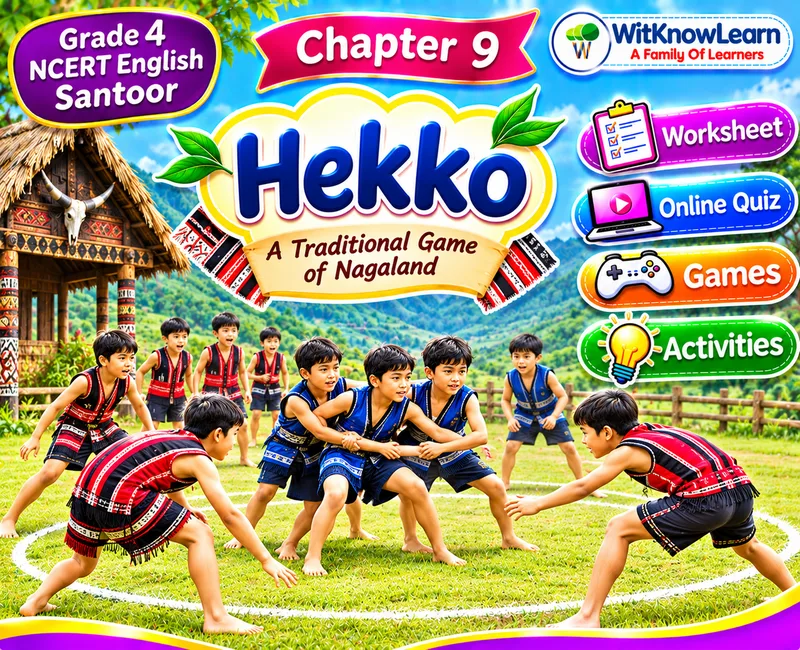
Hekko is Chapter 9 of NCERT Class 4 English Santoor, Unit 3: Fun with Games. This page uses fresh examples to practise the chapter’s reading and language skills.
Chapter overview
The opening connects a folk narrative with the name of a traditional game. The text then explains team roles, the playing space, points and conditions that end play. The language work explores meaning-sensitive spellings, animal sound words and past-tense forms.
Learning objectives
- Distinguish a traditional story from factual explanation.
- Read a rule and identify its effect.
- Use context to choose between similar-sounding words.
- Match an animal with a suitable sound word.
- Recognise st, ch and gl letter beginnings.
- Build regular past forms using appropriate spelling steps.
- Recognise that some verbs are irregular.
- Organise a new-game idea into clear rules.
Learning outcomes
Children can answer a reading question from its clue, select a meaningful spelling, form a simple past verb and explain a rule clearly. They can create a short written plan and give reasons for their choices without expecting every personal response to have identical wording.
Hekko Class 4 resources on this page
| Resource | Includes |
|---|---|
| Online quiz | 20 questions, a timer and a full review |
| Learning cards | 6 illustrated reading and grammar reminders |
| Past Tense Detective Lab | 3 picture rounds with form and spelling-step boxes |
| Games and word labs | 5 games and 5 language tasks |
| Challenges | 5 activities marked out of 3, total 15 |
| Practice sheet | 16 answers with live marking and reveal |
| Creative extras | A meaning explorer, game-plan preview and personal writing |
Meaning Rules and Examples
| Point | Rule or reminder | Fresh example |
|---|---|---|
| Regular past | Many verbs add ed | Call → called |
| Final e | Add d | Save → saved |
| Consonant + y | Often change y to i and add ed | Cry → cried |
| Vowel + y | Keep y and add ed | Stay → stayed |
| Short vowel-consonant pattern | Some verbs double the final consonant | Tap → tapped |
| Irregular past | Learn the separate form | Bring → brought |
| Belonging | Their shows possession | Their bicycles are outside |
| Place or existence | There can point to a place or introduce existence | There is a bicycle outside |
Eight solved examples
- Completed action: Yesterday the child brushed the dog. Brushed is the past form of brush.
- Final e: The helper moved a chair. Move needs only d.
- Consonant + y: The baby cried. Cry changes y to i before ed.
- Vowel + y: The visitors stayed. Stay keeps its y.
- Double consonant: The player nodded. Nod doubles d before ed.
- Irregular form: The artist drew a boat. Drew is the past of draw.
- Meaning choice: I would like a pear. Pear names the fruit; pair means a set of two.
- Sound word: A bee buzzes. Buzz describes its familiar sound.
Sound and spelling
Some words share a pronunciation but differ in spelling and meaning. Other pairs are close in some accents and distinct in others. Read the whole sentence rather than deciding from sound alone. For example, write is an action and right can mean correct or a direction.
Letter beginnings
In words such as stop and glow, st and gl are consonant clusters: both consonant sounds are heard. In chair and cheese, ch represents one sound. The sorting activity groups words by their initial letters, so it does not imply that every two-letter beginning works the same way.
Regular past spelling limits
Do not turn a useful example into an unlimited rule. Fix becomes fixed without doubling x. Open becomes opened without doubling n. Longer words can depend on stress, and some spelling variants exist. Learn a new verb with a reliable example rather than doubling every last consonant.
Common mistakes
| Mistake | Correction |
|---|---|
| Smileed | Smiled: add d after final e |
| Tryed | Tried: consonant + y changes to i before ed |
| Goed | Went: use the irregular form |
| Choosing their just because of the sound | Check whether the sentence means belonging |
| Treating ch as two sounds in chair | It represents one sound in this word |
| Presenting a folk tale as a scientific report | Recognise the text’s traditional storytelling purpose |
Use the skills in daily life
Write a diary entry about completed events. Explain a game with clear roles, turns and a winning condition. Check confusing spellings in a message. When learning about a tradition, distinguish what the story says from what a factual description explains.
A cultural exploration
The chapter invites learners to find out about the Hornbill festival. A useful personal fact card can identify the place, one cultural feature and a question for further research. Describe a tradition respectfully and avoid assuming that every community celebrates in exactly the same way.
Explore Meanings and Invent
Word Meaning Explorer
Choose a pair to compare its meanings and see two new example sentences. Read both sentences aloud if you wish, then explain how the meaning chooses the spelling.
My New Game Plan
Invent a tabletop or word game. Include a goal, materials, player turns and a clear way to finish. Preview the plan below.
See one invented game plan
Colour Trail: Two players use coloured paper tiles. On each turn, a player adds a tile that shares a colour with the previous one. If no match is available, they pass. The game ends after all tiles are used or both players pass. Count placed tiles and congratulate both players on the finished trail.
Yesterday in Four Sentences
Write about four completed actions from a real or imagined day. Use at least two regular past verbs and one irregular past verb.
See an example diary
Yesterday I sorted my cards. Later I made a paper envelope. I decorated it with stars. Finally I sent it to a friend.
Change One Rule
Choose a familiar board or word game. Suggest one change and explain its benefit. Think about whether the change gives all players a fair chance to take part.
My Animal Sound Scene
Imagine a morning scene with three animals. Write a sentence for each animal using a sound verb. Add a place detail if it helps the reader picture the scene.
See possible scene lines
A rooster crows near the shed. A sheep bleats beside the fence. A bee buzzes above a flower.
A Festival Fact Card
Find out about a festival named in the chapter. Write its name, where it is held and one cultural feature in your own words. Add one question you would like to explore next.
More NCERT Santoor Class 4 Chapters
Frequently Asked Questions
What is Hekko in Class 4 English?
Hekko is Chapter 9 of NCERT Class 4 English Santoor, in Unit 3 Fun with Games. The page combines reading comprehension with sound-alike spellings, animal sounds and simple past verbs.
What does Hekko mean?
The chapter explains the name as challenging the tiger. It connects the name with a traditional folk narrative.
Where is Hekko played in the chapter?
The reading identifies Mokokchung district in Nagaland. Its account introduces a traditional team game.
What are Aami and Aakho?
They are the two team roles in the reading. Aami represents humans and Aakho represents tigers. Aami begins inside the circle; Aakho begins outside it.
How many players are in each team?
The chapter describes eleven players per team. Use the assigned reading when answering its rule questions.
What does Joko mean?
In the chapter, Joko means surrender. It is used by a caught Aakho player.
What is the simple past tense?
It can describe a completed event at a past time. For example, The artist sketched a bird yesterday. Sketched is the past form of sketch.
How do we form regular past verbs?
Many verbs add ed, such as talk to talked. Verbs already ending in e add d. Some verbs need a spelling change, such as cry to cried or tap to tapped.
What are irregular past verbs?
They do not follow the regular ed pattern. Examples include eat to ate, bring to brought and take to took. Learn the form with the base verb.
How can I choose between words that sound alike?
Read the whole sentence and decide the meaning needed. Sound alone may not choose the spelling. For example, two gives a number and too can mean also or more than wanted. Pronunciation can vary by accent.
Does the Hekko worksheet include answers?
Yes. The 20-question online quiz includes a full review with explanations. The 16-question practice sheet has live marking and an answer reveal. Personal writing tasks offer examples rather than a single fixed answer.
What is included beyond the worksheet?
The page has six learning cards, a three-round past spelling lab, five games, five word labs, five challenges, a practice sheet, an interactive word-meaning explorer and a new-game plan preview.
 Download