CLASS 2 MATHS • THE FRACTION PLAYGROUND
Fractions Worksheet for Class 2
with Online Quiz and Activities
A little colouring. A little sharing. A whole lot of learning! Explore equal parts, halves, thirds and quarters with pictures you can change.
Colour and Share
Paint pizza slices and share counters fairly.
See It Change
Move a slider, build a fraction and compare pictures.
Think and Explain
Solve small stories and spot equal shares.
Fractions Class 2 Online Quiz
Question 7 / 20 • Easy
What fraction is coloured here?
Tap an answer to continue.
Grown-up guide to the quiz
There are 10 easy, five average and five thinking questions. The 20-minute timer waits until the first answer or navigation action. Answers move to the next question, except at the last one. Children can revisit any question. Submission or timeout shows all answers and explanations. Restart clears the quiz and pauses the timer. An adult may read the questions aloud.
Five Clickable Fraction Games
Open the raised box to choose a game. Each game has five little challenges.
Pizza Painter
Tap slice numbers to colour or clear equal slices. Any correct selection works.
Colour 1 of the 2 equal pizza slices.
Five Picture-Based Fraction Activities
Choose an activity. Its picture, question and controls stay together.
Fraction Stories and Extra Practice
Little Sharing Stories
Use a drawing or counters, then type a whole-number answer.
14 beads are shared equally between 2 children. How many does each get?
How to use the playground
Five games and five activities provide 50 tasks. Five extra-practice sets add 25 more. Work on a few at a time. Changing a set keeps entries while this page remains open. Games and activities share one active main workspace. Extra practice works independently. Use Reset options to clear the current task or its whole set.
Eight Little Tips for Fraction Learners
- Find the whole first.
- Check that the shares are equal.
- Count all equal parts.
- Count the coloured parts.
- Say half for one of two equal parts.
- Say quarter for one of four equal parts.
- Compare pieces from the same-sized whole.
- Use counters when a sharing story feels tricky.
Five Tips for Parents and Teachers
- Begin with paper folding and equal sharing.
- Ask the child to point to the whole before naming its fraction.
- Accept different shading patterns when the correct number of equal parts is coloured.
- Read story questions aloud and allow time to move counters.
- Use short sessions and ask how the child knows, rather than focusing on speed.
Fractions Worksheet for Class 2 Guide Examples and Important Questions
Can two children share a sandwich fairly? How many quarters make a whole? This fractions worksheet for Class 2 page helps children connect fraction names with pictures and everyday sharing. Use the printable worksheet offered on this page for pencil-and-paper practice, then try the online quiz, colouring games and activities.
What Is a Fraction for Class 2?
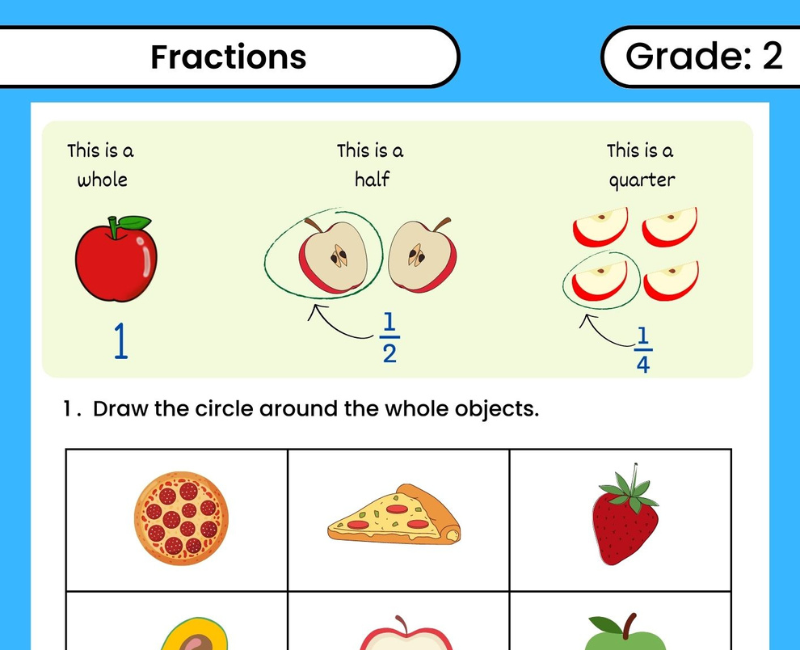
A fraction can show equal parts of a whole. The whole might be a paper strip, a circle or a collection of counters. Begin by finding what is being treated as the whole. Then check that its parts, or the groups in a sharing task, are equal.
For a shape, equal parts have the same area. Two pieces do not have to face the same direction to be equal. At this stage, folding paper or comparing simple rectangular sections makes equality easier to see.
Equal and Unequal Parts Worksheet Practice
A rectangle cut into two equal areas has two halves. A rectangle cut into one tiny piece and one large piece does not have two halves. Counting two pieces is not enough. They must be equal parts of the same whole.
Fold a rectangular paper so that its two sides meet. Open it and trace the fold. Each equal part is one half. Fold again to make four equal sections. Each is one quarter.
Halves Thirds and Quarters for Class 2
| Equal parts in one whole | One part is called | Written as |
|---|---|---|
| 2 | One half | 1/2 |
| 3 | One third | 1/3 |
| 4 | One quarter or one fourth | 1/4 |
Two halves make one whole. Three thirds make one whole. Four quarters make one whole. Thirds can be explored using three equal rectangular sections, so children can count and compare without guessing the size of circular slices.
How to Read and Write Fractions
In 3/4, the bottom number, 4, tells us there are four equal parts in the whole. The top number, 3, tells us that three of those parts are being counted. In a shading question, those are the coloured parts. The top number is the numerator and the bottom number is the denominator.
Introduce the picture and spoken words before expecting children to remember these longer terms. Saying “three of four equal parts” explains the fraction more clearly than learning a symbol alone.
Shading Fractions Worksheet with Pictures
To shade 1/2, divide the whole into two equal parts and colour one. To shade 3/4, start with four equal parts and colour three. Different selections can represent the same fraction. On a square divided into four equal sections, colouring any two sections represents 2/4 of the square.
Two quarters cover one half.
The interactive painters accept any selection with the correct number of equal parts. Children can tap again to remove colour and revise their picture.
Half and Quarter of a Collection
A fraction can also describe part of a set. To find half of eight counters, share all eight equally between two groups. Each group has four. To find a quarter of twelve counters, share all twelve equally between four groups. Each group has three.
There are 12 identical crayons. Four children share them equally.
Make four groups and give one crayon to each child in turn. Continue until all crayons are shared. Each child gets three crayons. One child's share is one quarter of the collection.
With a collection, equal groups contain the same number of objects. Keep the object type and counting unit clear. For a shape, we compare area; for a group of counters, we count objects.
Comparing Fractions Using the Same Whole
Use two strips of the same length and width. Colour one half of one strip and one quarter of the other. The half covers more area. This supports 1/2 is greater than 1/4 when both fractions refer to the same whole.
The same-whole condition matters. A quarter of a very large cake could be larger than half of a tiny cake. Children should compare matching pictures before using a rule about the numbers.
Two Quarters Make One Half
Split a strip into four equal sections and colour two. Place it beside a matching strip divided into two halves with one half coloured. Both cover the same amount. Therefore 2/4 and 1/2 represent the same fraction of the whole. The Same Amount Studio lets children build this relationship rather than memorise it.
Fractions Class 2 Word Problems with Answers
- A roti is cut into two equal parts. What is one part called?
One half, written 1/2.
- A paper strip has four equal sections. Three are coloured. What fraction is coloured?
Three quarters, written 3/4.
- Ten buttons are shared equally between two children. How many does each get?
Five buttons. Five is half of ten.
- Eight counters are shared equally between four groups. How many are in one group?
Two counters. Two is a quarter of eight.
- One quarter of a four-part whole is coloured. How many quarters remain uncoloured?
Three quarters remain. Four quarters make the whole.
- Two unequal pieces are made from one sheet. Is each piece one half?
No. Halves must be two equal parts of the whole.
Common Fraction Mistakes and Simple Corrections
Counting pieces without checking equality — first check whether the pieces are equal. Counting only the coloured parts — also count every equal part to identify the denominator. Thinking a quarter is bigger because four is bigger than two — compare equal-sized wholes divided into four and two parts. Thinking the shaded parts must touch — separate equal sections can still represent the same fraction.
How to Use a Printable Fractions Worksheet at Home
Begin with one picture. Let the child identify the whole, point to each equal part and explain the shading. Follow with a short sharing task using counters. Finish with a game or a few quiz questions. Revisit mistakes with a drawing instead of asking the child to memorise an answer.
This page focuses on introductory equal parts, simple fraction names and small sharing tasks. Follow the child's school sequence when deciding how much notation or comparison to introduce. The activities are original practice material and are not a claim that every school teaches fractions in exactly the same order.
More Class 2 Maths Practice
Frequently Asked Questions
What is a fraction in Class 2 Maths?
A fraction can show equal parts of a whole or a part of a collection. For example, one of two equal parts is one half.
Why must fraction parts be equal?
The fraction name describes equal shares. Two unequal pieces are not two halves, even though there are two pieces.
What is one half?
One half is one of two equal parts of a whole. It is written 1/2.
What is one quarter?
One quarter, also called one fourth, is one of four equal parts. It is written 1/4.
What is one third?
One third is one of three equal parts of a whole. It is written 1/3.
How many halves make a whole?
Two halves make one whole. Similarly, three thirds or four quarters make one whole.
How do children write the shaded fraction?
Count all equal parts for the bottom number. Count the shaded parts for the top number.
Is one half greater than one quarter?
Yes, when both refer to the same whole. Compare matching strips or circles to see the difference.
Are two quarters equal to one half?
Yes. Two of four equal parts cover the same amount as one of two equal parts of the same whole.
How do I find half of a group?
Share all the objects into two equal groups. The number in one group is half the total.
Can the coloured parts be in different places?
Yes. When the whole is divided into equal parts, count how many are coloured. They do not all need to touch.
Can I use these activities on a phone?
The activities use tap buttons, native selectors and sliders. No dragging is required. Pictures and controls stack on smaller screens.
 Download