CLASS 10 SCIENCE • EXPLORE THE LIVING WORLD
Life Processes Class 10 Worksheet
with Online Quiz and Activities
Follow a nutrient, trace a heartbeat and discover how cells stay alive. Learn nutrition, respiration, transportation and excretion through labelled diagrams, evidence and interactive challenges.
Explore the Diagrams
Identify organs and connect each structure to its job.
♥Follow the Process
Connect digestion, gas exchange, circulation and filtration.
✓Explain the Evidence
Reason through cases and repair common misconceptions.
Life Processes Class 10 Online Quiz
Question 1 of 20 • Easy • Answered 0/20
Which group contains the main maintenance processes studied in this chapter?
Quiz instructions
Answer 10 easy, five average and five HOTS questions in 20 minutes. The timer starts with your first answer or navigation. An answer advances to the next question except at the end. Use Previous or the numbered buttons to review. One mark per correct answer, no negative marking. Submission or timeout reveals the score and all explanations.
Interactive Life Processes Games
Diagram Feature Detective
Tap the numbered feature on the diagram or use its label button. The labels are learning aids, not a drawing test.
Select the main site of digested nutrient absorption.
Schematic learning model • not to scale
Biology Models and Learning Activities
How to use these activities
Tap the raised selector to change the topic. Keep the question, diagram and answer controls together in the activity card. Games and learning activities share one selected workspace; extra practice is independent. Answers remain while the page stays open. Diagrams are simplified schematics rather than anatomical drawings to scale.
Life Processes Extra Questions and Practice
Compare the Life Processes
Use the distinction that explains the observation.
Breathing versus cellular respiration.
Explore 15 sets with five tasks each. Reset one question or the entire set using Reset options.
Eight Revision Tips for Students
- Connect every diagram label with a function.
- Trace food through the alimentary canal, keeping accessory glands separate.
- Distinguish breathing, gas exchange and cellular respiration.
- Define arteries and veins by blood-flow direction.
- Practise the two loops of human double circulation.
- Compare xylem transport with phloem translocation.
- Separate filtration from selective reabsorption in a nephron.
- Give evidence and controls when explaining a biological investigation.
Five Teaching Tips for Parents and Teachers
- Ask students to explain why a structure suits its function.
- Use the virtual leaf model to change one condition at a time.
- Trace arrows aloud before asking for diagram labels.
- Discuss why an attractive diagram still needs a clear key and accurate direction.
- Use wrong options to uncover misconceptions, then ask students to repair the explanation.
Life Processes Class 10 Notes Important Questions and Solutions
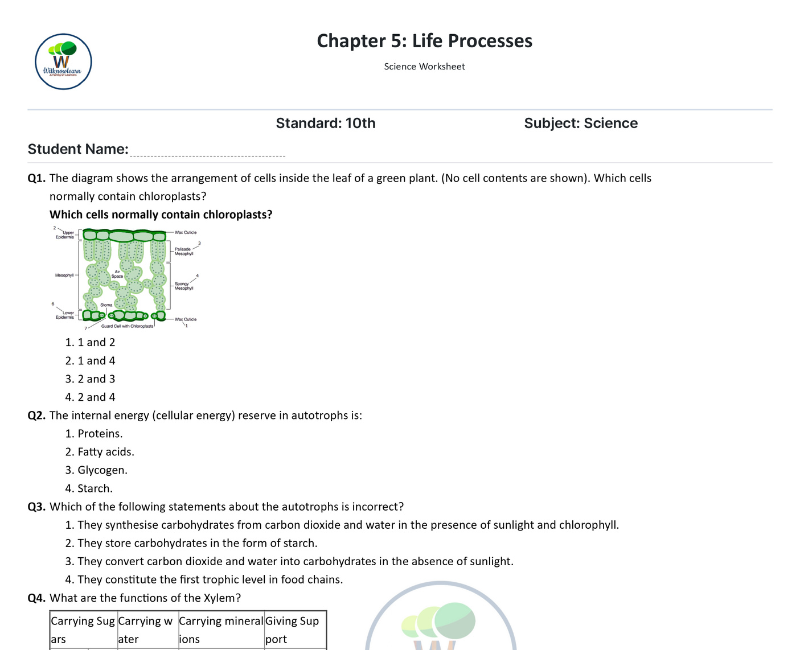
This Life Processes Class 10 worksheet page brings together written practice, an online quiz and interactive biology activities. Revise nutrition, respiration, transportation and excretion in plants and animals. Use the worksheet download already provided on this page for written answers, then test your understanding through the models and explanations above.
Life Processes Class 10 Important Questions
Prepare structure–function questions on villi, alveoli, the heart, stomata and nephrons. Practise explaining double circulation, the role of bile, the breakdown of glucose, transport in plants, and urine formation. These are useful practice themes rather than a prediction of a board paper.
Nutrition in Plants and Photosynthesis Equation
Autotrophic nutrition uses an inorganic carbon source to build organic food. Green plants use light captured by chlorophyll to support photosynthesis. Carbon dioxide enters mainly through stomata, while roots supply water. A commonly used net school equation is shown below; it summarises a complex process.
6CO₂ + 6H₂O → C₆H₁₂O₆ + 6O₂.
Conditions include light and chlorophyll.
The oxygen released in photosynthesis comes from water.
Some of the carbohydrate formed can be stored as starch.
Photosynthesis Experiment and Starch Test Questions
Destarching reduces previously stored starch so a later iodine result can be connected to the experimental conditions. Compare otherwise similar leaves or plants while changing one factor. Iodine turns blue-black where starch is detected. A partly covered leaf investigates light; a suitable carbon-dioxide comparison investigates CO₂ availability; a variegated leaf can illustrate the role of green tissue. The virtual model assumes enough water, appropriate temperature, a healthy destarched leaf and sufficient time.
Human Digestive System Diagram and Enzyme Table
| Part or secretion | Main Class 10 function |
|---|---|
| Mouth and salivary amylase | Chewing and the beginning of starch digestion |
| Stomach and pepsin | Protein digestion in an acidic environment |
| Liver and bile | Bile emulsifies fats and helps provide conditions for intestinal digestion |
| Pancreatic enzymes | Help digest carbohydrates, proteins and fats |
| Small intestine and villi | Complete digestion and absorb digested nutrients |
| Large intestine | Absorb water and help form faeces |
Bile is produced by the liver and stored in the gall bladder. It is not a digestive enzyme. Food passes through the alimentary canal rather than entering the liver or pancreas. Finger-like villi increase the surface available for absorption.
Life Processes Case Based Question with Solution
A blockage prevents bile from reaching the small intestine. Which food component is especially affected?
Identify the normal role of bile in emulsifying fats.
Emulsification divides large fat globules into smaller droplets.
This increases the surface available for lipase action.
Fat digestion is therefore especially affected.
Bile supports digestion without itself being an enzyme.
Aerobic and Anaerobic Respiration Class 10
The first stage of glucose breakdown occurs in the cytoplasm and produces pyruvate. With oxygen, later aerobic stages occur in mitochondria and release substantially more usable energy than fermentation. ATP transfers energy for cellular work. Breathing moves air; gas exchange transfers gases; cellular respiration is a chemical process inside cells.
| Condition or example | School-level outcome |
|---|---|
| Aerobic breakdown | Carbon dioxide, water and a greater energy yield |
| Yeast fermentation | Ethanol, carbon dioxide and a smaller energy yield |
| Oxygen-limited muscle model | Lactate, often called lactic acid in school texts, and a smaller energy yield |
Do not use the simplified muscle pathway to explain all exercise pain or delayed soreness. Plants also respire during the day and at night; photosynthesis does not replace cellular respiration.
Alveoli Diagram and Mechanism of Breathing
Many alveoli provide a large gas-exchange area. Their thin, moist walls and nearby blood supply help oxygen diffuse from alveolar air into blood and carbon dioxide diffuse in the opposite direction. During normal inhalation, the diaphragm contracts and flattens. Thoracic volume increases, pressure falls relative to the surroundings and air enters.
Human Heart Diagram and Double Circulation
Body → venae cavae → right atrium.
Right atrium → right ventricle → pulmonary artery → lungs.
Lungs → pulmonary veins → left atrium.
Left atrium → left ventricle → aorta → body.
Blood passes through the heart twice in a complete pulmonary and systemic cycle. Separation of the two sides limits mixing of oxygen-rich and oxygen-poor blood. The left ventricle has a thicker muscular wall because it pumps into the systemic circulation at higher pressure. Blue in a diagram is a convention for oxygen-poor blood, not its literal colour.
Difference Between Arteries and Veins
Arteries carry blood away from the heart and veins carry it towards the heart. Oxygen content is not the definition. In normal postnatal circulation, the pulmonary artery carries oxygen-poor blood to the lungs, while pulmonary veins return oxygen-rich blood. Arteries generally have thicker muscular walls; many veins have valves that help limit backflow.
Transportation in Plants Xylem and Phloem
Xylem transports water and minerals, mainly from roots towards aerial parts. Transpiration creates a pull that helps move water through the plant. Phloem translocates sugars from a source to a sink, using energy-dependent loading processes. A sink may be a root, fruit, growing shoot or storage organ. Phloem transport is not always downward; direction depends on the source and sink.
Nephron Diagram and Urine Formation Class 10
Blood is filtered across the glomerular filtration surface.
Bowman’s capsule receives the filtrate.
The tubule selectively reabsorbs useful substances and needed water into blood.
Further processing helps produce urine.
Urine passes towards collecting ducts, then leaves the kidney through the ureter.
The urinary bladder stores urine and the urethra carries it outside.
Small useful molecules such as glucose can enter the filtrate and are normally reabsorbed in a healthy person. Urine volume depends partly on water balance and the waste load. Not all filtrate becomes urine. Kidneys form urine; the bladder stores it.
Excretion and Egestion Difference
Excretion removes metabolic wastes, such as urea, from the body. Egestion removes undigested and unabsorbed food residues from the digestive tract. Plants can remove or manage wastes through diffusion, storage in tissues, leaf loss, and secretions such as gums and resins.
Life Processes Extra Questions with Answers
- Why is diffusion alone insufficient in a large multicellular organism? Many cells are far from the outside, and diffusion over long distances is too slow to meet their needs.
- Why is a herbivore’s small intestine generally longer than a carnivore’s? Plant material can require a longer passage for digestion; diet and digestive adaptations affect the comparison.
- What happens when stomata close? Water loss can decrease, while carbon-dioxide entry can also become limited.
- Why are valves useful in the heart? They help maintain one-way blood flow.
- Why is a filtrate glucose molecule not automatically a urine glucose molecule? It can be reabsorbed from the tubule into blood.
Current Syllabus and Sample Paper Update
The official CBSE Science syllabus for 2026–27 includes the basic concepts of nutrition, respiration, transport and excretion in plants and animals. The official Science sample paper includes bile-related digestion, intestine adaptations, photosynthesis investigation and kidney reabsorption. Use these for reasoning practice. A sample paper is not a record of questions repeated in actual board exams.
Chapter reference NCERT Science Life Processes. Content reviewed on 22 October 2026. The interactive questions on this page are original practice questions, not official CBSE questions.
Related Class 10 Science Resources
Frequently Asked Questions
What are the four main life processes in Class 10?
Nutrition, respiration, transportation and excretion maintain individual organisms. Reproduction is essential for species continuity but is not needed to maintain the life of an individual.
Why is bile important if it is not an enzyme?
It emulsifies fats into smaller droplets and helps provide suitable conditions for intestinal digestion. The liver produces bile and the gall bladder stores it.
Why does the small intestine have villi?
Villi increase absorptive surface area. Their blood supply and lymphatic transport help carry absorbed nutrients away.
What is the balanced equation for photosynthesis?
A common net school equation is 6CO₂ + 6H₂O → C₆H₁₂O₆ + 6O₂, in the presence of light and chlorophyll. The released oxygen originates from water.
Why is a plant destarched before a photosynthesis experiment?
Destarching reduces previously stored starch so a later iodine test can be interpreted in relation to the experimental conditions.
How is breathing different from cellular respiration?
Breathing moves air into and out of respiratory organs. Cellular respiration releases usable energy through chemical reactions inside cells.
Where does glucose breakdown begin?
The first stage occurs in the cytoplasm and produces pyruvate. Later aerobic stages take place in mitochondria.
Why is human circulation called double circulation?
A complete cycle includes pulmonary and systemic loops, so blood passes through the heart twice.
Do all arteries carry oxygen-rich blood?
No. Arteries carry blood away from the heart. The pulmonary artery carries oxygen-poor blood to the lungs in normal postnatal circulation.
How are xylem and phloem different?
Xylem transports water and minerals, mainly from roots towards shoots. Phloem carries sugars from a source to a sink; direction depends on their locations.
What are the main steps in urine formation?
Glomerular filtration and selective tubular reabsorption are central Class 10 concepts. The filtrate is further processed before urine passes into the urinary drainage system.
Which Life Processes questions should I practise for boards?
Practise labelled diagrams, structure and function, digestion, photosynthesis investigations, respiration pathways, double circulation, plant transport and nephron reasoning. Use official papers to identify genuine previous-year questions.
 Download