CBSE Class 10 Science • Chapter 3
Metals and Non-metals Class 10 Worksheet with Answers
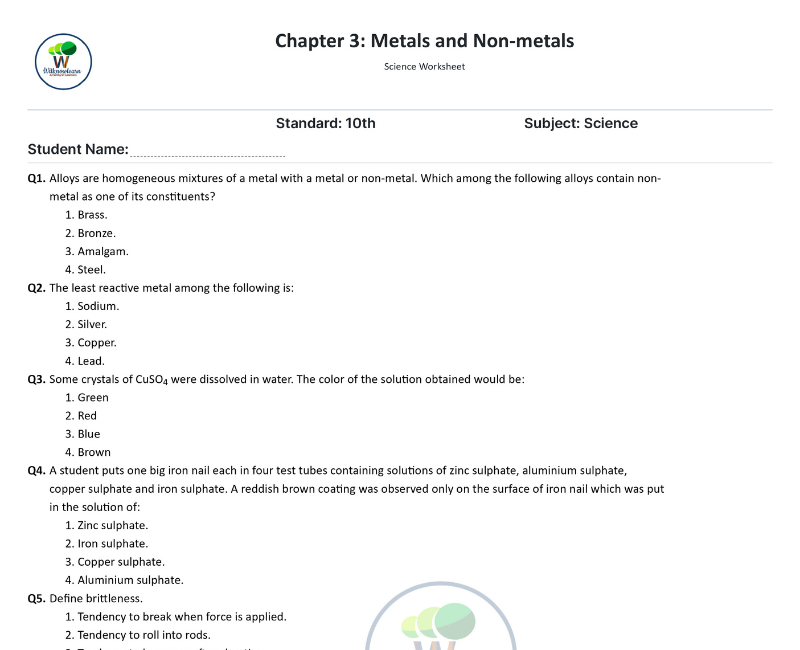
Why is copper used in electrical wires, why is sodium stored under kerosene, and why does iron rust? Use the Metals and Non-metals Class 10 worksheet with answers to revise the properties of elements, chemical reactions, the reactivity series, ionic compounds, extraction and corrosion. Attempt the worksheet first, then check your answers to identify concepts that need more practice.
This chapter connects everyday materials with their physical and chemical behaviour. Copper can be drawn into wires, aluminium can be rolled into foil, and zinc can protect iron from corrosion. Understanding the reasons behind these uses helps you answer application questions more clearly.
Before attempting the worksheet on Metals and Non-metals Class 10, revise the Metals and Non-metals Class 10 notes and mind map . Use the summary below for a quick review, then practise equations, observations and explanations.
Metals and Non-metals Class 10 Summary
Metals generally lose electrons to form positive ions, while many non-metals gain electrons when forming ionic compounds with metals. Their physical properties also differ, although several important exceptions must be remembered.
| Property | Metals: general behaviour | Non-metals: general behaviour |
|---|---|---|
| Lustre | Usually shiny when freshly cut or polished. | Usually dull; iodine is lustrous. |
| Malleability | Can usually be beaten into thin sheets. | Solid non-metals are generally brittle. |
| Ductility | Can usually be drawn into wires. | Generally cannot be drawn into wires. |
| Electrical conductivity | Generally good conductors. | Generally poor conductors; graphite conducts. |
| State at room temperature | Generally solid; mercury is liquid. | May be solid, liquid or gas; bromine is liquid. |
| Sound | Many metals are sonorous. | Generally non-sonorous. |
Important Exceptions to Remember
Sodium and potassium are soft metals that can be cut with a knife. Mercury is a liquid metal at room temperature. Graphite is a non-metal that conducts electricity, iodine is lustrous, and diamond is exceptionally hard. Avoid treating a general property as a rule without exceptions.
Metals and Non-metals Class 10 Important Reactions
Reaction with Oxygen
Many metals react with oxygen to form metal oxides. Most metal oxides are basic, but aluminium oxide and zinc oxide are amphoteric: they react with both acids and bases. Many non-metal oxides are acidic, although neutral oxides also exist.
Example: Burning Magnesium
2Mg + O2 → 2MgO
Magnesium burns with a dazzling white flame and forms white magnesium oxide. The oxide reacts with water to form magnesium hydroxide, which is basic.
Reaction with Water
Metals react differently with water depending on their reactivity. Sodium and potassium react vigorously with cold water. Calcium also reacts with cold water, while magnesium reacts with hot water. Aluminium, zinc and iron react with steam under suitable conditions. Copper, silver and gold do not react with water under ordinary conditions.
Sodium with cold water:
2Na + 2H2O → 2NaOH + H2
Iron with steam:
3Fe + 4H2O(g) → Fe3O4 + 4H2
Reaction with Dilute Acids
Many metals above hydrogen in the reactivity series react with dilute hydrochloric acid to produce a salt and hydrogen. Copper does not release hydrogen from dilute hydrochloric acid because it is below hydrogen in the series.
Zn + 2HCl → ZnCl2 + H2
Observation: Gas bubbles appear as zinc reacts. Hydrogen gives a characteristic pop when tested appropriately in a supervised laboratory.
Reactivity Series and Displacement Reactions
The reactivity series arranges metals according to their relative tendency to react. A more reactive metal can displace a less reactive metal from its salt solution. Hydrogen is included as a reference for comparing reactions with dilute acids.
Common Reactivity Series for Revision
K > Na > Ca > Mg > Al > Zn > Fe > Pb > H > Cu > Hg > Ag > Au
Reactivity generally decreases from left to right.
Worked Example: Iron in Copper Sulphate Solution
Fe + CuSO4 → FeSO4 + Cu
Iron is more reactive than copper, so it displaces copper. A reddish-brown copper deposit forms on the iron, and the blue solution gradually becomes pale green as iron(II) sulphate forms.
Copper placed in iron(II) sulphate solution does not produce the reverse displacement under ordinary conditions.
Ionic Compounds: Formation and Properties
Ionic compounds form through electron transfer followed by attraction between oppositely charged ions. In sodium chloride, sodium loses one electron to form Na+, and chlorine gains one electron to form Cl−. The ions are held together by strong electrostatic attraction.
Example: Formation of Magnesium Chloride
Magnesium has electronic configuration 2, 8, 2 and loses two electrons.
Mg → Mg2+ + 2e−
Each chlorine atom gains one electron.
2Cl + 2e− → 2Cl−
One Mg2+ ion combines with two Cl− ions, giving the formula MgCl2.
- High melting points: considerable energy is needed to overcome the strong attractions between ions.
- Solid-state conductivity: ions are held in fixed positions, so the solid does not conduct electricity.
- Molten or aqueous conductivity: mobile ions carry electric charge.
- Solubility: many ionic compounds dissolve in water, but not all are soluble.
Extraction of Metals Class 10 Short Notes
A mineral is a naturally occurring substance containing a metal or its compounds. An ore is a mineral from which a metal can be extracted economically. The extraction method depends strongly on the metal’s reactivity and the nature of its ore.
| Reactivity group | Examples | Common approach |
|---|---|---|
| Highly reactive | Sodium, calcium, magnesium, aluminium. | Electrolytic reduction of suitable molten compounds. |
| Moderately reactive | Zinc, iron, lead. | Convert suitable ores into oxides, then reduce the oxides. |
| Low reactivity | Copper, mercury, silver, gold. | Methods vary; some compounds yield metals on heating, and some metals occur in the native state. |
Roasting and Calcination
Roasting heats a sulphide ore strongly in excess air to convert it into an oxide. Calcination heats suitable ores, such as carbonate ores, in limited or no air.
Roasting zinc sulphide:
2ZnS + 3O2 → 2ZnO + 2SO2
Calcination of zinc carbonate:
ZnCO3 → ZnO + CO2
Reduction of zinc oxide on heating:
ZnO + C → Zn + CO
Electrolytic Refining of Copper
In electrolytic refining, impure copper forms the anode and a thin sheet of pure copper forms the cathode. An acidified copper sulphate solution serves as the electrolyte. Copper dissolves from the anode and deposits on the cathode. Insoluble impurities collect below the anode as anode mud.
Corrosion and Its Prevention
Corrosion is the gradual deterioration of a metal through reactions with its surroundings. Iron rusts when exposed to both oxygen and water. Rust is commonly described as hydrated iron(III) oxide. Silver develops a dark coating of silver sulphide, while copper can develop a green coating containing basic copper carbonate.
Painting, oiling and greasing create protective barriers. Galvanisation coats iron or steel with zinc. Alloying can also improve corrosion resistance; stainless steel contains chromium, which helps form a protective surface layer.
Metals and Non-metals Class 10 MCQs with Answers
1. Which non-metal conducts electricity?
A. Sulphur
B. Graphite
C. Phosphorus
D. Oxygen
Answer: B. Graphite. Graphite has electrons that can move through its structure.
2. Which oxide is amphoteric?
A. Na2O
B. CO2
C. Al2O3
D. SO2
Answer: C. Aluminium oxide. It reacts with both acids and bases.
3. Why does molten sodium chloride conduct electricity?
A. Its ions can move
B. It contains copper
C. Its molecules release protons
D. Its ions remain fixed
Answer: A. Mobile sodium and chloride ions carry charge through the melt.
Assertion–Reason Practice
Assertion: Solid sodium chloride does not conduct electricity.
Reason: Its ions are held in fixed positions in the crystal lattice.
Answer: Both statements are true, and the reason correctly explains the assertion.
Metals and Non-metals Class 10 Case Study Questions
Case Study: Comparing Zinc and Copper
A student places zinc in copper sulphate solution and copper in zinc sulphate solution. A copper deposit forms in the first experiment, while no displacement is observed in the second.
Question 1: Which metal is more reactive?
Zinc is more reactive than copper.
Question 2: Write the reaction equation.
Zn + CuSO4 → ZnSO4 + Cu
Question 3: Why does copper not displace zinc?
Copper is less reactive than zinc and cannot displace it
from zinc sulphate solution under ordinary conditions.
Metals and Non-metals Class 10 Important Questions
Use these Metals and Non-metals Class 10 extra questions alongside the worksheet and textbook exercises:
- Explain malleability and ductility with one use of each property.
- Give exceptions to the general physical properties of metals and non-metals.
- Explain why sodium is stored under kerosene.
- Write equations for reactions of metals with oxygen, water and dilute acids.
- Predict displacement reactions using the reactivity series.
- Explain ionic bond formation in sodium chloride and magnesium chloride.
- Compare roasting and calcination with equations.
- Describe electrolytic refining of copper with a labelled diagram.
- Explain the conditions necessary for rusting and methods of prevention.
How to Use the Worksheet as a Chapter Test
Attempt the Metals and Non-metals Class 10 worksheet without consulting the answers. Check your work and group mistakes into properties, equations, reactivity, ionic bonding or extraction. Revise the relevant topic and attempt the incorrect questions again.
For reaction answers, include a balanced equation and the relevant condition or observation. For explanations, connect the property directly to the use or behaviour being asked about.
Frequently Asked Questions
Why is sodium stored under kerosene?
Sodium reacts rapidly with oxygen and moisture. Kerosene prevents direct contact with air and water, reducing the chance of a vigorous reaction.
Why does aluminium resist corrosion despite being reactive?
Aluminium forms a thin, protective aluminium oxide layer on its surface. This layer limits further contact between the metal and its surroundings.
Why does copper not react with dilute hydrochloric acid?
Copper is below hydrogen in the reactivity series. It cannot displace hydrogen from dilute hydrochloric acid under ordinary conditions.
Do metals always release hydrogen when reacting with acids?
No. The outcome depends on the metal and the acid. Nitric acid is an oxidising acid, so hydrogen is generally not evolved. Magnesium and manganese can release hydrogen with very dilute nitric acid.
What is the difference between an ore and a mineral?
Minerals occur naturally and may contain metals or their compounds. An ore is a mineral from which a metal can be extracted economically. All ores are minerals, but all minerals are not ores.
Why are highly reactive metals extracted by electrolysis?
Their compounds are difficult to reduce using common chemical reducing agents such as carbon. Electrolysis supplies electrical energy to reduce their ions to metals.
Why do ionic compounds conduct when molten but not when solid?
In a solid, ions cannot move freely. Melting allows the ions to move and carry electric charge. Aqueous solutions also conduct when the dissolved compound provides mobile ions.
What is an amphoteric oxide?
An amphoteric oxide reacts with both acids and bases. Aluminium oxide and zinc oxide are important Class 10 examples.
What is galvanisation?
Galvanisation coats iron or steel with zinc to protect it from corrosion. Zinc provides a barrier and can also offer sacrificial protection if the coating is scratched.
Which diagrams should I practise for this chapter?
Practise electron-transfer diagrams for ionic compounds, a labelled setup for electrolytic refining of copper, and the experimental arrangement showing conditions necessary for rusting. Explain the function of each labelled part.
Where can I find Metals and Non-metals Class 10 notes and a mind map?
Visit our Metals and Non-metals Class 10 notes and mind map for revision before returning to the worksheet for practice.
 Download