Class 3 English Grammar
Adverbs Class 3 English Grammar Worksheet with Quiz and Activities
The rabbit runs quickly, the elephant walks slowly and the lion roars loudly! Learn how adverbs tell how, when, where and how often an action happens, and how to make -ly words, with this Adverbs worksheet for Class 3. On WitKnowLearn you get the Adverbs Class 3 online quiz, online activities and interactive games, labs and a practice sheet, all on one page.
Flip the cards and try the Action Track Lab, then tap the Games, Labs or Challenges square.
Adverbs Class 3 Online Quiz
20 questions · tap an answer to move on · full review at the end
An adverb tells us more about:
Flip the cards, try the Action Track Lab, then play the games, do the labs and take the challenges. Earn up to 3 stars in every activity.
Fact cards: tap a card to flip it
Action Track Lab
Watch HOW each animal moves on the track. Then drag the adverb that describes the action into the sentence (or tap it). Describe all 5 actions.
🎬 Action 1 of 5: watch HOW the animal moves, then choose the adverb.
The elephant walks ______.
- 🎬The elephant walks ___.
Watch the action. - ⬜The rabbit runs ___.
Watch the action. - ⬜The frog jumps ___.
Watch the action. - ⬜The mouse creeps ___.
Watch the action. - ⬜The lion roars ___.
Watch the action. - ⬜What did we find?
Describe all 5 actions to unlock.
Challenge marks: 0 / 15 (0 of 5 challenges done)
Finish all 5 challenges to see your comment.
Practice sheet
Type your answers in the boxes. For word answers write in small letters. Press Check when you finish.
ALook at the picture and write the adverb
BMake adverbs from these words
CFill in an adverb that tells when or where
DWrite the adverb from each sentence
Adverbs Class 3 Activities
Watch animals move, sort adverbs and fix -ly mistakes. Earn up to 3 stars in every activity.
What is an adverb?
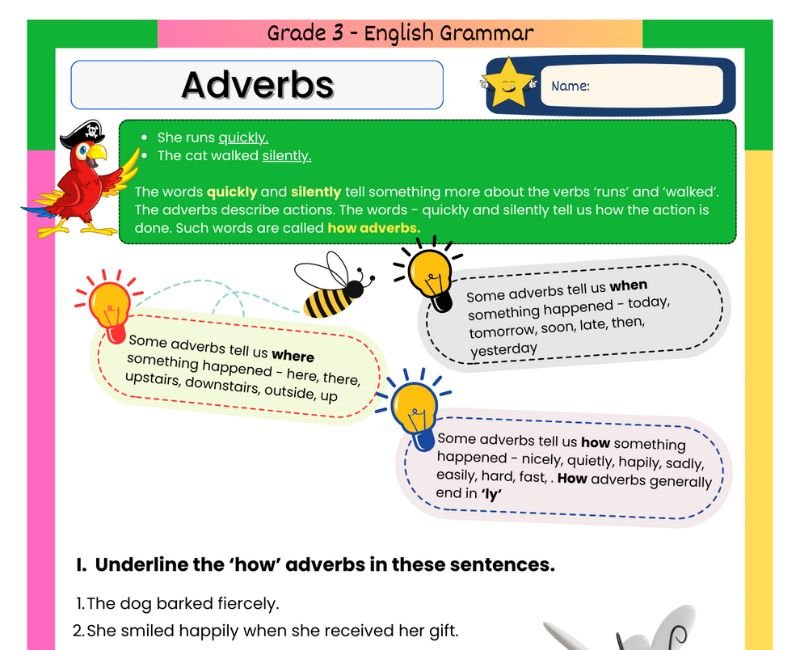
An adverb is a word that tells us more about an action (a verb). It tells us how, when, where or how often something happens.
Think of a race. The rabbit runs quickly, the elephant walks slowly and the frog jumps high. The action words are runs, walks and jumps. The adverbs quickly, slowly and high tell us how each animal moves.
Types of adverbs
| Type | Question | Examples | Sentence |
|---|---|---|---|
| Manner | How? | quickly, slowly, loudly, softly | The lion roars loudly. |
| Time | When? | now, today, tomorrow, soon | We will go tomorrow. |
| Place | Where? | here, there, outside, up | The children play outside. |
| Frequency | How often? | always, often, never, daily | I always say thank you. |
How to make -ly adverbs
- Most words: add ly. quick → quickly, soft → softly.
- Words ending in y: change y to i and add ly. happy → happily, easy → easily.
- Words ending in le: change e to y. gentle → gently, simple → simply.
- Some adverbs do not change: fast, hard, high, late.
More examples
This Adverbs worksheet for Class 3 turns grammar into a board game with online activities and interactive games. Flip the fact cards, watch the animals in the Action Track Lab, then play the games, do the labs and try the challenges.
English Grammar Adverbs Class 3
Adverbs are words that tell us more about an action: how it happens, when it happens, where it happens and how often. This guide explains the kinds of adverbs, how to make -ly adverbs and the common mistakes children make, in simple words for Class 3 students, parents and teachers. It goes with the Adverbs worksheet for Class 3 on WitKnowLearn, which also gives an online quiz, online activities and interactive games on the same page.
Introduction to Class 3 English Grammar Adverbs
Subject: English Grammar, Class 3. Topic: Adverbs. This page is built around the learning goals schools test for the topic; it is not a copy of a single textbook chapter.
What is there in this topic
- What an adverb is
- Adverbs of manner (how): quickly, slowly, loudly
- Adverbs of time (when): now, today, tomorrow
- Adverbs of place (where): here, there, outside
- Adverbs of frequency (how often): always, never, sometimes
- Making -ly adverbs from adjectives
Learning objectives
These objectives are written for this page from the topic's goals; they are not copied from any one book.
- Find adverbs in sentences.
- Tell adverbs apart from adjectives.
- Sort adverbs into how, when, where and how often.
- Spell -ly adverbs correctly.
- Use adverbs to describe actions clearly.
Learning outcomes
After this page a child can:
- Say "The rabbit runs quickly" and "The elephant walks slowly".
- Change happy → happily and gentle → gently.
- Pick out the adverb in "We will go tomorrow".
- Correct mistakes like "He runs quick".
Adverbs Class 3 resources on this page
| Resource | What it does |
|---|---|
| Adverbs Class 3 online quiz | 20 questions in three levels with a full answer review |
| Flip cards | Six cards on what an adverb is, how, when, where, how often and -ly spelling |
| Action Track Lab | Watch five animals move and describe each action with an adverb |
| 5 interactive games | Adjective or adverb sort, adverb bubbles, -ly memory, adverb gaps, quick pick |
| 5 language labs | How/when/where sort, picture actions, -ly spelling, adverb hunt, sentence doctor |
| 5 challenges | Marked out of 3 each with a total out of 15 |
| Practice sheet | 16 questions with pictures, word banks and a live score |
Kinds of adverbs
| Kind | Question it answers | Examples |
|---|---|---|
| Manner | How? | quickly, slowly, loudly, softly, happily, carefully |
| Time | When? | now, today, yesterday, tomorrow, soon, early |
| Place | Where? | here, there, outside, inside, up, everywhere |
| Frequency | How often? | always, often, sometimes, never, daily |
Making -ly adverbs
| Rule | Examples |
|---|---|
| Most adjectives: add ly | quick → quickly, slow → slowly, sad → sadly |
| Ending in y: change y to i, add ly | happy → happily, easy → easily |
| Ending in le: change e to y | gentle → gently, simple → simply |
| No change | fast, hard, high, late |
Types of questions
- Find the adverb
- Adjective or adverb?
- Make an adverb
- How, when, where or how often?
- Fill in the adverb
- Correct the sentence
Solved examples
Common mistakes
| Mistake | Correct |
|---|---|
| He runs quick. | He runs quickly. |
| happyly | happily |
| gentlely | gently |
| fastly | fast |
| Thinking "lovely" is an adverb | lovely is an adjective (a lovely dress) |
Daily life
We use adverbs all day: "Walk carefully!" "Come here." "I will do it later." "I always say thank you." Adverbs make instructions clear and stories exciting.
What your child learns from the Adverbs worksheet
- To describe how actions happen
- To talk about time, place and how often
- To spell -ly words
- To write more vivid sentences
Tips for parents and teachers
- Play "Act the adverb": the child walks slowly, quickly, sadly or happily.
- Ask how, when and where questions about the child's day.
- Make a chart of -ly words and add new ones each week.
- Read a story aloud and spot all the adverbs.
- Let the child retry the challenges to earn 3 stars.
Related English Grammar Worksheets
- Simple Present Tense Worksheet Class 3
- Present Continuous Tense Worksheet Class 3
- Conjunctions Worksheet Class 3
- Simple Past Tense Worksheet Class 3
- Articles Worksheet Class 3
- Pronouns Worksheet Class 3
- Adjectives Worksheet Class 3
- Comparison of Adjectives Worksheet Class 3
- Possessive Nouns Worksheet Class 3
- Contractions Worksheet Class 3
- Prepositions Worksheet Class 3
- Verbs Is Am Are Worksheet Class 3
Frequently Asked Questions
What is an adverb in Class 3 English grammar?
An adverb is a word that tells us more about an action (verb): how, when, where or how often it happens. The rabbit runs quickly.
What are the kinds of adverbs?
Adverbs of manner (how: quickly), time (when: tomorrow), place (where: outside) and frequency (how often: always).
How do we make adverbs from adjectives?
Usually by adding -ly: quick → quickly. Words ending in y change to -ily (happy → happily). Words ending in -le change to -ly (gentle → gently).
Do all adverbs end in -ly?
No. fast, hard, high, late, now, here, soon and always are adverbs without -ly.
What is the difference between an adjective and an adverb?
An adjective describes a noun (a quick rabbit). An adverb describes an action (the rabbit runs quickly).
Is "lovely" an adverb?
No. lovely ends in -ly but it describes a noun (a lovely flower), so it is an adjective. friendly and ugly are adjectives too.
How can I find the adverb in a sentence?
Find the action word and ask How? When? Where? or How often? The word that answers is the adverb.
Does this page have Adverbs Class 3 questions and answers?
Yes. The 20-question Adverbs Class 3 online quiz shows the correct answer and a reason for every question at the end, and the practice sheet has a Show answers button for all 16 questions.
Which class is this worksheet for?
It is made for Class 3 English grammar. It is also good for revision in Class 2 and Class 4.
What can children do on this page?
On WitKnowLearn they get an online quiz, online activities and interactive games: an action track with moving animals, picture actions, -ly spelling, an adverb hunt, a sentence doctor, bubble popping and more, all on the screen.
Can my child use these activities on a phone?
Yes. All drag activities work with a finger on phones and tablets and with a mouse on computers. Tapping also works.
What is included on this page?
A 20-question online quiz with review, flip cards, the Action Track Lab, 5 interactive games, 5 language labs, 5 marked challenges, a 16-question practice sheet, a complete guide, 12 related Class 3 English grammar worksheets and these FAQs.
 Download