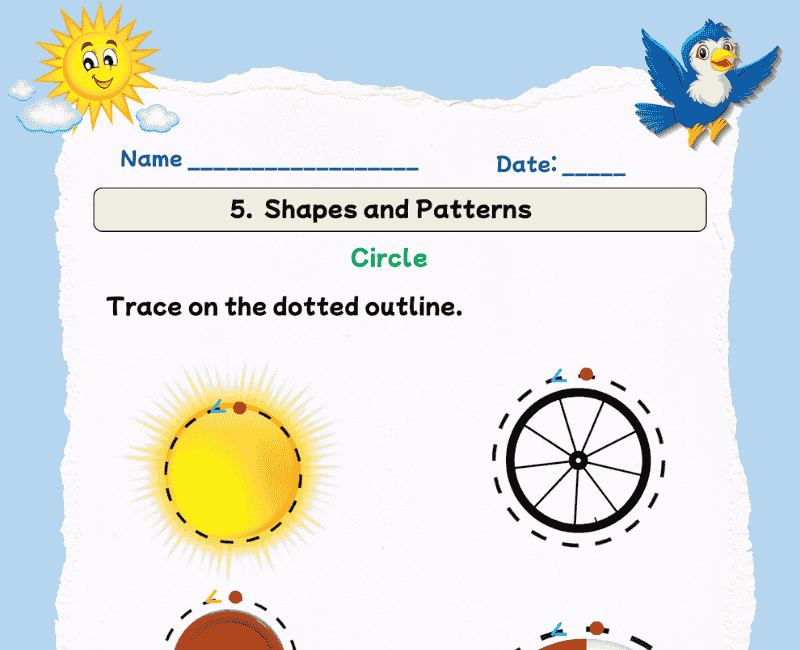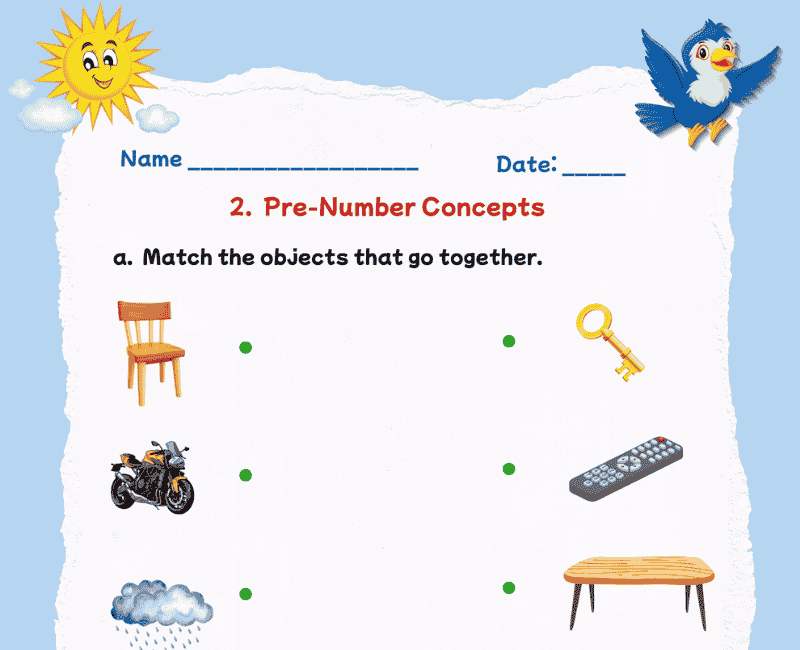
Look, Match and Play Before Numbers! 🌟
20 quiz questions and 10 clickable games and activities are waiting below. Explore more and fewer, near and far, inside and outside, matching, sorting and patterns.
👇 Scroll down—move teddy, sort cards and build a pattern!
📝 Pre-number Concepts Quiz for LKG
20 questions: 5 easy, 7 average and 8 thinking questions. An adult can read aloud. Tap an answer to move automatically to the next question. Use numbered buttons or Previous/Next to revisit any question. The 20-minute timer starts with the first answer or question change.
⏱ Time left: 20:00
Question 1 of 20 • Easy • Answered 0/20
Which group has more dots?
Question navigation — green means answered.
🎮 Pre-number Concept Online Games for LKG
Move teddy, sort shape cards into baskets, pair socks, arrange a garden and give each cup a spoon. Choose a game below. 😊
1. 🧸 Move Teddy Near and Far
Move teddy closer to or farther from the house. Watch the picture change.
Teddy is far from the house.
2. 🧺 Sort the Shape Cards
Tap a card, then tap its matching basket. Move all four cards.
Choose a card, then its basket.
3. 🧦 Make Matching Pairs
Tap two socks with the same symbol. Find three pairs.
Tap two matching socks.
4. 🌱 Arrange a Growing Garden
Tap the plants in this order: shortest, middle, tallest.
Ready to play!
5. 🥄 One Spoon for Each Cup
Tap each cup to give it one spoon. Tap again to take the spoon away.
Ready to play!
✏️ Pre-number Concept Online Activities for JR KG
Trace words, draw inside and outside, fill a cup, make equal groups and build a repeating pattern. Each task responds to your taps or drawing.
6. ✏️ Trace Pre-number Words
Choose a word. Trace its pale letters with the red pen.
✏️ Trace MORE.
7. 🎨 Draw Inside and Outside
Draw one toy inside the box and another outside it. An adult can discuss the positions with you.
Ready to play!
8. 💧 Fill and Empty the Cup
Add or pour out water. Explore empty, partly full and full.
The cup is empty.
9. 🍎 Make Two Equal Groups
Add or remove dots. Make group A and group B have the same number.
Group B has more dots.
10. 🌼 Build a Repeating Pattern
Start with a flower. Add flower, leaf, flower, leaf until there are six pictures.
0 of 6 pictures placed.
📄 Pre-number Concept Worksheet for LKG
Use the existing download option near the top of this page for the printable worksheet. The online quiz and activities provide additional original practice.
📖 Read the pre-number concepts learning guide
A pre-number concept worksheet for LKG introduces the ideas children use before formal number work. Junior Kindergarten, also called JR KG or LKG, gives children opportunities to compare, match, sort and describe objects. These experiences help them understand how groups and positions relate to one another. Begin with familiar toys, cups, blocks or picture cards and use short spoken instructions.
Pre-number concepts include more and fewer, equal groups, big and small, long and short, near and far, inside and outside, and full and empty. Introduce one pair of words at a time. Ask a child to put a toy inside a box, then move it outside. To explore near and far, keep a reference object in one place and move another object closer or farther away.
Matching helps children notice things that belong together. They might pair socks with the same symbol or give one spoon to each cup. This one-to-one correspondence is useful preparation for counting. If one cup has no spoon, the child can see that the two groups do not yet match. Adding a spoon completes the pairing without requiring a written calculation.
Sorting develops attention to a chosen feature. Children can group cards by shape while ignoring other details, or sort objects by size against a clear reference. Explain the rule before beginning and keep it consistent. Once the child understands one rule, try another on a different occasion. Discuss why an object belongs in a particular group.
Comparing quantities is easier when children can see every object. Small groups of dots allow them to pair items or count with adult help. Use “fewer” for a smaller number of separate objects and “less” when talking about an amount such as water. Full and empty activities offer another useful comparison: a cup can also be partly full, rather than belonging only to two categories.
The pre-number concepts quiz contains 20 original LKG-level questions, with five easy, seven average and eight thinking questions. Picture prompts cover position, quantity, matching, simple patterns and ordering. Selecting an answer automatically opens the next question. Children can revisit questions using the numbered buttons or Previous/Next controls before submitting their answers.
The timer starts with the first answer or navigation action and stays inside the quiz. Results show marks out of 20, unanswered questions and explanations. An adult can read prompts aloud and review the pictures with the child. The harder questions involve a small change, such as adding one item to make two groups equal; they do not require advanced maths.
Ten clickable games and activities extend the printable pre-number worksheet. Move teddy, place shape cards in baskets, pair socks and complete a table with one spoon per cup. Creative tasks include tracing several short words with a red pen and drawing toys inside and outside a guide box. Children can also change water levels, adjust groups and build a flower–leaf pattern. Use short sessions, praise careful observation and choose related nursery or UKG practice according to the child’s readiness.
💬 Pre-number Concepts FAQs for LKG
😊 What are pre-number concepts?
They are early maths ideas such as matching, sorting, comparing quantities, ordering objects and describing positions.
🧸 Are these activities suitable for JR KG?
Yes. This page is designed for LKG or Junior Kindergarten, commonly called JR KG. An adult can read the instructions.
🎮 Are the activities different from the MCQ quiz?
Yes. Children move objects, sort cards, pair socks, draw, trace, fill a cup and build a pattern.
📝 Can a child revisit quiz questions?
Yes. Selecting an answer moves forward automatically. Numbered buttons and Previous/Next allow changes before submission.
📄 Where can I get the printable worksheet?
Use the existing download option near the top of the page.
🍎 Should I say less or fewer?
Use fewer for separate items, such as fewer apples. Use less for an amount, such as less water.
 Download