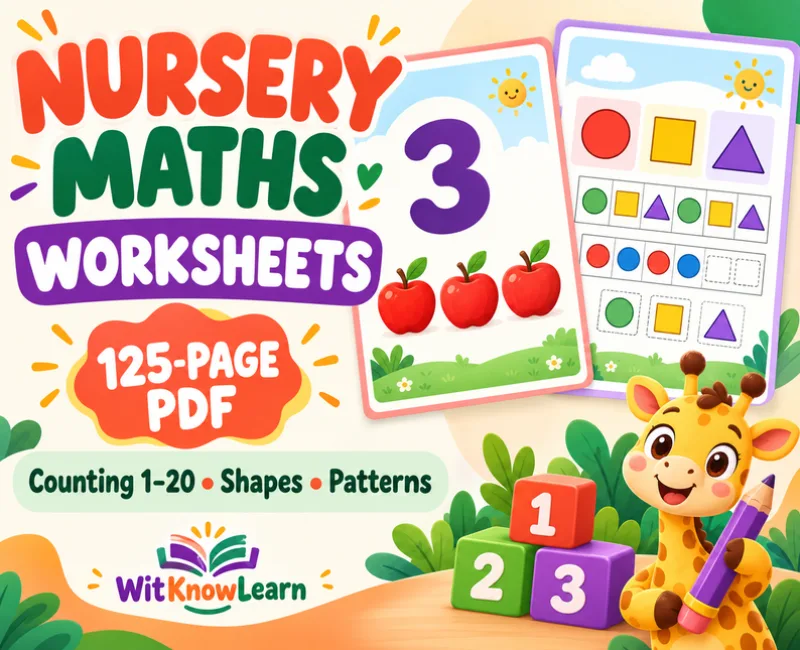
🌈 Nursery Maths Worksheets – Online Quiz, Games and Printable Activities
Make early mathematics enjoyable with our nursery maths worksheets, a 20-question online quiz and six interactive learning games. Children can explore counting, number recognition, shapes, sorting, patterns, big and small, tall and short, and everyday position words through colourful activities.
This WitKnowLearn nursery maths activity ebook is presented as an NEP 2020-inspired resource that encourages play-based, hands-on learning. Start with the quiz, enjoy the games and explore the printable activity book below.
📝 20 MCQs ⏱️ 20 Minutes 🎮 6 Games 🔢 Counting 1–20 🧩 Early Maths📝 Nursery Maths Online Quiz – 20 Questions
Answer picture-based questions about counting, shapes, patterns, comparisons and early maths concepts. Parents and teachers can read the questions aloud.
Answered: 0/20
Question Navigation
Answered questions are highlighted in green. You can change answers before submitting.
🎮 Six Interactive Nursery Maths Learning Games
These nursery maths online activities practise counting, shapes, patterns, sorting, comparisons and missing numbers with instant feedback.
1. 🍎 Count and Match
Count the objects and choose the correct number.
2. 🔺 Identify the Shape
Look at the shape and choose its name.
3. 🧩 Complete the Pattern
Which picture comes next?
4. 🐻 Big or Small?
Tap the SMALL circle.
5. 🎯 Sort the Objects
Which group does this belong to?
6. 🔢 Find the Missing Number
Complete the number sequence.
📚 Nursery Maths Worksheets PDF – NEP 2020-Based Early Learning Activities
Our nursery maths worksheets provide a collection of picture-based early mathematics activities for young children. The nursery maths ebook introduces counting, numbers, shapes, patterns, sorting, matching, comparison and spatial relationships through activities that encourage observation and participation.
Children learn early maths concepts more naturally when they can look at pictures, handle objects, talk about what they notice and try different activities. The printable worksheets can be combined with everyday learning experiences using toys, blocks, crayons and familiar household objects.
🔢 Number Recognition and Counting Worksheets 1 to 20
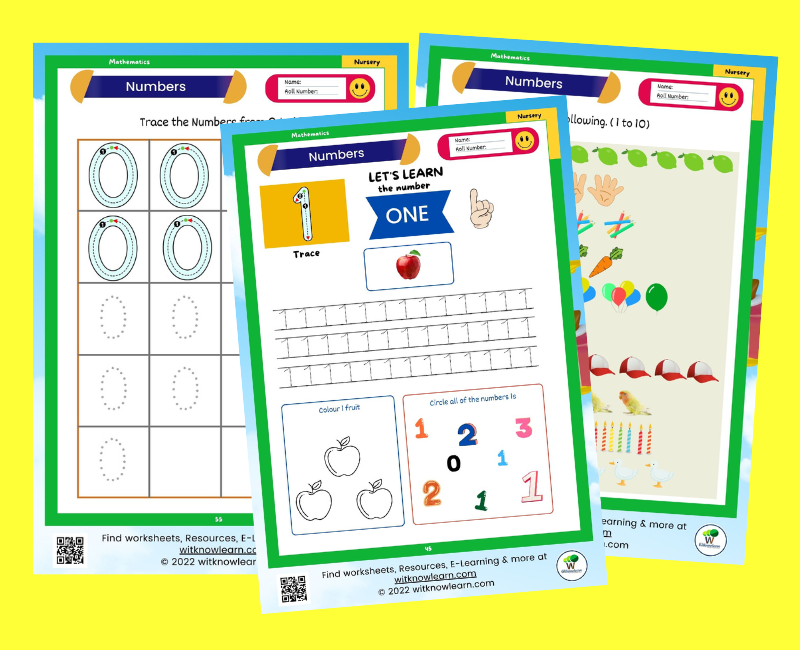
Counting is a foundational nursery maths skill. Children can begin by recognising groups containing one, two or three objects before gradually moving towards larger quantities. Counting pictures of apples, balloons, animals and other familiar objects helps children connect spoken number words with actual quantities.
The activity ebook includes number recognition and counting practice up to 20. Children can point to each object while counting aloud, then identify the matching numeral. Teachers should introduce larger quantities according to each child's readiness.
0️⃣ Understanding Zero, One and Many
Early number learning includes understanding the difference between none, one and many. An empty container can demonstrate zero, a single toy can represent one and a group of toys can illustrate many.
These comparisons help children develop number vocabulary before moving towards more formal counting activities.
🔵 Shapes and Geometry Worksheets for Nursery
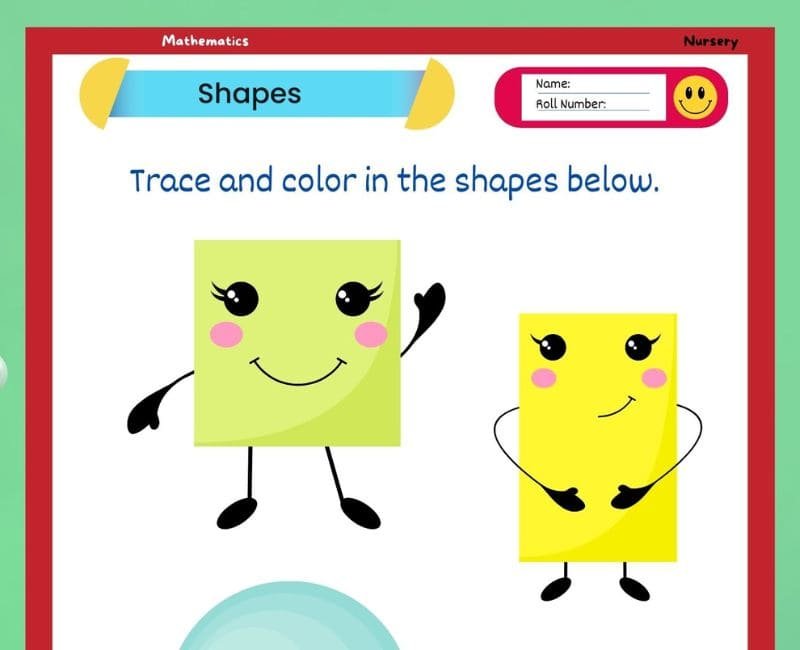
Shape recognition helps children observe the outlines and features of familiar objects. Nursery children can explore circles, squares, triangles, rectangles, stars, ovals, hearts and diamond shapes through matching, colouring and sorting activities.
For example, children can compare a circular lid with a printed circle or identify a rectangular book. Drawing and colouring shapes provide further opportunities to practise visual recognition and hand control.
🧩 Patterns Worksheets for Nursery
Pattern activities encourage children to observe repeating arrangements and predict what comes next. A simple pattern such as circle, square, circle, square can be continued by choosing another circle.
Children can also create their own patterns using coloured blocks, paper shapes or classroom objects. Some patterns may have more than one possible continuation when the rule has not been specified, so teachers can encourage children to explain their choices.
🎯 Sorting and Matching Worksheets
Sorting activities help children group objects according to a shared characteristic such as shape, colour or size. For example, children may separate triangles from squares or place similar pictures together.
Matching activities can involve connecting shapes with shadows, matching pictures with their parts or linking quantities to numerals. These tasks develop observation, comparison and early reasoning skills.
🐻 Big and Small Worksheets for Nursery
Big and small are important early comparison concepts. Children can compare a large bear with a small bear, identify larger and smaller objects or match objects according to their sizes.
Using actual toys and classroom materials helps children understand these concepts beyond printed pictures.
📏 Tall and Short Worksheets
Tall and short activities introduce comparison of height. Children can compare two trees, two buildings or two people and identify which one is taller or shorter.
Parents can extend these activities by comparing safe household objects or using building blocks of different heights.
🥛 Full and Empty Worksheets
Full and empty are useful everyday maths concepts. Children can observe pictures of containers and identify which are full or empty.
Teachers may demonstrate the concept using a cup, bowl or container and ask children to describe what they see.
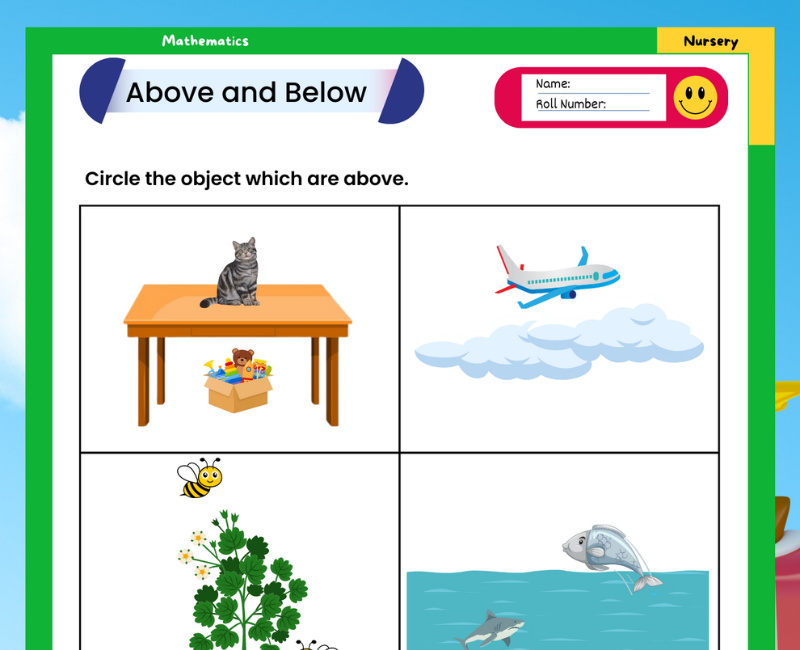
⬆️ Up and Down Worksheets
Up and down activities help children understand position and direction. Pictures of an aeroplane in the sky or an object on the ground can be used to discuss relative positions.
Movement activities such as raising and lowering hands can make these concepts more engaging.
📦 Inside and Outside Worksheets
Inside and outside are important spatial relationship words. Children can identify a toy inside a box, a ball outside a basket or objects placed in different positions.
These activities can be practised through simple instructions such as placing a block inside a container and then moving it outside.
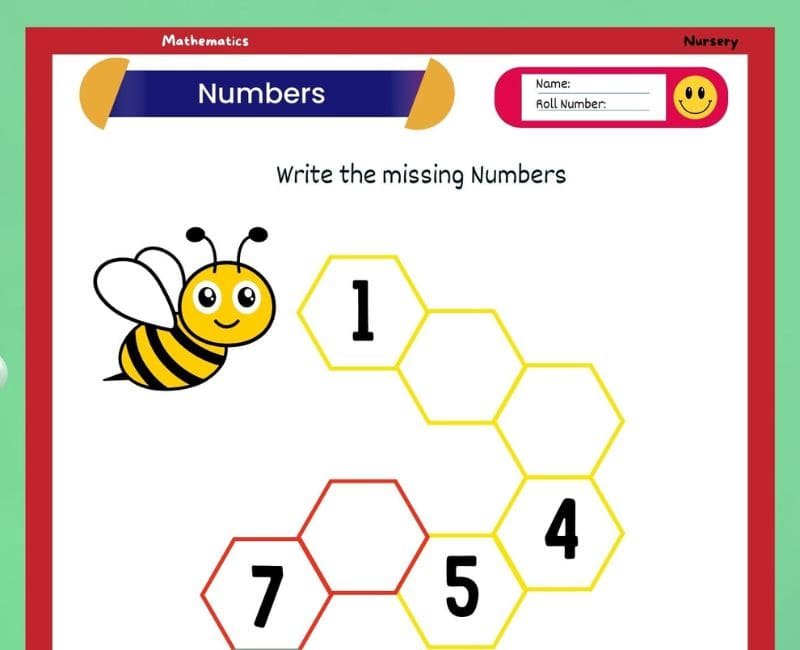
➡️ Before and After Number Activities
Number sequencing activities help children understand the order of counting numbers. For example, the number after 5 is 6, while the number before 8 is 7.
Using number cards or arranging objects in a line can support understanding of before and after.
🎨 Colouring, Drawing and Cut-and-Paste Activities
Hands-on activities allow nursery children to practise early maths concepts while developing coordination and observation. Children can colour matching shapes, draw their favourite shapes or place prepared cutouts in the correct locations.
Adults should supervise cutting and provide child-safe materials. Prepared cutouts can be useful when children are not yet ready to cut independently.
🔍 Odd One Out and Observation Activities
Odd-one-out activities encourage children to compare pictures and identify an item that differs from the others. For example, among three fruits and one vehicle, the vehicle is the odd one out.
Observation activities may also ask children to identify objects that can roll or complete a picture by matching its parts.
🔢 Join-the-Dots Number Activities
Join-the-dots activities combine number sequencing with pencil movement. Children follow numbered points in the correct order to complete a picture.
The nursery maths ebook includes join-the-dots activities using sequences up to 15 and 18. Adults can demonstrate the first few steps before allowing children to continue independently.
🎮 Nursery Maths Online Quiz and Interactive Learning Games
The nursery maths online quiz on this page contains 20 multiple-choice questions covering counting, shapes, patterns, comparisons and basic spatial concepts. Children can answer the questions at their own pace within a 20-minute timer.
Six interactive learning games offer additional practice with counting objects, identifying shapes, completing patterns, comparing sizes, sorting objects and recognising missing numbers. Immediate feedback encourages children to try again and learn from their choices.
🌈 Nursery Maths Learning Games and Play-Based Activities
Play-based activities can make early maths more meaningful. Children can count toys, sort blocks, match picture cards and identify shapes in their surroundings.
Combining digital games with real-world activities provides opportunities to practise mathematical vocabulary through conversation and movement.
📖 NEP 2020 and Activity-Based Early Mathematics
India's National Education Policy 2020 highlights the importance of early childhood care and education, including play-based and activity-based learning. Early mathematics experiences can include counting, shapes, colours, puzzles, drawing and hands-on exploration.
This WitKnowLearn activity resource is designed to support aspects of that educational approach. It is an independent learning resource and should not be interpreted as an officially approved NCERT, CBSE or government publication.
🖨️ Printable Nursery Maths Worksheets PDF
Printable nursery maths worksheets can support guided classroom lessons, homework and home-learning sessions. Parents and teachers can select activities according to children's interests and current understanding.
The ebook includes activity pages and supporting cutout materials. Use the existing download option on this WitKnowLearn worksheet page to access the available PDF. Confirm the PDF's total page count before displaying a page-count claim in your website content.
👩🏫 How Parents and Teachers Can Use These Worksheets
Start with a simple activity that the child can understand. Demonstrate the task, read the instructions aloud and encourage children to respond by pointing, counting, drawing or talking about the pictures.
Short, enjoyable sessions are often more suitable than completing many worksheets at once. Revisit familiar concepts and gradually introduce new activities as children gain confidence.
🌟 Benefits of Nursery Maths Worksheets
Early maths activities support number awareness, observation, matching, sorting, comparison, problem-solving and spatial vocabulary. Children also practise following instructions, recognising patterns and communicating their ideas.
When worksheets are combined with conversation, toys, movement and practical activities, children can explore mathematical ideas in a variety of ways.
📝 Five Nursery Maths Practice Exercises
Exercise 1: Count the Objects
- 🍎 🍎 🍎 = __
- ⭐ ⭐ ⭐ ⭐ ⭐ = __
- 🎈 🎈 = __
- 🐟 🐟 🐟 🐟 = __
- 🌸 🌸 🌸 🌸 🌸 🌸 = __
Show Answers
1. 3; 2. 5; 3. 2; 4. 4; 5. 6.
Exercise 2: Identify the Shapes
- Which shape has three sides?
- Which shape is round with no corners?
- Which shape has four equal sides?
- Which shape is usually used to represent a door?
- Which shape looks like a stretched circle?
Show Answers
1. Triangle; 2. Circle; 3. Square; 4. Rectangle; 5. Oval.
Exercise 3: Complete the Patterns
- 🔴 🔵 🔴 🔵 __
- ⭐ 🌸 ⭐ 🌸 __
- 🍎 🍌 🍎 🍌 __
- 🟨 🟩 🟨 🟩 __
- 🐟 🐟 🦋 🐟 🐟 __
Show Answers
1. 🔴; 2. ⭐; 3. 🍎; 4. 🟨; 5. 🦋.
Exercise 4: Compare and Identify
- Which is taller: a tree or a pencil?
- Which can be empty: a cup or a colour?
- Which is usually bigger: an elephant or an ant?
- Is a toy inside a closed box inside or outside?
- Which is usually in the sky: an aeroplane or a car?
Show Suggested Answers
1. Tree; 2. Cup; 3. Elephant; 4. Inside; 5. Aeroplane.
Exercise 5: Missing Numbers
- 1, 2, __, 4
- 5, __, 7, 8
- 9, 10, __, 12
- 13, __, 15, 16
- 17, 18, __, 20
Show Answers
1. 3; 2. 6; 3. 11; 4. 14; 5. 19.
👩🏫 Teaching Tips for Nursery Maths
- Begin with counting one, two and three objects.
- Introduce numbers up to 20 gradually according to readiness.
- Use real toys and blocks for counting and sorting.
- Encourage children to name shapes aloud.
- Demonstrate simple repeating patterns before asking children to complete them.
- Practise big and small, tall and short using familiar objects.
- Use physical containers to demonstrate full, empty, inside and outside.
- Prepare cutouts safely before starting paste activities.
- Read quiz instructions aloud for non-readers.
- Keep learning playful and allow time for exploration.
🔗 Related Nursery Maths Worksheets
❓ Frequently Asked Questions
What are nursery maths worksheets?
Nursery maths worksheets are early learning activities that introduce counting, shapes, patterns, sorting, matching and basic comparison concepts through pictures and simple tasks.
Which maths topics are included in this nursery activity ebook?
The described activities cover counting up to 20, zero, shapes, patterns, sorting, matching, big and small, tall and short, full and empty, inside and outside, and other early maths concepts.
Are these nursery maths worksheets NEP 2020 based?
The resource is presented as inspired by NEP 2020's emphasis on activity-based early learning. It is an independent WitKnowLearn resource, not an officially approved government publication.
How many numbers should a nursery child learn?
Children can begin with small quantities and gradually practise counting towards 10 and 20 according to their individual readiness.
Are shapes and sorting activities included?
Yes. The described ebook includes shape recognition, matching, colouring and sorting activities.
Can children play nursery maths games online?
Yes. This page includes a 20-question online quiz and six interactive activities for counting, shapes, patterns, comparisons, sorting and missing numbers.
Can I print selected nursery maths worksheet pages?
Yes. Parents and teachers can print selected pages of the available PDF, together with any supporting cutout sheets required for those activities.
Does the ebook include formal addition and subtraction?
The existing resource description focuses on early counting, recognition, matching and comparison rather than a formal addition and subtraction course.
 Download