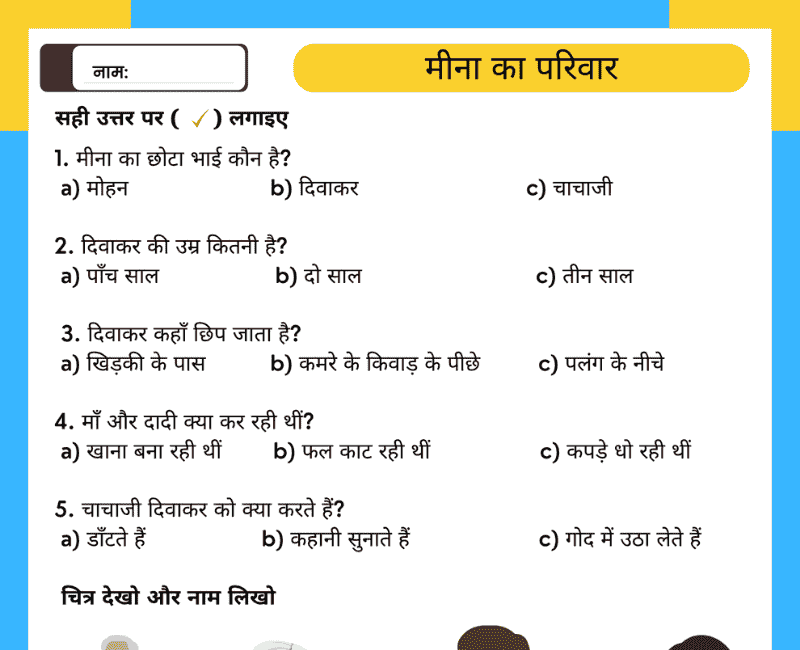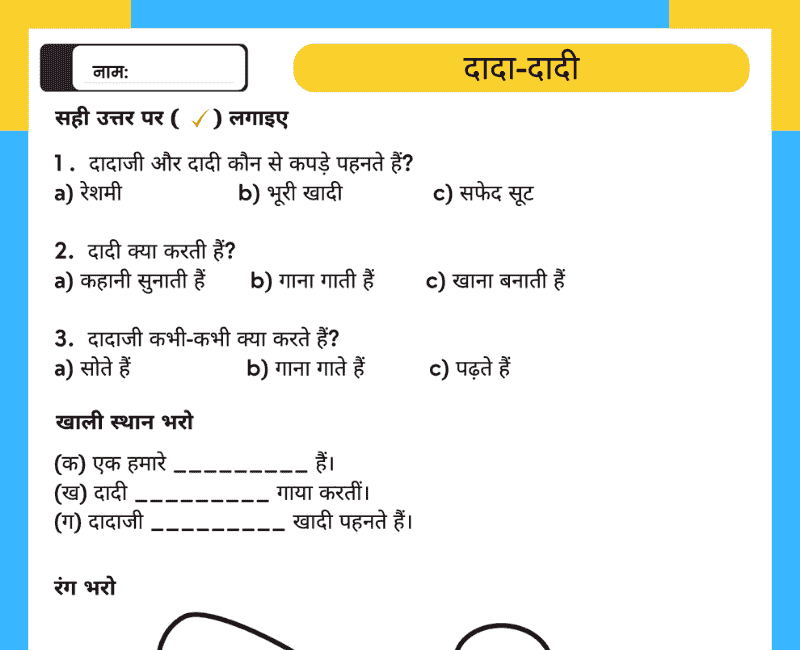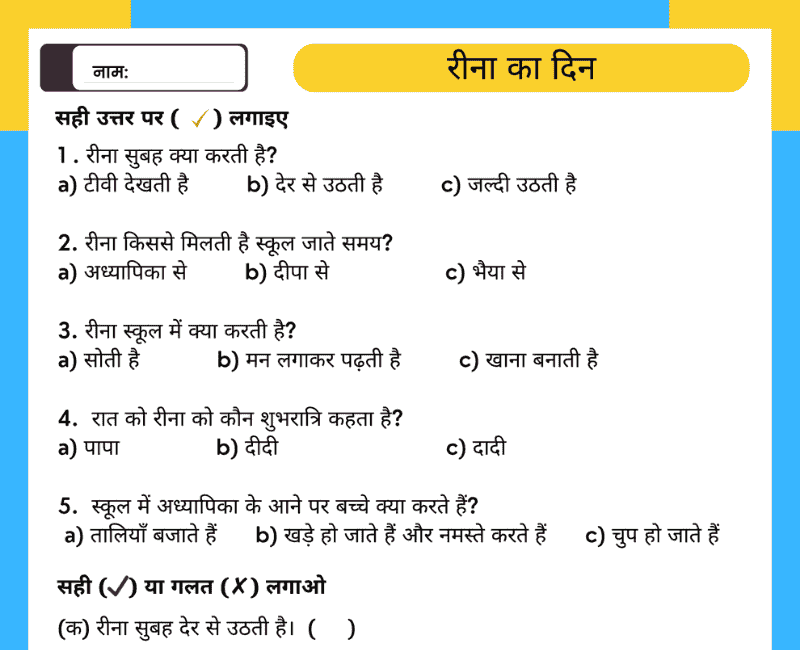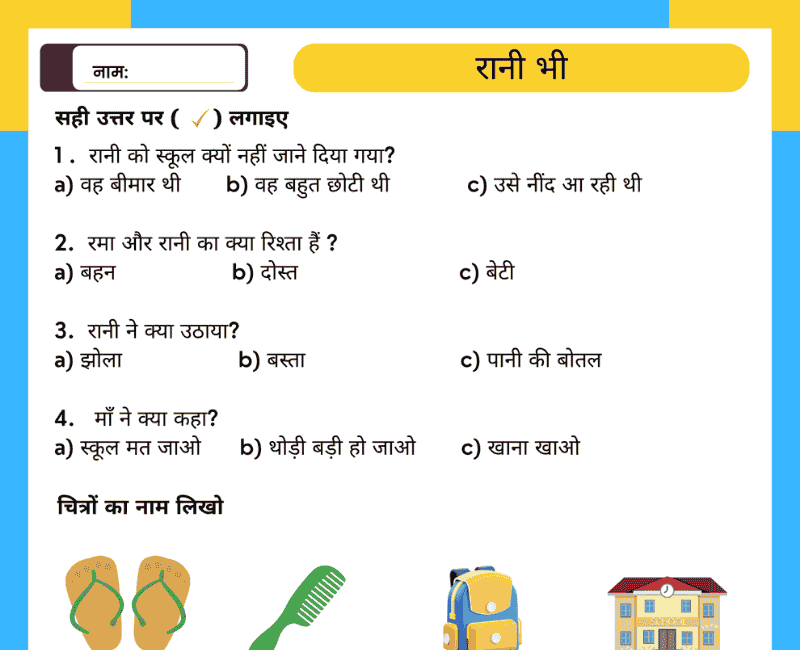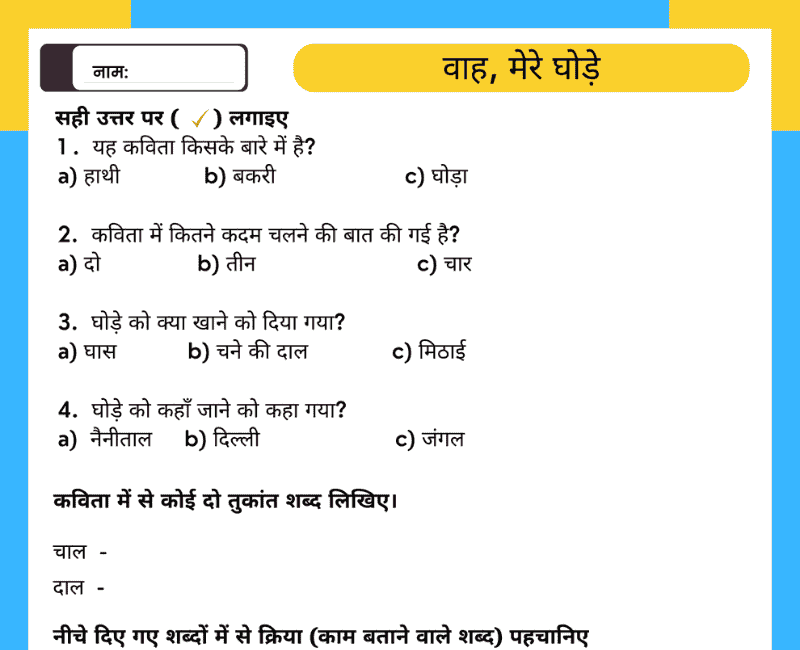
🐎 Vah Mere Ghode Class 1 Hindi Worksheet with Online Quiz and Games
Explore rhythm, rhymes and Hindi words through वाह, मेरे घोड़े! This Vah Mere Ghode Class 1 Hindi worksheet page brings the NCERT poem’s language into playful reading practice.
Try a 20-question online quiz, play 10 games and activities, and complete five short practice tasks based on NCERT Class 1 Hindi Sarangi Chapter 7. Questions and learning words are in Hindi; instructions and controls are in English.
📝 Vah Mere Ghode Online Quiz for Class 1
Question 1/20 • Easy • 0/20 answered
कविता में किस जानवर को पुकारा गया है?
🎮 Vah Mere Ghode Online Games for Class 1
Follow a screen beat, connect word sounds and build chapter vocabulary.
1. 👣 Three Screen Steps
Move the horse along three numbered stones. This is a new practice board, not a map or an extra poem event.
शुरू
Ready to begin.
2. 📮 Beginning Sound Stables
Select each word and deliver it to the box for its first sound.
Ready to begin.
3. 🔤 Build नैनीताल
Arrange the written chunks to match the place name. This is word building, not a count of speech sounds.
नैनीताल
…
Ready to begin.
4. 🎵 Arrange Rhyming Word Cards
Arrange the word cards in the model order and listen to their endings.
ताल → दाल → कमाल
…
Ready to begin.
5. 🃏 Chapter Word Memory
Reveal two cards and find identical chapter exercise words.
Find three identical-word pairs.
🎨 Vah Mere Ghode Online Activities for Class 1
Construct a horse picture, explore letter shapes and create a reading card.
6. 🥁 Copy a Screen Sound Pattern
Copy this new pattern using the chapter’s letter sounds. No physical movement or speed is required.
त → घ → घ → त
…
Ready to begin.
7. 🐎 Assemble a Horse Picture
Add or remove the labelled picture sections to construct a simple horse. These labels support picture talk.
Ready to begin.
8. 🔎 Spot ड़
Select only the cards that show ड़. Notice the dot below the letter.
ड़
Ready to begin.
9. 🧩 Last Written Consonant
Match each word to its last written consonant. This task asks about writing, not the final vowel sound.
Ready to begin.
10. 💬 Make a Poem Response Card
Choose a way you want to explore the poem. The card is displayed here, not sent.
…
Ready to begin.
✏️ Vah Mere Ghode Hindi Practice for Class 1
Try five short tasks with separate prompts.
1. 🔤 Build धागा
Arrange the written chunks to match the model.
धागा
…
Ready to begin.
2. 🖼️ Match Picture Words
Match these chapter exercise words with their pictures.
Ready to begin.
3. 🔎 Find कमाल
Select the two exact word matches.
कमाल
Ready to begin.
4. 🧱 Build a Practice Description
Arrange the words to make a new sentence about the practice horse picture. It is not a quoted poem line.
…
Ready to begin.
5. 🌟 Choose a Word to Remember
Choose a chapter word for a learning card. There is no single correct favourite.
…
Ready to begin.
📖 About the Vah Mere Ghode Class 1 Hindi Worksheet
Read the Vah Mere Ghode worksheet learning guide
The Vah Mere Ghode worksheet for Class 1 supports early Hindi learning through a rhythmic poem. Children listen to repeated language, notice rhymes and connect written words with their meanings.
NCERT Sarangi Chapter 7 is credited to Ramesh Tailang. The poem addresses a horse through an imaginative, playful voice. Read it from the official textbook so children can enjoy its rhythm before answering comprehension questions.
For Vah Mere Ghode Class 1 Hindi practice, begin with listening. Say a few words naturally and compare their endings. A rhyme depends on sound, not on identical first letters or matching meanings. Children can respond by pointing to cards rather than speaking aloud.
The chapter also introduces practice with त, घ and ड़. Connect each written form with a familiar example. When exploring a word ending, distinguish the last spoken sound from the last written consonant; these are not always the same.
The Vah Mere Ghode online quiz includes poem understanding and original language questions. The separate games use movement on screen, construction, sorting, memory and picture building. New practice pictures are learning models, not additional events in the poem.
No physical riding or food tasting is needed. Treat the poem’s food reference as part of its imaginative language rather than animal-feeding guidance. Use the existing worksheet download option for paper practice and the official NCERT Sarangi ebook link below for the complete poem.
👨👩👧 Tips for Parent and Teachers
- Read the poem for enjoyment before checking details.
- Say rhyming words clearly and compare their ending sounds.
- Point to the difference between घ and ध.
- Keep screen rhythm play optional and free from speed pressure.
- Accept listening, pointing and arranging as ways to participate.
🌟 Tips for Students
- Listen to the whole question.
- Notice the sound at the beginning of a word.
- Look closely at letter shapes.
- Listen to word endings when finding rhymes.
- Use Undo to change tile order.
- Ask an adult about an unfamiliar word.
- Try again after reading the feedback.
❓ Vah Mere Ghode Class 1 Hindi Worksheet FAQs
Which NCERT book contains Vah Mere Ghode?
It is Chapter 7 of the Class 1 Hindi textbook Sarangi.
Who wrote the poem?
The poem is credited to रमेश तैलंग, written in English as Ramesh Tailang.
Which place is named in the poem?
The poem names Nainital.
Which food is mentioned?
The poem mentions chana dal.
Which Hindi letters are explored in the exercises?
The chapter draws attention to त, घ and ड़.
How can children recognise rhymes?
Say the words naturally and listen for matching endings. Their beginning sounds and meanings can differ.
Why is repeated language useful in a poem?
It can help listeners recognise a pattern and participate in its rhythm.
Must children act like a horse?
No. They can listen, point, arrange words or use the screen activities.
Are the games repeated quiz questions?
No. They use different prompts through construction, matching, memory and screen movement.
Where can I read the complete poem?
Use the official Sarangi ebook link above. The worksheet uses this page’s existing download option.
🌈 Online Vah Mere Ghode Quiz for Class 1
Enjoy the rhythm, explore the sounds and build Hindi words!
Try the Online Quiz Download