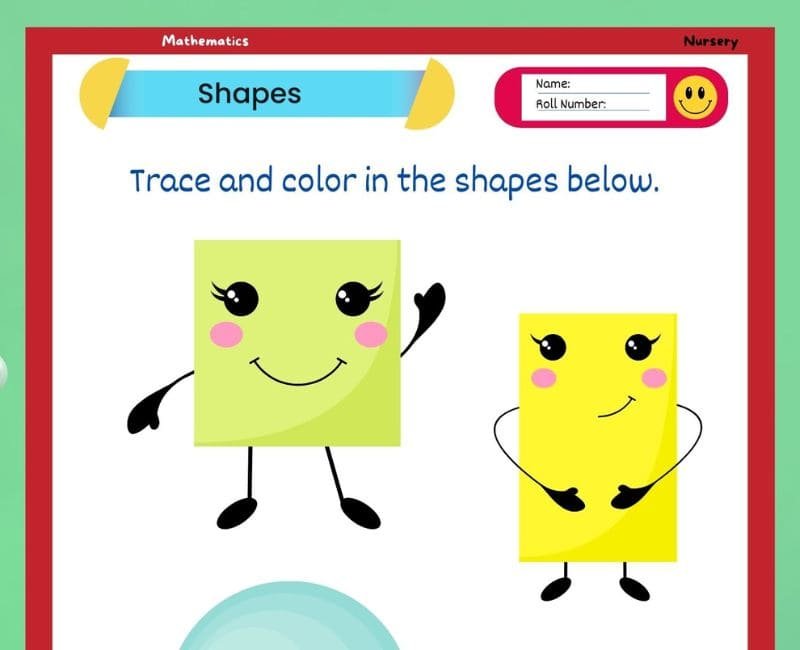
🔵 Shapes Quiz, Games and Colouring Worksheets for Nursery
Explore basic shapes with our identifying and colouring shapes worksheets for nursery, a 20-question online quiz and six interactive activities. Children can recognise circles, squares, triangles, rectangles, ovals, stars and more while practising shape names, matching and colouring.
Start with the picture-based MCQ quiz, enjoy the games and then explore the printable 16-page worksheet resource, practice exercises and teaching tips below.
📝 20 MCQs ⏱️ 20 Minutes 🎮 6 Games 🖨️ 16 Pages📝 Identify the Shapes – 20-Question Nursery Quiz
Look at each picture and choose the correct answer. You have 20 minutes. Parents and teachers can read the questions aloud.
Answered: 0/20
Question Navigation
🎮 Six Interactive Shapes Learning Games
Play these nursery shapes games to practise identifying, matching, counting, colouring and tracing basic geometric shapes.
1. 🔎 Name That Shape
Look at the picture. What shape is it?
2. 🎯 Find the Requested Shape
Tap the triangle.
3. 🎨 Colour the Shape
Colour the oval green.
4. 🔢 Count the Shapes
How many matching shapes can you see?
5. 🧠 Shape and Real-Life Object
What shape is this clock face?
6. ✏️ Trace a Shape
Trace the dotted outline using your finger or mouse.
Freehand tracing practice; your drawing is not automatically graded.
📚 Identifying and Colouring Shapes Worksheets for Nursery
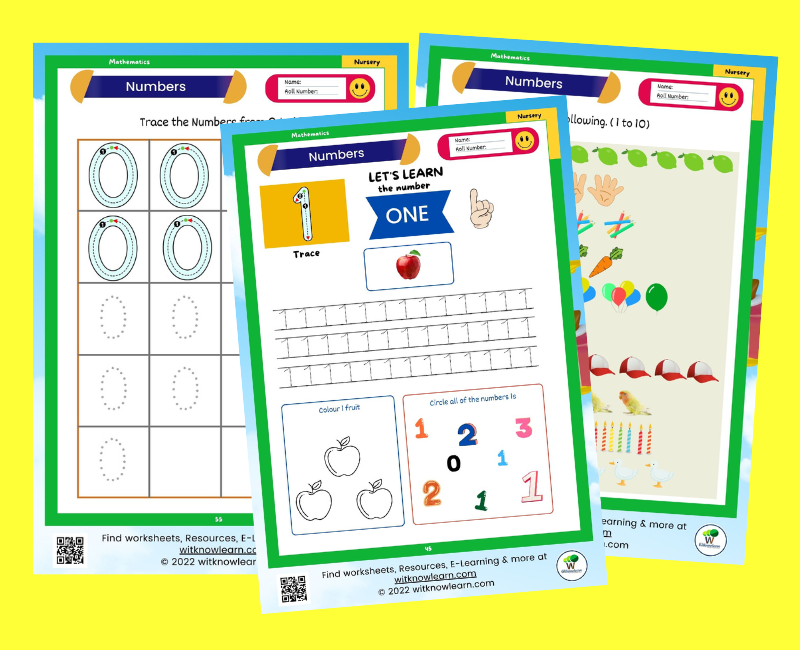
Our shapes worksheets for nursery introduce children to basic two-dimensional shapes through recognising, colouring and tracing activities. The 16-page identifying and colouring shapes worksheet resource supports early geometry skills using familiar visual patterns and simple practice.
Children can learn to notice the difference between straight and curved edges, identify common shapes in everyday objects and build confidence in naming shapes. Printable worksheets can be combined with interactive shapes games to make learning varied and enjoyable.
🔵 Circle Worksheets for Nursery
A circle is a round shape with a curved boundary and no corners. Children can identify circles in clocks, plates, wheels and coins. Circle colouring worksheets invite learners to recognise and colour circular outlines while strengthening their observation skills.
🟨 Square Worksheets for Nursery
A square has four equal sides and four corners. Children can find square shapes in floor tiles, picture frames and some windows. Square tracing activities help children practise following straight lines and turning at corners.
🔺 Triangle Worksheets for Nursery
A triangle has three straight sides and three corners. Children may recognise triangles in road signs, roof shapes and triangular flags. Triangle worksheets can ask children to identify triangles among other shapes, trace their outlines or colour them.
🟩 Rectangle Worksheets for Nursery
A rectangle has four straight sides and four corners, with opposite sides equal. Rectangular objects include many books, doors and screens. Comparing squares and rectangles helps children notice both similarities and differences.
🥚 Oval Worksheets for Nursery
An oval is a rounded shape that is usually longer in one direction than the other. Children can compare ovals with circles and practise colouring oval outlines. An egg outline is a familiar visual example, although real eggs are not perfect geometric ovals.
⭐ Star Worksheets for Nursery
Star shapes are popular in early learning activities. Children can recognise stars in stickers, decorations and picture cards. Star tracing and colouring activities encourage careful observation of pointed shapes.
❤️ Heart Worksheets for Nursery
Heart shapes are familiar from cards, drawings and decorations. Nursery children can practise identifying, matching and colouring heart outlines while developing visual recognition skills.
💎 Diamond Shape Worksheets
A diamond shape is commonly shown as a four-sided shape with pointed top and bottom corners. In early learning materials, children can identify diamond-shaped outlines and compare them with squares.
🎨 Shapes Colouring Activities for Nursery
Colouring shapes helps children connect shape names with visual outlines. Teachers can give instructions such as colour the circle red, colour the triangle blue or colour the square green. These activities combine shape recognition with colour vocabulary and listening practice.
✏️ Shape Tracing Worksheets for Nursery
Tracing activities encourage children to follow outlines using a pencil, crayon or finger. Practising circles, squares, triangles and rectangles can support hand control and familiarity with different lines and curves.
Children can begin with large outlines before moving towards smaller shapes. Parents should allow children to work at a comfortable pace rather than expecting perfect tracing immediately.
🧩 Shape Matching Activities
Matching shapes is a useful way to practise visual discrimination. Children can match two circles, identify a triangle among rectangles or connect a shape with a similar real-life object.
Using toys, blocks and picture cards alongside printable worksheets gives children additional opportunities to explore geometric shapes.
🎮 Shapes Online Quiz and Learning Games
The interactive shapes online quiz on this page contains 20 multiple-choice questions. Children can identify common shapes and answer questions about their properties and familiar examples.
Six interactive activities provide additional practice through selecting shapes, colouring, counting, identifying real-life objects and tracing outlines. Immediate feedback in the answer-based games helps children recognise correct choices and try again.
🖨️ 16 Pages Identifying and Colouring Shapes Worksheet PDF
This WitKnowLearn resource is listed as a 16-page collection of identifying and colouring shapes worksheets for nursery. Parents and teachers can use the worksheet download option available on the page to access the printable resource.
Printable shape activities can be used for classroom lessons, homework and additional home practice. Combining paper-based learning with interactive games allows children to practise the same concepts in different ways.
🌟 Benefits of Learning Shapes in Nursery
Shape recognition supports early mathematical thinking, observation and comparison. Children begin to identify visual features such as corners, straight sides and curved boundaries. These experiences build a foundation for later geometry learning.
Colouring, matching and tracing shapes also provide opportunities to practise attention, coordination and following simple instructions.
📝 Five Shapes Practice Exercises for Nursery
Exercise 1: Identify the Shape
- Which shape has three sides?
- Which shape is round and has no corners?
- Which shape has four equal sides?
- Which shape is commonly used for a door outline?
- Which shape looks like a stretched circle?
Show Answers
1. Triangle; 2. Circle; 3. Square; 4. Rectangle; 5. Oval.
Exercise 2: Count the Sides
- How many sides does a triangle have?
- How many sides does a square have?
- How many sides does a rectangle have?
- How many corners does a circle have?
- How many corners does a triangle have?
Show Answers
1. Three; 2. Four; 3. Four; 4. Zero; 5. Three.
Exercise 3: Match Shapes with Objects
- Clock face — Which shape?
- Door — Which shape?
- Square floor tile — Which shape?
- Triangular road sign — Which shape?
- Star sticker — Which shape?
Show Answers
1. Circle; 2. Rectangle; 3. Square; 4. Triangle; 5. Star.
Exercise 4: Colour the Shapes
- Draw and colour a red circle.
- Draw and colour a blue square.
- Draw and colour a green triangle.
- Draw and colour a yellow rectangle.
- Draw and colour a pink heart.
Show Answer Guidance
Check that each shape has been drawn and coloured according to the instructions.
Exercise 5: Find Shapes Around You
- Find one circular object.
- Find one rectangular object.
- Find one square object.
- Find a triangular shape in a picture.
- Draw a star.
Show Suggested Answers
Examples: plate, book, square tile, triangular flag and a hand-drawn star.
👩🏫 Teaching Tips for Parents and Nursery Teachers
- Introduce one or two shapes at a time.
- Use real objects such as plates, books and blocks.
- Encourage children to say shape names aloud.
- Compare shapes using sides and corners.
- Provide crayons for colouring activities.
- Use large shape outlines for tracing practice.
- Read quiz questions aloud when necessary.
- Combine printable worksheets with interactive games.
🔗 Related Nursery Worksheets
❓ Frequently Asked Questions
What are shapes worksheets for nursery?
They are early learning worksheets that help children identify, match, trace and colour common geometric shapes.
Which shapes should nursery children learn first?
Circles, squares, triangles and rectangles are common introductory shapes. Ovals, stars and hearts can be introduced gradually.
How can I teach shapes to nursery children?
Use shape flashcards, everyday objects, colouring activities, tracing and simple matching games.
How many sides does a triangle have?
A triangle has three straight sides and three corners.
What is the difference between a square and rectangle?
A square has four equal sides. A rectangle has four right angles and opposite sides equal; a square is a special type of rectangle.
Why are colouring shapes activities useful?
They encourage shape recognition, colour identification and careful observation.
Can children play the shapes quiz online?
Yes. This page includes a 20-question quiz and six interactive shapes activities.
How many pages are in this shapes worksheet resource?
The WitKnowLearn resource is listed as a 16-page identifying and colouring shapes worksheet collection.
 Download