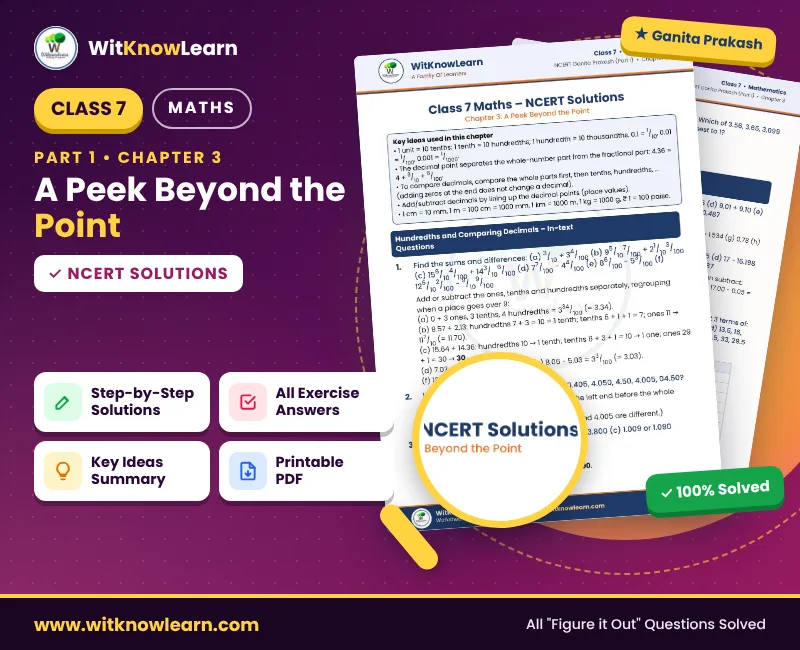
A Peek Beyond the Point Class 7 NCERT Solutions Chapter 3
Step by step answers to every question of Ganita Prakash Part 1 Chapter 3, section by section, with a quick quiz, extra questions and exam tips.
Chapter at a Glance
- The chapter builds the decimal system place by place: 1 unit = 10 tenths, 1 tenth = 10 hundredths and 1 hundredth = 10 thousandths.
- A decimal such as 4.36 is read as 4 + 3/10 + 6/100, so fractions and decimals describe the same numbers.
- Decimals are compared from the left: whole parts first, then tenths, then hundredths. Zeros at the right-hand end change nothing.
- Addition and subtraction work when the decimal points are lined up, with extra zeros added where needed.
- Units of measurement are decimal too: 1 cm = 10 mm, 1 m = 100 cm, 1 km = 1000 m, 1 kg = 1000 g and ₹ 1 = 100 paise.
Key Terms in A Peek Beyond the Point Class 7
| Term | What it means |
|---|---|
| Decimal point | The dot that separates the whole number part from the fractional part. |
| Tenth | One of ten equal parts of a unit, written 0.1 or 1/10. |
| Hundredth | One of a hundred equal parts of a unit, written 0.01 or 1/100. |
| Thousandth | One of a thousand equal parts of a unit, written 0.001 or 1/1000. |
| Equivalent decimals | Decimals that look different but are equal, such as 4.5, 4.50 and 04.50. |
| Place value in decimals | Each step to the right of the point is ten times smaller than the one before it. |
Play the Quiz
Ten quick questions from this chapter. Play first, then check the full solutions below.
Which of these equals 4.5?
A Peek Beyond the Point Class 7 NCERT Solutions Ganita Prakash
Every question of the chapter is solved below in the order the textbook asks it, grouped by section. Each solution shows the working line by line and ends with a clear answer.
Figure it Out: Hundredths and comparing decimals, in-text questions (4 questions)
1. Find the sums and differences: (a) 3/10 + 34/100, (b) 9.57 + 2.13, (c) 15.64 + 14.36, (d) 7.07 − 4.04, (e) 8.06 − 5.03, (f) 12.62 − 0.99.
2. Which of these are the same: 4.5, 4.05, 0.405, 4.050, 4.50, 4.005, 04.50?
3. Which is greater: (a) 1.23 or 1.32, (b) 3.81 or 13.800, (c) 1.009 or 1.090?
4. (i) Which of 0.9, 1.1, 1.01 and 1.11 is closest to 1.09? (ii) Which of 3.56, 3.65 and 3.099 is closest to 4? (iii) Which of 0.8, 0.69 and 1.08 is closest to 1?
Figure it Out: 3.5 Units of measurement (2 questions)
5. Fill in: 12 mm, 56 mm, 70 mm, 9 mm, 134 mm and 2036 mm in centimetres; and 36 cm, 50 cm, 89 cm, 4 cm, 325 cm and 207 cm in metres.
6. Fill in: 465 g, 68 g, 1560 g, 704 g, 560 g and 2500 g in kilograms; 10 p, 5 p and 36 p in rupees. How many millimetres make 1 m, and can 1 mm be written as 1/1000 m?
Figure it Out: 3.7 Addition and subtraction of decimals (4 questions)
7. Find the sums: (a) 5.3 + 2.6, (b) 18 + 8.8, (c) 2.15 + 5.26, (d) 9.01 + 9.10, (e) 29.19 + 9.91, (f) 0.934 + 0.6, (g) 0.75 + 0.03, (h) 6.236 + 0.487.
8. Find the differences: (a) 5.6 − 2.3, (b) 18 − 8.8, (c) 10.4 − 4.5, (d) 17 − 16.198, (e) 17 − 0.05, (f) 34.505 − 18.1, (g) 9.9 − 9.09, (h) 6.236 − 0.487.
9. Continue the sequence 4.4, 4.8, 5.2, 5.6, 6.0, and then give the change and the next three terms of: (a) 4.4, 4.45, 4.5; (b) 25.75, 26.25, 26.75; (c) 10.56, 10.67, 10.78; (d) 13.5, 16, 18.5; (e) 8.5, 9.4, 10.3; (f) 5, 4.95, 4.90; (g) 12.45, 11.95, 11.45; (h) 36.5, 33, 29.5.
10. Sonu says the sum of two decimals is always greater than the sum of their whole number parts and less than 2 more than that sum. Is this true for 25.936 + 8.202, and does it hold for any two decimals?
Figure it Out: 3.8 More on the decimal system, end of chapter exercises (16 questions)
11. Convert into decimals: (a) 5/100, (b) 16/1000, (c) 12/10, (d) 254/1000.
12. Write as a sum of tenths, hundredths and thousandths: (a) 0.34, (b) 1.02, (c) 0.8, (d) 0.362.
13. What decimal does each letter stand for on a number line running from 6.4 to 6.6 with four equal divisions between 6.4 and 6.5?
14. Arrange in descending order: (a) 11.01, 1.011, 1.101, 11.10, 1.01; (b) 2.567, 2.675, 2.768, 2.499, 2.698; (c) 4.678 g, 4.595 g, 4.600 g, 4.656 g, 4.666 g; (d) 33.13 m, 33.31 m, 33.133 m, 33.331 m, 33.313 m.
15. Using the digits 1, 4, 0, 8 and 6 once each, make (a) the decimal number closest to 30 and (b) the smallest decimal number between 100 and 1000.
16. Will a decimal number with more digits always be greater than one with fewer digits?
17. Mahi buys 0.25 kg of beans, 0.3 kg of carrots, 0.5 kg of potatoes, 0.2 kg of capsicums and 0.05 kg of ginger. What is the total weight?
18. Pinto supplies 3.79 L, 4.2 L and 4.25 L of milk in three days and 25 L over six days. How much does he supply in the last three days?
19. Tinku weighed 35.75 kg in January and 34.50 kg in February. Did he gain or lose, and by how much?
20. Extend the pattern 5.5, 6.4, 6.39, 7.29, 7.28, ...
21. How many millimetres make one kilometre?
22. Travel insurance costs 45 paise per passenger. What is the total fee if one lakh people take it?
23. Which is greater: (a) 10/1000 or 1/10, (b) one hundredth or 90 thousandths, (c) one thousandth or 90 hundredths?
24. Write in decimal form: (b) 12 tens and 12 tenths, (c) 10 tens, 10 ones, 10 tenths and 10 hundredths, (d) 25 tens, 25 ones, 25 tenths and 25 hundredths.
25. Using each digit from 0 to 9 at most once, fill two three-place decimals so that their sum is as close as possible to 10.5.
26. Write in decimal form: (a) 1/2, (b) 3/2, (c) 1/4, (d) 3/4, (e) 1/5, (f) 4/5.
Quick Revision Notes
- 0.1 = 1/10, 0.01 = 1/100 and 0.001 = 1/1000.
- Adding zeros at the right-hand end of a decimal does not change its value.
- To compare, line up the places and read from the left.
- To add or subtract, line up the decimal points and fill the gaps with zeros.
- 1 cm = 10 mm, 1 m = 1000 mm, 1 km = 10,00,000 mm.
- 1 kg = 1000 g and ₹ 1 = 100 paise.
- 1/2 = 0.5, 1/4 = 0.25, 3/4 = 0.75, 1/5 = 0.2 and 4/5 = 0.8.
Important Points to Remember
- Count the zeros in the denominator to decide the number of decimal places.
- A number with more digits is not automatically larger.
- Always give both decimals the same number of places before subtracting.
- When a question gives a number line, divide the gap by the number of parts before reading any letter.
- Converting grams to kilograms moves the point three places; centimetres to metres moves it two.
- Paise to rupees moves the point two places.
- A fraction becomes a decimal most easily when its denominator is made 10, 100 or 1000.
- Money answers are written with two decimal places, as in ₹ 45.00.
- Patterns in decimal sequences may alternate between two different steps.
- Check an answer roughly: 25.936 + 8.202 must lie between 33 and 35.
Common Mistakes Students Make
| Mistake | What to do instead |
|---|---|
| Treating 4.05 as equal to 4.5 | Only zeros at the right-hand end can be dropped or added |
| Lining decimals up at the right-hand end | Line up the decimal points instead |
| Writing 16/1000 as 0.16 | Three zeros mean three decimal places, so 0.016 |
| Dividing grams by 100 to get kilograms | A kilogram holds 1000 g, so divide by 1000 |
| Assuming each small division on a number line is 0.01 | Divide the gap by the number of parts |
| Judging size by the number of digits | Compare whole parts, then tenths, then hundredths |
A Peek Beyond the Point in Real Life
- Shop weights and prices are decimals: 0.25 kg of beans and ₹ 45.50 at the till.
- Height and distance are measured in metres and centimetres, which is the same decimal idea.
- Petrol pumps, water meters and electricity bills all read in decimals.
- Athletics times are recorded to hundredths of a second, and medals are often decided there.
- Medicine doses in millilitres and grams depend on reading decimal places correctly.
Extra Questions with Answers
Very short answer questions
1. Write 7/100 as a decimal.
2. Which is greater, 0.6 or 0.59?
3. Write 2 m 5 cm in metres.
4. Find 0.8 + 0.35.
5. Write 1/5 as a decimal.
Short answer questions
1. Arrange 5.07, 5.7, 5.007 and 5.70 in ascending order.
2. A rope of 12 m has 3.75 m cut from it. How much is left?
3. Change 2345 g into kilograms and 2345 mm into metres.
4. Find the missing term: 7.2, 7.45, 7.7, ___, 8.2.
5. Write 3/4 of a rupee in decimal form.
Long answer questions
1. A shopper buys 1.25 kg rice, 0.75 kg dal and 0.4 kg sugar, and the bag can hold 3 kg. How much more can be added?
2. A runner covers 2.45 km, 3.8 km and 1.75 km on three days. Find the total distance in kilometres and in metres.
3. Using the digits 2, 5, 7 and 9 once each, make the largest and the smallest numbers of the form two digits, a point, then two digits, and find their difference.
Exam Tips for Chapter 3
- Write the decimal points one under the other before adding or subtracting.
- Fill short decimals with zeros so that every number has the same number of places.
- State the unit in the final line, and use two places for money.
- In comparison questions, show the place you compared, such as the tenths.
- Check the size of your answer against a rough estimate before writing it down.
Read the full chapter description
A Peek Beyond the Point is the third chapter of Ganita Prakash Part 1 for Class 7, and it opens the space between whole numbers. Tenths, hundredths and thousandths are built one from another, so that the decimal point is seen as a boundary rather than a rule to memorise.
Comparing decimals is treated as reading from the left, place by place, which explains at once why 2.5 is larger than 2.05 and why 0.999 is still less than 1. Addition and subtraction then become a matter of lining the points up and filling the short numbers with zeros.
The chapter closes with measurement, where millimetres, centimetres, metres, grams, kilograms, paise and rupees all turn out to be the same decimal system in different clothes, and with a set of puzzles on making numbers from given digits.
A Peek Beyond the Point Class 7 FAQs
What does the decimal point separate?
The whole number part from the fractional part. In 4.36 the 4 is whole, the 3 counts tenths and the 6 counts hundredths.
Is 4.5 the same as 4.50?
Yes. Zeros written at the right-hand end after the point do not change the value, so 4.5, 4.50 and 04.50 are all equal.
How do I compare two decimals?
Compare the whole parts first. If they are equal compare the tenths, then the hundredths, then the thousandths, stopping at the first place where they differ.
How do I add or subtract decimals?
Write the numbers with their decimal points in a line, add zeros so that both have the same number of places, then work place by place.
How many millimetres are in a metre?
One thousand, so 1 mm = 0.001 m and 1 km = 10,00,000 mm.
How do I change grams into kilograms?
Divide by 1000, which moves the decimal point three places to the left. So 465 g = 0.465 kg.
How do I write a fraction as a decimal?
Make the denominator 10, 100 or 1000. For example 1/4 = 25/100 = 0.25 and 4/5 = 8/10 = 0.8.
Does a decimal with more digits have a bigger value?
No. 2.05 has more digits than 2.5 but is smaller, because the tenths decide first.
How do I read letters marked on a decimal number line?
Divide the gap between two labelled points by the number of equal parts, then count the parts from the nearer label.
Do these solutions follow the new NCERT syllabus?
Yes. They follow Ganita Prakash Part 1, the current NCERT textbook for Class 7 Maths, and solve every question of Chapter 3 in order.
More Class 7 Maths Practice
Worksheets with online quizzes and games for every chapter of Ganita Prakash.
A Peek Beyond the Point worksheet with online quiz and games →
WitKnowLearn: worksheets, notes and solutions. These solutions follow NCERT Ganita Prakash Part 1, Chapter 3.
 Download