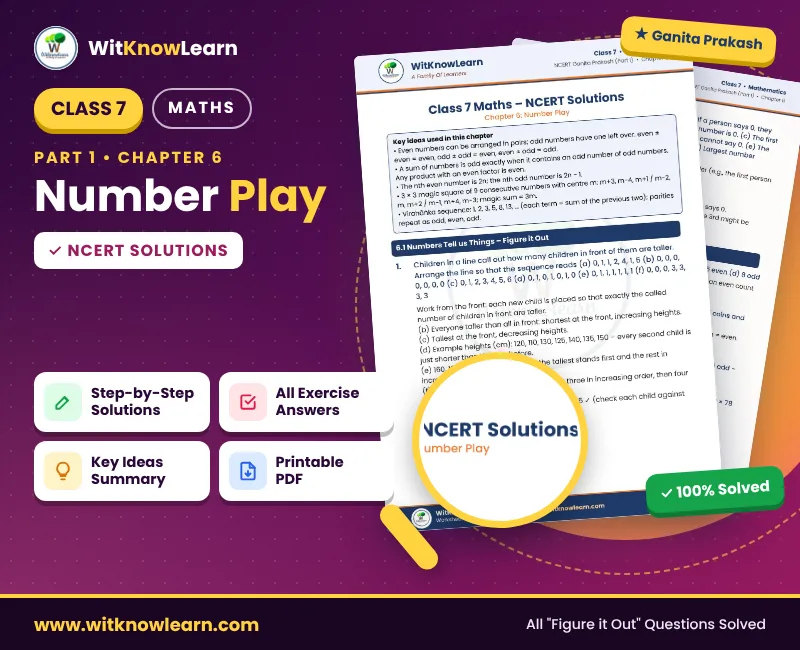
Number Play Class 7 NCERT Solutions Chapter 6
Step by step answers to every question of Ganita Prakash Part 1 Chapter 6, section by section, with a quick quiz, extra questions and exam tips.
Chapter at a Glance
- Even numbers can be arranged in pairs and odd numbers always leave one over, which is the idea behind every parity rule.
- even ± even = even, odd ± odd = even and even ± odd = odd, so a sum is odd exactly when it holds an odd number of odd terms.
- A product is odd only when every factor is odd; a single even factor makes it even.
- The nth even number is 2n and the nth odd number is 2n − 1.
- A 3 by 3 magic square of nine consecutive numbers with centre m has magic sum 3m.
- The Virahāṅka sequence 1, 2, 3, 5, 8, 13 grows by adding the two previous terms, and its parities repeat as odd, even, odd.
Key Terms in Number Play Class 7
| Term | What it means |
|---|---|
| Parity | Whether a number is odd or even. |
| Even number | A number that can be split into two equal whole parts, such as 2n. |
| Odd number | A number that leaves one over when paired up, such as 2n − 1. |
| Magic square | A square grid whose rows, columns and diagonals all add to the same total. |
| Magic sum | The common total of each line of a magic square; for a 3 by 3 square with centre m it is 3m. |
| Virahāṅka sequence | The sequence 1, 2, 3, 5, 8, 13, in which each term is the sum of the two before it. |
| Cryptarithm | A puzzle in which letters stand for digits, such as UT + TA = TAT. |
Play the Quiz
Ten quick questions from this chapter. Play first, then check the full solutions below.
The sum of an odd number of odd numbers is
Number Play Class 7 NCERT Solutions Ganita Prakash
Every question of the chapter is solved below in the order the textbook asks it, grouped by section. Each solution shows the working line by line and ends with a clear answer.
Figure it Out: 6.1 Numbers tell us things (2 questions)
1. Children in a line call out how many children in front of them are taller. Arrange the line so that the sequence reads (a) 0, 1, 1, 2, 4, 1, 5; (b) all zeros; (c) 0, 1, 2, 3, 4, 5, 6; (d) 0, 1, 0, 1, 0, 1, 0; (e) 0, 1, 1, 1, 1, 1, 1; (f) 0, 0, 0, 3, 3, 3, 3.
2. Always true, sometimes true or never true? (a) If a person says 0 they are the tallest. (b) If a person is the tallest their number is 0. (c) The first person's number is 0. (d) A person in the middle cannot say 0. (e) The person with the largest number is the shortest. (f) What is the largest number possible in a group of 8?
Figure it Out: 6.2 Picking parity (5 questions)
3. Find the parity of: (a) 2 even numbers and 2 odd numbers added, (b) 2 odd and 3 even, (c) 5 even numbers, (d) 8 odd numbers.
4. Lakpa has an odd number of ₹ 1 coins, an odd number of ₹ 5 coins and an even number of ₹ 10 coins. Can his total be ₹ 205?
5. Find the parity of: (d) even − even, (e) odd − odd, (f) even − odd, (g) odd − even.
6. Find the parity of the number of small squares in grids of (a) 27 × 13, (b) 42 × 78, (c) 135 × 654.
7. Give an expression that is always odd and one, like 3n + 4, that can be either. What is the nth even number, and can all odd numbers be listed?
Figure it Out: 6.3 Explorations in grids and 6.4 the Virahanka sequence (7 questions)
8. How many different magic squares can be made using the numbers 1 to 9?
9. Create a magic square using the numbers 2 to 10.
10. Take a magic square and (a) increase every number by 1, (b) double every number. Is it still magic, and how does the magic sum change?
11. What other operations turn a magic square into another magic square?
12. How can a magic square be made from any nine consecutive numbers, such as 2 to 10, 3 to 11 or 9 to 17?
13. Using the general form with centre m: (1) make a magic square with centre 25, (2) find the sum of any line, (3) add 1 to and then double every term, (4) make a square with magic sum 60, (5) can non-consecutive numbers make a magic square?
14. Write the next three numbers of 1, 2, 3, 5, 8, ..., 55, 89. Can you tell the parity of the next one, and what is the parity pattern?
Figure it Out: End of chapter exercises (11 questions)
15. A bulb is on and Dorjee toggles its switch 77 times. Is it on or off at the end?
16. Fifty loose sheets, each printed on both sides, fall out of an encyclopaedia. Can the sum of their page numbers be 6000?
17. Fill a 2 by 3 grid with three odd and three even numbers so that the first row has an odd sum, the second an even sum, and the columns have sums that are even, even and odd.
18. Make a 3 by 3 magic square with magic sum 0, not using all zeros.
19. Give the parity of (a) the sum of an odd number of even numbers, (b) the sum of an even number of odd numbers, (c) the sum of an even number of even numbers, (d) the sum of an odd number of odd numbers.
20. What is the parity of the sum of the numbers from 1 to 100?
21. 987 and 1597 are consecutive Virahanka numbers. Find the next two and the previous two.
22. In how many ways can Angaan climb 8 steps taking 1 or 2 steps at a time?
23. What is the parity of the 20th Virahanka number?
24. Which of these are true? (a) 4m − 1 always gives odd numbers. (b) All even numbers can be written as 6j − 4. (c) 2p + 1 and 2q − 1 both describe all odd numbers. (d) 2f + 3 gives both even and odd numbers.
25. Solve the cryptarithm UT + TA = TAT.
Quick Revision Notes
- even + even = even, odd + odd = even, even + odd = odd, and subtraction follows the same rules.
- A sum is odd exactly when the number of odd terms in it is odd.
- A product is even as soon as one factor is even.
- 2n gives every even number and 2n − 1 gives every odd number.
- In the 1 to 9 magic square the centre is 5 and the magic sum is 15.
- Adding a constant to every entry, or multiplying every entry by one, keeps a square magic.
- Virahāṅka numbers: each term is the sum of the two before, and the parity pattern repeats every three terms.
Important Points to Remember
- Count the odd numbers, not the total of numbers, when judging the parity of a sum.
- Parity can prove something impossible without any calculation at all.
- When parity is not enough, look for a divisibility argument, as in the 50 sheets question.
- The centre of a 3 by 3 magic square is always one third of the magic sum.
- Shifting or scaling a known magic square is faster than building a new one.
- Negative numbers are allowed in a magic square, and are needed for a magic sum of 0.
- Counting staircase climbs gives Virahāṅka numbers, because the last step was either 1 or 2.
- The parity of a Virahāṅka number depends only on its position modulo 3.
- In a cryptarithm, start with the leading digit, which is usually forced.
- Always test a general claim with at least one odd and one even value.
Common Mistakes Students Make
| Mistake | What to do instead |
|---|---|
| Saying odd − odd is odd | Two odd numbers differ by an even amount, as in 7 − 3 = 4 |
| Judging a sum’s parity by how many numbers are added | Only the count of odd numbers matters |
| Calling 3n + 4 always even | The term 3n changes parity with n |
| Adding 1 to the magic sum after adding 1 to each entry | Each line gains 3, since it has three entries |
| Assuming a magic square needs consecutive numbers | Any evenly spaced set works, such as the multiples of 3 |
| Multiplying the choices for the staircase problem | The counts add, giving the Virahāṅka numbers |
Number Play in Real Life
- Parity checks are used in computers to spot errors in stored or transmitted data.
- Light switches, flipped coins and reversible processes all depend on whether the number of changes is odd or even.
- Magic squares appear in temple carvings and in puzzles across many cultures.
- Virahāṅka numbers, known elsewhere as Fibonacci numbers, come from Indian studies of poetic metre and show up in plant growth.
- Sharing and pairing problems in daily life, from seating to packing, usually turn on odd and even.
Extra Questions with Answers
Very short answer questions
1. Is 37 + 54 odd or even?
2. What is the parity of 15 × 22?
3. Write the 12th even number.
4. What is the magic sum of a 3 by 3 square with centre 7?
5. Write the next Virahāṅka number after 13 and 21.
Short answer questions
1. Can the sum of five odd numbers be 20? Explain.
2. A magic square of 1 to 9 is multiplied by 4. What is its new magic sum?
3. Find the parity of the sum 1 + 3 + 5 + ... + 19.
4. In how many ways can a child climb 6 steps taking 1 or 2 at a time?
5. Is 2f + 3 ever even?
Long answer questions
1. Build a 3 by 3 magic square with magic sum 36, and show that each line works.
2. Show that the sum of any three consecutive Virahāṅka numbers is even.
3. A page torn from a book has two consecutive page numbers adding to 97. Is this possible? Explain.
Exam Tips for Chapter 6
- State the parity rule you are using before applying it.
- In impossibility questions, say clearly why the parity cannot match.
- Draw the magic square grid neatly and show one line adding up as a check.
- For sequence questions, write out a few terms before jumping to the answer.
- In cryptarithms, explain how you fixed the first digit; that reasoning earns marks.
Read the full chapter description
Number Play is the sixth chapter of Ganita Prakash Part 1 for Class 7, and it turns simple observations about numbers into tools for proof. It opens with children in a line calling out how many in front are taller, which quietly teaches how to read information from a list of numbers.
Parity is then developed carefully. Instead of memorising rules, students see why an odd number pairs up with one left over, and why a sum is odd exactly when it contains an odd number of odd terms. That one idea settles questions about coins, grids, light switches and torn pages without any long calculation.
The chapter closes with magic squares, where a general form with centre m explains every example at once, and with the Virahāṅka sequence, whose terms count the ways of climbing a staircase and whose parities repeat in a block of three. All of these are solved here step by step.
Number Play Class 7 FAQs
What is parity?
Whether a number is odd or even. Parity rules let many questions be answered without doing the arithmetic.
When is a sum odd?
Exactly when it contains an odd number of odd terms. Even terms never change the parity.
When is a product odd?
Only when every factor is odd. A single even factor makes the whole product even.
What is the nth even number and the nth odd number?
The nth even number is 2n and the nth odd number is 2n − 1.
What is the magic sum of a 3 by 3 magic square?
Three times the centre number. For 1 to 9 the centre is 5, so the magic sum is 15.
Can a magic square be made from numbers that are not consecutive?
Yes. Multiplying every entry of the 1 to 9 square by 3 gives a magic square with magic sum 45.
What is the Virahāṅka sequence?
The sequence 1, 2, 3, 5, 8, 13, 21, in which each term is the sum of the two before it. It is also known as the Fibonacci sequence.
Why do staircase problems give Virahāṅka numbers?
Because the last move is either a single step or a double step, so the ways of reaching a step are the ways of reaching the two steps before it, added together.
How do I start a cryptarithm such as UT + TA = TAT?
Look at the leading digit. Two two-digit numbers add to less than 200, so T must be 1, and the rest follows.
Do these solutions follow the new NCERT syllabus?
Yes. They follow Ganita Prakash Part 1, the current NCERT textbook for Class 7 Maths, and solve every question of Chapter 6 in order.
More Class 7 Maths Practice
Worksheets with online quizzes and games for every chapter of Ganita Prakash.
Number Play worksheet with online quiz and games →
WitKnowLearn: worksheets, notes and solutions. These solutions follow NCERT Ganita Prakash Part 1, Chapter 6.
 Download