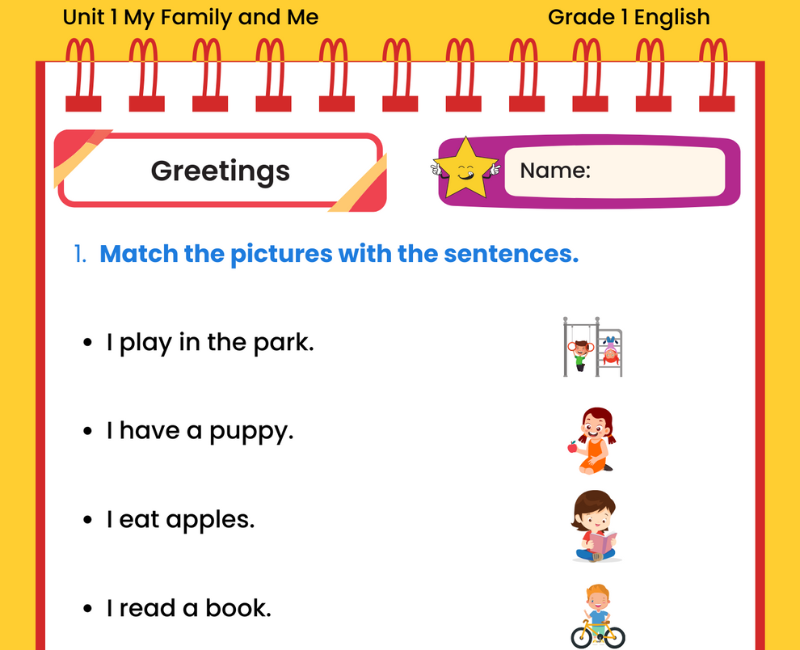
👋 Greetings Worksheet for Class 1
Meet, greet and reply with this Greetings Class 1 worksheet based on NCERT Mridang Unit 1 Chapter 2. Practise morning, afternoon and evening greetings, bedtime wishes and familiar action words.
Enjoy a 20-question online quiz, 10 online games and activities, and five practice tasks. Deliver greeting cards, build conversations, repair words and create a pretend welcome message.
📝 Greetings Online Quiz for Class 1
Questions and explanations can change language. English answer choices stay in English for reading practice. Games and activities are in English.
Question 1/20 • Easy • 0/20 answered
What is a greeting used for?
🎮 Greetings Online Games for Class 1
Match situations, build a short exchange and explore words through pictures and sounds.
1. 📮 Deliver the Greeting Cards
Choose a situation card, then its matching time-specific phrase. The night card is a bedtime wish.
Choose a situation.
Ready to try!
2. 💬 Rebuild a Four-Turn Conversation
In this original role-play, Dev greets Ria first. Ria replies. Dev then asks a question and Ria answers.
Build here.
Ready to try!
3. 🌅 Travel Along the Greeting Day
Visit the four stops. Read the phrase at each stop, then check that you explored all four. The scenes are teaching pictures, not exact clock-time rules.
Ready to try!
4. 🖼️ Give Daily Actions Their Captions
Match the labelled picture with an appropriate English action phrase. These are original practice captions.
Ready to try!
5. 🔊 Sort the Sound Mail
An adult can say each word. Sort by the beginning sounds /g/, /j/ and /f/. The /j/ label here represents the sound in jam.
Choose a word.
Ready to try!
🧩 Greetings Online Activities for Class 1
Make a spelling bridge, repair messages and create a pretend role-play conversation.
6. 🔤 Build AFTERNOON
Use the model word to arrange the letter tiles. Repeated letters are separate pieces.
AFTERNOON
Build here.
Ready to try!
7. 🔧 Repair Two Greeting Messages
Rewrite each greeting with an opening capital letter. A final full stop or exclamation mark is accepted.
Ready to try!
8. 🃏 Match Greeting Phrase Halves
Find the two halves that form the displayed phrase. The word Morning pairs with Good; the other pairs are fixed original expressions.
Find three phrase pairs.
9. 🎨 Make a Pretend Welcome Card
Choose a fictional recipient and a setting, then match the greeting. This card is created only inside the activity; it is not sent anywhere.
Ready to try!
10. 🎭 Build a Greeting Role-Play
Choose a setting, an opening and a matching reply. Practise by speaking, pointing or reading with an adult.
Ready to try!
✏️ Greetings English Practice for Class 1
1. 📝 Complete the Missing Greeting Word
Type the missing English word using the situation clue.
Ready to try!
2. 🔗 Connect Action Words
Match each original phrase with its sensible ending.
Ready to try!
3. 🔤 Build a Friendly Question
Arrange this original conversation question.
Build here.
Ready to try!
4. 🔎 Match the Beginning Sound
An adult can say each pair aloud. Match the shared beginning.
Ready to try!
5. 💬 Choose Your Way to Greet
Create a personal participation card. Every listed option is accepted.
Ready to try!
📖 Greetings Class 1 Mridang Learning Guide
Read about greetings replies and speaking practice
Greetings is Chapter 2 in Unit 1 of NCERT’s Class 1 English textbook Mridang. It introduces familiar ways of meeting people and wishing them well. Children can connect English expressions with greetings already used in their homes and communities.
A Greetings worksheet for Class 1 should link a phrase with a meaningful situation. Good morning suits a morning meeting, good afternoon an afternoon meeting and good evening an evening meeting. The lesson connects good night with going to bed. It is useful to explain that good night normally closes an interaction rather than opens an evening visit.
These phrases are not the only polite choices. Hello can be used at different times, and greetings in home languages are equally worthy of respect. The quiz asks for the time-specific expression being practised, rather than treating every alternative greeting as rude or incorrect.
Replying matters as much as beginning. Use a short exchange with two roles, let children take turns and model listening while another person speaks. Avoid requiring a child to disclose personal information. The role-play games use fictional names and classroom situations.
The lesson also connects pictures with familiar actions. Children can recognise words related to grooming, eating, looking, listening, walking and playing. Use a clear picture or label before asking for a sentence. Initial-sound activities provide additional early-reading practice.
Short writing tasks should remain manageable. Children can join phrase halves, arrange word cards and notice an opening capital letter. When an activity accepts a greeting with either a full stop or an exclamation mark, both can be reasonable. Do not mark a sensible punctuation choice wrong without explaining the task.
Speaking activities can be adapted. A child may greet by pointing to a card, using a communication aid or joining with adult support. Quiet participation does not mean a child is unwilling to learn. Encourage practice without making loud speech, eye contact or physical gestures compulsory.
Use the existing worksheet download option on this page for paper practice. Read the NCERT lesson, try a conversation game and revisit a phrase during an ordinary classroom routine. The original exchanges on this page extend the learning; they are not presented as quotations from the textbook.
👨👩👧 Tips for Parent and Teacher
- Teach each phrase through a clear, familiar situation.
- Explain greeting someone versus saying good night before bed.
- Welcome greetings in children’s home languages.
- Let children use cards or communication aids when helpful.
- Use fictional names rather than requesting personal details.
🌟 Tips for Students
- Notice the time or situation in the question.
- Read both words in a greeting.
- Listen while your partner takes a turn.
- Use a greeting card if speaking feels difficult.
- Check the first capital letter in a message.
- Try Undo when word tiles need a change.
- Respect different ways people greet one another.
❓ Greetings Class 1 Worksheet FAQs
Which NCERT book contains the Greetings lesson?
Greetings is Chapter 2 in Unit 1 of the Class 1 English textbook Mridang.
What greetings should Class 1 children practise?
Useful examples include good morning, good afternoon, good evening, hello and familiar home-language greetings. The lesson also introduces good night at bedtime.
When do we say good morning?
It is a time-specific greeting used when meeting someone in the morning.
What is the difference between good evening and good night?
Good evening normally greets someone during the evening. Good night normally ends an interaction or is said before going to bed.
Can we use hello at different times?
Yes. Hello is a general greeting that is not limited to one part of the day.
How can a child reply to good afternoon?
A simple reply is “Good afternoon.” The child may add the person’s name or title when appropriate.
Does the lesson include action words?
Yes. It includes familiar daily actions alongside greetings and early language activities.
How can I teach greetings through role-play?
Give a clear setting, assign two fictional roles and let children practise a short exchange. Switch roles and offer picture cards when helpful.
Are home-language greetings acceptable?
Yes. They can connect children’s existing language knowledge with new English expressions.
What if a child does not want to speak aloud?
Offer pointing, greeting cards, a communication aid or supported participation. Build confidence without forcing speech or eye contact.
👋 Online Greetings Quiz for Class 1
Choose a situation, practise a reply and create a friendly message.
Return to the Greetings Quiz ↑ Download