Addition and Subtraction Worksheets for Class 1
What happens when three more pencils are added to a group of five? How many biscuits remain when two are taken away from seven? Addition and subtraction help children answer everyday questions about joining groups, taking away objects and finding how many are left.
Use the addition and subtraction worksheets for Class 1 available on this page for regular maths practice. The examples, activities and extra questions below offer further support for parents and teachers. Start with objects and small numbers, then move towards written sums as children become comfortable with each operation.
Understanding Addition: Joining and Counting On
Addition combines quantities to find a total. The plus sign (+) tells us to add. For example, place four counters on a table and add three more. Count all the counters to find seven. The number sentence is 4 + 3 = 7.
Once children can count both groups accurately, introduce counting on. To solve 6 + 2, keep six in mind and count two more numbers: seven, eight. The answer is eight. This helps children add without restarting their count from one each time.
Try it together: There are 5 books on a shelf. Add 4 more books. Count on from 5: 6, 7, 8, 9. Therefore, 5 + 4 = 9 books.
Understanding Subtraction: Taking Away and Finding What Remains
Subtraction can show how many objects remain after some are removed. The minus sign (-) tells us to subtract. If there are eight buttons and three are taken away, five remain. Write this as 8 - 3 = 5.
Children can use counters, draw pictures or count backwards to solve subtraction sums. For 9 - 2, start at nine and count back two steps: eight, seven. Make sure children count the steps rather than counting the starting number as the first step.
Try it together: A plate holds 10 grapes. A child eats 4 grapes. Remove four counters from a group of ten and count the remaining six. Therefore, 10 - 4 = 6 grapes.
Using a Number Line for Addition and Subtraction
Draw a number line with numbers increasing from left to right. For addition, move towards the greater numbers. To solve 7 + 3, begin at seven and make three jumps to the right, landing on eight, nine and ten. The answer is ten.
For subtraction, move towards the smaller numbers. To solve 12 - 4, begin at twelve and make four jumps to the left, landing on eleven, ten, nine and eight. The answer is eight. Ask children to mark each jump so they can check that they moved the correct number of steps.
Simple Two-Digit Addition and Subtraction
When children are ready for two-digit sums, connect the calculation to tens and ones. Begin with examples that do not require regrouping. In 23 + 14, add three ones and four ones to get seven ones. Add two tens and one ten to get three tens. The result is 37.
For 46 - 12, subtract two ones from six ones to get four ones. Subtract one ten from four tens to get three tens. The answer is 34. If children write these sums vertically, help them place ones under ones and tens under tens.
Use bundles of ten sticks and individual sticks to make the place values visible. Continue with smaller sums if a child still needs practice counting or recognising numbers.
Extra Addition and Subtraction Questions with Answers
Try these additional questions in a notebook. Read the operation sign carefully before solving. Use counters or a number line whenever needed.
- 3 + 4 = ___
- 6 + 2 = ___
- 5 + 5 = ___
- 9 - 3 = ___
- 8 - 5 = ___
- 7 - 0 = ___
- 12 + 4 = ___
- 18 - 6 = ___
- 23 + 14 = ___
- 46 - 12 = ___
- 4 + ___ = 9
- ___ - 3 = 5
- Meera has 6 crayons. She receives 3 more. How many crayons does she have now?
- There are 11 birds on a fence. Four fly away. How many birds remain?
View answers to the extra practice questions
1. 7; 2. 8; 3. 10; 4. 6; 5. 3; 6. 7; 7. 16; 8. 12; 9. 37; 10. 34; 11. 5; 12. 8; 13. 9 crayons, because 6 + 3 = 9; 14. 7 birds, because 11 - 4 = 7.
Connect Addition and Subtraction with a Number Family
The numbers 4, 5 and 9 form a number family. They can make four related facts: 4 + 5 = 9, 5 + 4 = 9, 9 - 4 = 5 and 9 - 5 = 4. Show these relationships using two groups of counters.
These facts also help children check answers. If 9 - 4 = 5, adding the five remaining objects to the four removed objects gives nine again. Encourage children to explain what happened to the objects as well as naming the answer.
Related Class 1 Maths Worksheets
Support addition and subtraction practice with these resources for counting, number order and place value.
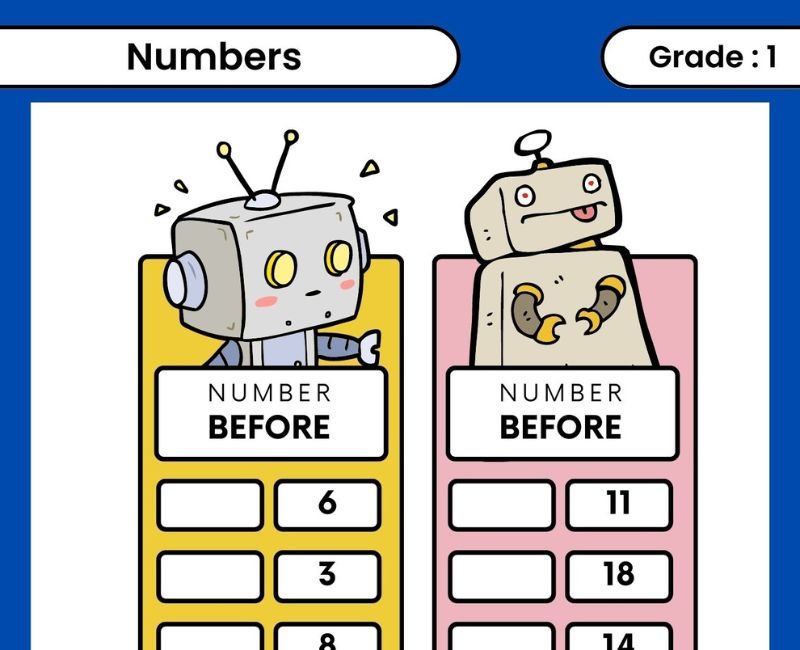
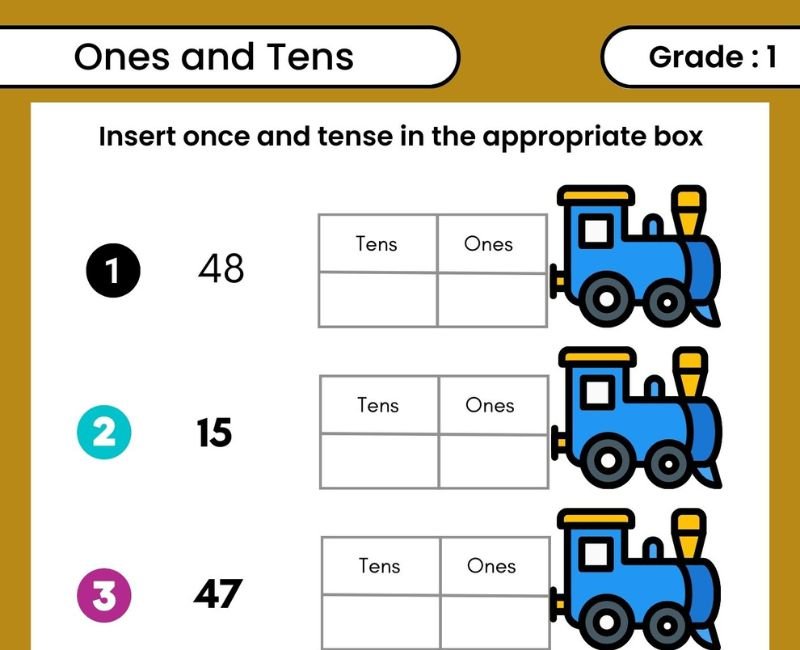
Numbers 1 to 9 Worksheet: Build confidence in recognising numbers and counting objects. Numbers 1 to 20 Worksheet: Strengthen counting skills for simple sums. Before and After Numbers Worksheet: Practise moving forwards and backwards in number order. Tens and Ones Worksheet: Prepare for two-digit addition and subtraction. Comparing Numbers Worksheet: Explore greater than, less than and equal quantities. Browse Class 1 Maths Worksheets: Find more topics for classroom practice and revision.Frequently Asked Questions
How do I explain addition to a Class 1 child?
Make two small groups of objects, join them and count the total. Then write the matching addition sentence. For example, two counters joined with three counters make five: 2 + 3 = 5.
How can children learn subtraction using pictures?
Draw a group of objects, cross out the number being removed and count those remaining. To show 6 - 2, draw six circles, cross out two and count the four that remain.
What is the difference between counting all and counting on?
Counting all means counting every object from one. Counting on means starting with a known quantity and counting only the objects added. For 5 + 2, counting on gives six, seven.
Should children use their fingers to solve sums?
Fingers can help children represent small quantities and keep track of counting steps. Counters, drawings and number lines provide other ways to show the same calculation.
What happens when we add or subtract zero?
Adding zero or subtracting zero leaves the number unchanged. For example, 8 + 0 = 8 and 8 - 0 = 8. Subtracting a number from itself gives zero: 8 - 8 = 0.
How do children decide whether to add or subtract in a word problem?
Ask children to describe or act out the situation. Joining groups can be represented by addition, while removing objects can be represented by subtraction. Focus on what the story means rather than choosing an operation from one word alone.
Where can I find answers to the additional practice questions?
Open the answer section beneath the extra questions in this description. These answers correspond to the online practice questions listed above.
 Download