CBSE Class 10 Mathematics • Chapter 9
Some Applications of Trigonometry Class 10 Worksheet
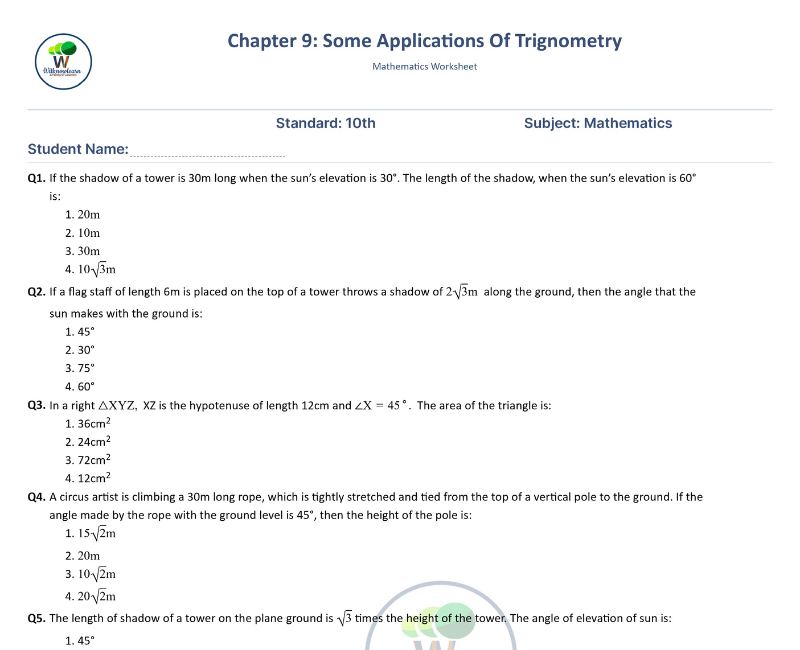
Practise heights and distances using angles of elevation and depression. Follow worked examples, solve case-based questions and revise the formulas needed to turn a word problem into a right triangle.
This Some Applications of Trigonometry Class 10 worksheet helps you apply trigonometric ratios to situations involving towers, buildings, ladders, shadows and observation points. The first step is understanding the geometry: identify the horizontal distance, vertical height and line of sight before choosing a formula.
Use the worksheet available on this page alongside the original examples, MCQs and extra questions below. For Class 10 Applications of Trigonometry, a clearly labelled sketch can help you avoid confusing a horizontal distance with a sloping length or overlooking the observer’s eye height.
Some Applications of Trigonometry: Introduction
Trigonometry can calculate a height or distance that is difficult to measure directly. For example, if the horizontal distance from a tower and the angle of elevation of its top are known, the tower’s height can be found using the tangent ratio.
Three Important Terms
Line of sight: The straight line joining the observer’s eye to the point being viewed.
Angle of elevation: The angle between the horizontal through the observer’s eye and an upward line of sight.
Angle of depression: The angle between the horizontal through the observer’s eye and a downward line of sight.
For the same line of sight, the angle of depression from the higher point equals the angle of elevation from the lower point when the horizontal reference lines are parallel. This follows from alternate interior angles.
Some Applications of Trigonometry Class 10 Formula Sheet
Let θ be the acute angle made by a sloping line with the horizontal. Let h be the vertical difference between its endpoints, d the horizontal distance and L the sloping length.
| Relationship | Formula | Useful When |
|---|---|---|
| Tangent ratio | tan θ = h/d | Vertical and horizontal distances are involved. |
| Vertical difference | h = d tan θ | Horizontal distance and angle are known. |
| Horizontal distance | d = h/tan θ | Vertical difference and angle are known. |
| Sine ratio | sin θ = h/L | A ladder, wire or line-of-sight length is involved. |
| Cosine ratio | cos θ = d/L | Horizontal distance and sloping length are involved. |
| Object height above level ground | H = e + d tan θ | The observer’s eye height is e and the object’s top is above eye level. |
| Angle | sin θ | cos θ | tan θ |
|---|---|---|---|
| 30° | 1/2 | √3/2 | 1/√3 |
| 45° | 1/√2 | 1/√2 | 1 |
| 60° | √3/2 | 1/2 | √3 |
Some Applications of Trigonometry Class 10 Solved Examples
Example 1: Find the Height of a Tower
Question: From a point on level ground 20√3 metres from the foot of a vertical tower, the angle of elevation of its top is 30°. Find the height. Treat the observation point as being at ground level.
Let the tower’s height be h metres.
tan 30° = h/(20√3)
1/√3 = h/(20√3)
h = 20√3 × 1/√3
h = 20 metres
Example 2: Include the Observer’s Eye Height
Question: A student’s eyes are 1.5 metres above level ground. Standing 18 metres from a vertical building, the student sees its top at an angle of elevation of 45°. Find the building’s height.
Let the building’s height be H metres.
Height above eye level = H − 1.5
tan 45° = (H − 1.5)/18
1 = (H − 1.5)/18
H − 1.5 = 18
H = 19.5 metres
The tangent calculation gives the height above the observer’s eyes. Add the eye height to obtain the full building height.
Example 3: Find a Ladder’s Length
Question: A ladder makes an angle of 60° with horizontal ground and reaches 6√3 metres up a vertical wall. Find its length.
Let the ladder’s length be L metres.
sin 60° = 6√3/L
√3/2 = 6√3/L
L = 6√3 × 2/√3
L = 12 metres
The ladder is the hypotenuse. Its length is greater than the vertical height reached.
Example 4: Use an Angle of Depression
Question: From a point 24 metres vertically above level ground, the angle of depression to a ground point is 30°. Find the horizontal distance to that point.
The corresponding angle of elevation is 30°.
Let the horizontal distance be d metres.
tan 30° = 24/d
1/√3 = 24/d
d = 24√3 metres
Some Applications of Trigonometry Class 10 Case-Based Questions
Case Study: Two Observation Points
Two ground-level points P and Q lie on the same straight line and on the same side of a vertical tower. Q is 20 metres closer to the tower than P. The angles of elevation of the top are 30° from P and 60° from Q.
1. Form the equations.
Let the distance from Q to the tower’s foot be x metres.
The distance from P is (x + 20) metres.
Let the tower’s height be h metres.
From Q:
tan 60° = h/x
h = x√3
From P:
tan 30° = h/(x + 20)
h = (x + 20)/√3
2. Find the nearer distance.
x√3 = (x + 20)/√3
3x = x + 20
2x = 20
x = 10 metres
3. Find the tower’s height.
h = 10√3
Height = 10√3 metres
4. Find the farther distance.
x + 20 = 30
Distance from P = 30 metres
The nearer point has the larger angle of elevation, which agrees with the geometry.
Some Applications of Trigonometry Class 10 MCQ with Answers
1. Which ratio directly connects height and horizontal distance?
A. sin θ B. cos θ C. tan θ
Answer: C. tan θ. It equals vertical difference divided by horizontal distance.
2. A tower’s height equals its shadow length. What is the Sun’s elevation?
A. 30° B. 45° C. 60° D. 90°
Answer: B. 45°. tan θ = height/shadow = 1.
3. An angle of depression is measured from which reference?
A. The vertical through the observer
B. The horizontal through the observer’s eye
C. The ground directly below the object
Answer: B. Measure downward from the horizontal to the line of sight.
4. A 10-metre ladder makes a 30° angle with the ground. How high does it reach?
A. 5 m B. 10 m C. 5√3 m D. 20 m
Answer: A. 5 metres. Height = 10 sin 30° = 5 metres.
Extra Questions for Class 10 Applications of Trigonometry
These original practice questions assume level ground and vertical structures. Treat the observation point as ground level unless an eye height is specified.
- A tower is viewed at 45° from a point 16 metres from its foot. Find its height.
- A pole’s shadow is 12√3 metres long when the Sun’s elevation is 30°. Find the pole’s height.
- A 20-metre ladder makes a 60° angle with the ground. Find the vertical height reached.
- From a point 15 metres above the ground, the angle of depression to a ground point is 45°. Find the horizontal distance.
- An observer’s eyes are 1.6 metres above the ground. The top of a building 10 metres away is seen at 45°. Find the building’s height.
Check the Practice Answers
- 16 metres.
- 12 metres.
- 10√3 metres.
- 15 metres.
- 11.6 metres.
Using This Worksheet with NCERT Exercise 9.1
For Some Applications of Trigonometry Class 10 Exercise 9.1, practise translating every statement into a labelled right triangle. Mark the right angle, horizontal reference and given distances before writing an equation.
Use this worksheet alongside Some Applications of Trigonometry Class 10 NCERT solutions, Exemplar problems and sample papers. When practising PYQs or using a previous year questions PDF, check the board and examination year. The worked examples above are additional original practice questions.
To make a useful Some Applications of Trigonometry Class 10 mind map, organise your revision around angle definitions, ratio selection, standard values, observer height and two-point problems. Then solve one example from each branch.
Common Mistakes to Avoid
- Measuring elevation or depression from the vertical.
- Using sloping distance as the horizontal distance.
- Forgetting to add the observer’s eye height.
- Adding distances when two points require subtraction, or vice versa.
- Using tan when the given length is the hypotenuse.
- Mixing centimetres and metres in the same equation.
- Rounding √3 too early in a multi-step calculation.
FAQs on Some Applications of Trigonometry Class 10
What are some applications of trigonometry?
Trigonometry can find heights and distances using measured angles. Class 10 examples include tower heights, shadow lengths, ladder lengths and distances viewed from buildings or lighthouses.
What is the difference between elevation and depression?
An angle of elevation is measured upward from the observer’s horizontal line. An angle of depression is measured downward from it. Both use the horizontal through the observer’s eye.
Why are the corresponding elevation and depression angles equal?
The horizontal lines through the two observation points are parallel. The line of sight acts as a transversal, making the corresponding elevation and depression angles alternate interior angles.
When should I use sin, cos or tan?
Use tan for vertical and horizontal distances, sin for vertical distance and hypotenuse, and cos for horizontal distance and hypotenuse. Choose the ratio containing the known side and the side you need to find.
Why is the observer’s height added in some questions?
The triangle gives the height difference between the observer’s eyes and the object’s top. On level ground, add the eye height to this difference to obtain the object’s full height.
How do I solve a problem with two observation points?
Use the same unknown height in two tangent equations. If the points lie on the same side, the farther distance is the nearer distance plus their separation. If the tower lies between them, the two horizontal distances add to the separation.
Does the angle of elevation increase when I move closer?
Yes, for the same fixed top point above eye level, with unchanged eye height on level ground. The vertical difference stays fixed while the horizontal distance decreases, so the angle increases.
Is a ladder or kite string the height?
Usually it is the sloping hypotenuse, not the vertical height. A straight ladder making angle θ with the ground reaches height L sin θ. For a kite, account for the hand height and assume a straight, taut string only when the question allows it.
How should I use a worksheet or test paper with solutions?
Attempt the questions first. Check your sketch, chosen ratio, equation and final units against the solution. Reattempt mistakes without looking at the answer.
What is the chapter’s board-exam weightage?
Use the official assessment information and sample paper for your board and examination year. Do not assume a fixed mark total for this chapter in every paper. Prepare direct calculations and case-based applications.
Can I use these examples with RD Sharma or NCERT Exemplar?
Yes. The ratio-selection and equation-formation methods apply to similar height-and-distance problems. Match your practice to the assigned syllabus and follow any method specified in the question.
Are KSEEB solutions and CBSE NCERT solutions interchangeable?
Match solutions to your textbook’s exact question and exercise numbering. The underlying trigonometry may be the same, but different boards or editions can organise questions differently.
 Download