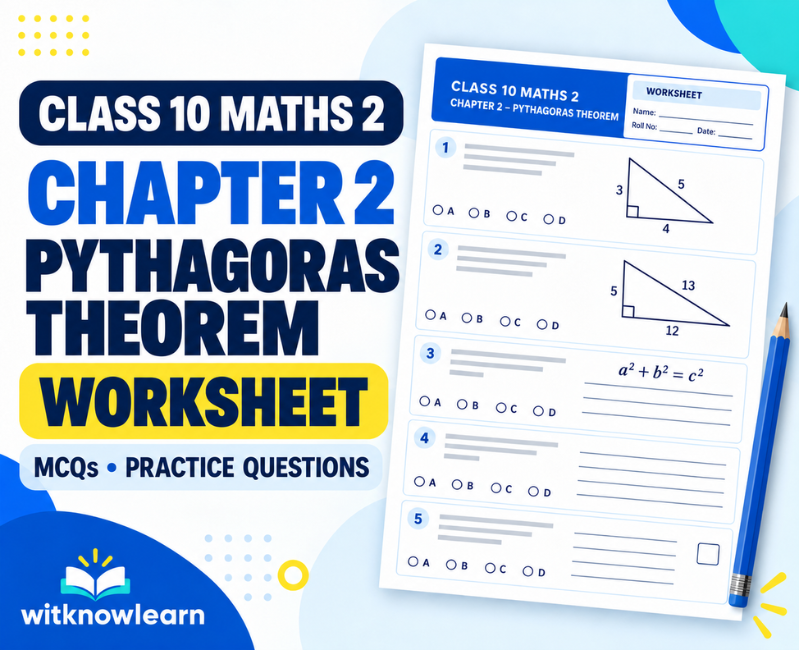
Class 10 Maths 2 Chapter 2 Pythagoras Theorem Worksheet
Strengthen your preparation with the Maharashtra Board Class 10 Maths 2 Chapter 2 Pythagoras Theorem Worksheet. Practise MCQs, missing-side calculations, Pythagorean triplets, theorem applications and board-exam-style questions.
Class 10 Pythagoras Theorem Worksheet
This Class 10 Pythagoras Theorem worksheet is designed for Maharashtra State Board students who need structured practice after learning Chapter 2. It begins with concept-based multiple-choice questions and progresses to numerical problems, geometrical applications and board-exam-style questions.
Students practise identifying the perpendicular side, base and hypotenuse; finding unknown lengths; checking whether a triangle is right-angled; and using Pythagorean triplets. Each longer question should be solved one mathematical step per line so that the method is clear and easy to verify.
Right-Angled Triangles
Identify the right angle and the side opposite it before selecting and applying the appropriate formula.
Missing Side Lengths
Calculate an unknown side using squares, subtraction and positive square roots.
Converse Theorem
Compare the square of the longest side with the sum of the squares of the other two sides.
Important Pythagoras Theorem Rules
The Pythagoras theorem applies only to a right-angled triangle. The hypotenuse is the side opposite the right angle and is always the longest side of the triangle.
- The hypotenuse is always opposite the right angle.
- The hypotenuse is the longest side of a right-angled triangle.
- Use the positive square root because the length of a side cannot be negative.
- For the converse theorem, identify and square the longest side separately.
- Compare the square of the longest side with the sum of the squares of the other two sides.
- Common Pythagorean triplets include 3, 4, 5; 5, 12, 13; 7, 24, 25; and 8, 15, 17.
Questions Included in the Worksheet
Multiple-Choice Questions
The MCQ section checks important concepts such as identifying the hypotenuse, selecting the correct theorem statement, recognising Pythagorean triplets and choosing the correct calculation.
Find the Unknown Side
Students use the Pythagoras theorem to calculate the hypotenuse or one of the shorter sides. They must substitute the values correctly, simplify the squares and take the positive square root.
Converse of Pythagoras Theorem
These questions require students to determine whether three given side lengths form a right-angled triangle. Students first identify the longest side and then compare both sides of the required relationship.
Pythagorean Triplets
Students identify familiar Pythagorean triplets and verify whether the given numbers satisfy a² + b² = c². This improves calculation speed during examinations.
Application Problems
Questions involving ladders, poles, diagonals, rectangular fields and shortest distances connect the theorem with practical measurements.
Board-Exam Practice
Mixed board-exam-style questions develop theorem selection, logical presentation, accurate calculation and the correct geometrical conclusion.
How to Solve the Pythagoras Theorem Worksheet
- Draw or study the triangle and mark the right angle.
- Identify the hypotenuse as the side opposite the right angle.
- Write the Pythagoras theorem before substituting the values.
- Substitute all measurements using the same unit.
- Calculate every square correctly and show one step per line.
- Transpose carefully when calculating one of the shorter sides.
- Take the positive square root of the final squared value.
- Write the final answer with the correct unit and conclusion.
Benefits of Practising This Worksheet
- Revises the complete Pythagoras Theorem chapter in a structured format.
- Improves understanding of the hypotenuse and right-angle position.
- Provides practice in calculating unknown side lengths.
- Strengthens the application of the converse theorem.
- Develops confidence in solving practical word problems.
- Improves the presentation of complete mathematical working.
- Supports school tests, prelims and Maharashtra SSC Board examination preparation.
Common Mistakes Students Should Avoid
- Do not select the longest-looking side without checking the position of the right angle.
- Do not write c = a² + b². The correct relation is c² = a² + b².
- Do not add all three squared sides when calculating a shorter side.
- Do not apply the converse theorem without first identifying the longest side.
- Do not take the square root before completing the calculation involving squares.
- Do not write a negative value as the length of a side.
- Do not omit the unit from the final answer.
- Check every square and square-root calculation before writing the conclusion.
Check Your Work with Chapter 2 Solutions
Attempt every worksheet question independently and show complete working. After completing the worksheet, compare your method, mathematical steps and final answers with the complete Chapter 2 Pythagoras Theorem solutions.
View Chapter 2 Solutions →Frequently Asked Questions
Select any question to view its answer.
What does the Chapter 2 worksheet cover?
How do I identify the hypotenuse?
What is the Pythagoras theorem formula?
What is the converse of the Pythagoras theorem?
What is a Pythagorean triplet?
Does this worksheet contain MCQs?
Is this worksheet useful for Maharashtra SSC preparation?
How should I write a Pythagoras theorem solution?
When should I check the Chapter 2 solutions?
How many times should I practise this worksheet?
 Download