CLASS 10 MATHEMATICS • INTERACTIVE PRACTICE
Introduction to Trigonometry
Worksheet with Online Quiz
Understand the sides, choose the ratio and build the proof. Practise with a timed quiz and interactive right-triangle activities.
Trigonometric Ratios
Identify opposite, adjacent and hypotenuse before choosing a ratio.
Explore right-triangle games →Standard Angles
Connect exact values with 0°, 30°, 45°, 60° and 90°.
Test your standard values →Trigonometric Identities
Use identities, repair errors and explain each algebraic step.
Build your reasoning →Introduction to Trigonometry Online Quiz for Class 10
Question 1 of 20 • Easy • Answered 0/20
In a right triangle, opposite = 13 and hypotenuse = 85. Find sin θ.
Quiz instructions
Answer 10 easy, five average and five HOTS questions. Selecting an answer opens the next question. The timer starts with your first answer or question navigation. Revisit answers using Previous or the numbered buttons.
One mark per correct answer, no negative marking. Answers and explanations appear after submission or timeout.
Trigonometry Online Games for Class 10
Find the Right Side
Select a side on the diagram or use its side button.
△ABC is right-angled at B. Select its hypotenuse.
Selected side: None
How to use the games
Use the raised selector to choose one of five games. Every set contains five questions. Each selected question keeps its diagram and controls together.
Trigonometry Online Activities for Class 10
How to use the activities
Choose a set and enter exact answers. Use fractions such as 7/2 or radicals such as √3/2 and sqrt(3)/2. Entries remain saved as you move between sets.
Trigonometry Extra Online Practice for Class 10
Formula Reference Explorer
Read the reference and apply it to a new example.
Reference: sin θ = opposite/hypotenuse. Opposite = 20, adjacent = 99, hypotenuse = 101. Find sin θ and cos θ.
Enter a fraction, decimal or radical, such as 7/2, √3/2 or sqrt(3)/2.
About the extra practice
Five additional sets each contain five tasks: reference exploration, written calculations, scale models, reasoning and mathematical construction.
Trigonometry Revision Tips for Students
- Mark the right angle and reference angle before naming the sides.
- The hypotenuse stays fixed when the reference angle changes; opposite and adjacent can swap.
- Learn sin, cos and tan first, then use reciprocals for cosec, sec and cot.
- Write exact standard values and square the whole ratio when required.
- Keep denominators nonzero. “Not defined” is different from zero.
- Use one identity or algebraic operation per written line.
- Cancel factors rather than separate terms in a sum.
- Check the acute-angle condition before choosing a positive square root.
Trigonometry Tips for Parents and Teachers
- Ask learners to name the reference angle before choosing a ratio.
- Compare enlarged right triangles to show why ratios depend on the angle.
- Discuss why sine and cosine lie between zero and one for acute angles.
- Ask for the reason behind each proof-card step.
- Use a wrong example to distinguish a single-angle check from an identity proof.
Introduction to Trigonometry Class 10 Worksheet Guide
This Introduction to Trigonometry Class 10 worksheet page connects right-triangle diagrams with exact calculations. Fix the reference angle, identify the opposite side, adjacent side and hypotenuse, then choose the relationship that matches the information given.
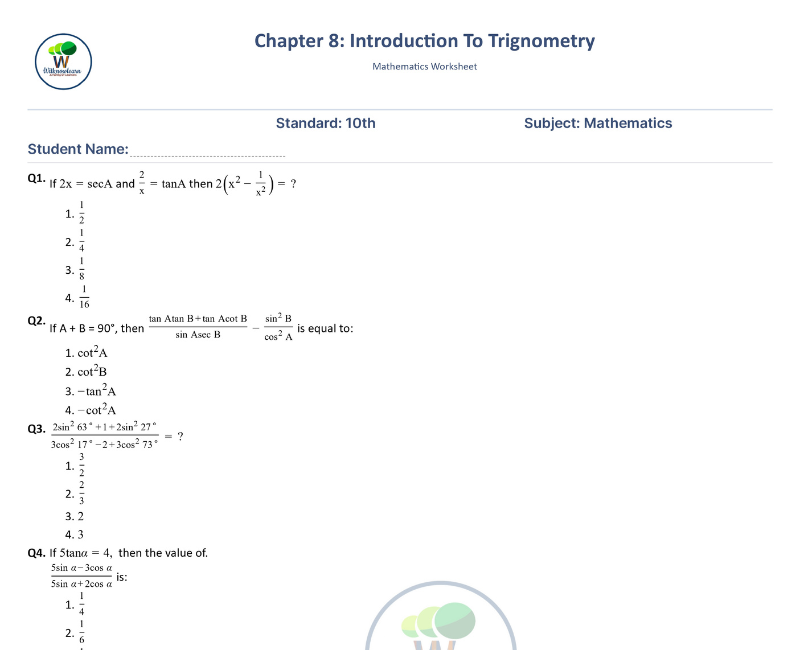
Use the online quiz to check your understanding, then practise with matching games, angle sliders and proof cards. For written work, use the existing worksheet download option on this page. The examples and extra questions below are original revision material.
Class 10 Trigonometry Important Questions for Exam Practice
Organise your revision around four useful question types: finding ratios from side lengths, finding other ratios from one given ratio, evaluating standard-angle expressions, and simplifying or proving identities. Practise explaining the method as well as obtaining the answer.
- Ratio questions: draw a right triangle, label the reference angle and use Pythagoras to find a missing side.
- Standard-value questions: substitute exact values first, then apply powers and arithmetic in order.
- Identity questions: transform one side through valid equalities using identities and factorisation.
- Reasoning and HOTS questions: combine relationships, justify a positive square root or give a counterexample to a false statement.
Trigonometry Question Types in Official CBSE Sample Papers
The 2024–25 Mathematics Standard sample paper includes a rational expression evaluated from a given tangent ratio. The 2025–26 sample paper includes a question linking sec θ + tan θ with sec θ − tan θ. These are official sample-paper examples, rather than a frequency ranking of actual board-exam questions.
Original practice: evaluate an expression from tan θ
For acute θ, tan θ = 3/2. Find (2sin θ + cos θ)/(2sin θ − cos θ).
Divide numerator and denominator by cos θ.
= (2tan θ + 1)/(2tan θ − 1)
= (2 × 3/2 + 1)/(2 × 3/2 − 1)
= (3 + 1)/(3 − 1)
= 4/2
= 2
Current CBSE Trigonometry Syllabus: What to Revise
The official CBSE Class 10 Mathematics syllabus for 2026–27 includes acute-angle ratios, defined endpoint values at 0° and 90°, standard values at 30°, 45° and 60°, relationships between ratios, and simple trigonometric identities. Its 12-mark Trigonometry unit includes both Introduction to Trigonometry and Heights and Distances; 12 marks is not a separate allocation to this chapter.
Introduction to Trigonometry Class 10 Formula Sheet
For an acute angle θ, let O be the opposite leg, A the adjacent leg and H the hypotenuse.
- sin θ = O/H; cos θ = A/H; tan θ = O/A.
- cosec θ = H/O; sec θ = H/A; cot θ = A/O.
- tan θ = sin θ/cos θ and cot θ = cos θ/sin θ wherever defined.
sin² θ + cos² θ = 1
1 + tan² θ = sec² θ
1 + cot² θ = cosec² θ
These identities hold wherever their expressions are defined. In an acute right triangle, all six ratios are positive. Sine and cosine are less than one because a leg is shorter than the hypotenuse.
Introduction to Trigonometry Class 10 Table of Standard Values
Use exact values for 0°, 30°, 45°, 60° and 90°. Read “Not defined” carefully: it does not mean zero.
| Ratio | 0° | 30° | 45° | 60° | 90° |
|---|---|---|---|---|---|
| sin θ | 0 | 12 | 1√2 | √32 | 1 |
| cos θ | 1 | √32 | 1√2 | 12 | 0 |
| tan θ | 0 | 1√3 | 1 | √3 | Not defined |
| cosec θ | Not defined | 2 | √2 | 2√3 | 1 |
| sec θ | 1 | 2√3 | √2 | 2 | Not defined |
| cot θ | Not defined | √3 | 1 | 1√3 | 0 |
The endpoint values at 0° and 90° extend the acute-angle ratios. They do not describe ordinary right triangles with those angles as acute reference angles.
Class 10 Trigonometry Examples with Solutions
Example 1: Find ratios from two sides
△ABC is right-angled at B. AB = 16 cm and BC = 30 cm. Find sin A and cos A.
AC² = AB² + BC²
AC² = 16² + 30²
AC² = 256 + 900
AC² = 1156
AC = 34 cm
For angle A, opposite = 30, adjacent = 16 and hypotenuse = 34.
sin A = 30/34
sin A = 15/17
cos A = 16/34
cos A = 8/17
Example 2: Evaluate standard-angle values
Evaluate 2cos² 45° + sin 30°.
= 2 × (1/√2)² + 1/2
= 2 × 1/2 + 1/2
= 1 + 1/2
= 3/2
Square the cosine value before multiplying by 2.
Example 3: Simplify with an identity
For acute θ, simplify (cosec² θ − 1)/cot θ.
cosec² θ − 1 = cot² θ
(cosec² θ − 1)/cot θ = cot² θ/cot θ
= cot θ
The cancelled factor cot θ is nonzero for an acute angle.
Introduction to Trigonometry Class 10 Extra Questions with Answers
- For acute θ, sin θ = 11/61. Find sec θ and cot θ.
View answer and method
The adjacent leg is √(61²−11²) = 60, up to scale. Therefore sec θ = 61/60 and cot θ = 60/11.
- Evaluate cos² 45° + 3sin² 30°.
View answer and method
The value is 1/2 + 3×1/4 = 5/4.
- For acute θ, tan θ = 15/8. Find cosec θ.
View answer and method
Opposite and adjacent are proportional to 15 and 8. The hypotenuse is proportional to 17, so cosec θ = 17/15.
- For acute θ, sec² θ = 121/81. Find tan² θ.
View answer and method
tan² θ = sec² θ−1 = 121/81−1 = 40/81.
- For acute θ, sin θ + cos θ = 6/5. Find sin θ cos θ.
View answer and method
Squaring gives 36/25 = 1+2sin θ cos θ. Hence sin θ cos θ = 11/50.
When proving a trigonometric identity, transform one side through valid equalities. Checking one angle only tests one case. Match exercise numbers to your own textbook edition, and use the separate Applications of Trigonometry resource for further height-and-distance practice.
Related Class 10 Maths Worksheets and Revision
Introduction to Trigonometry Class 10 FAQs
How do I identify opposite and adjacent sides?
Choose the reference angle first. The opposite side faces it. The adjacent leg touches it and is not the hypotenuse.
How can I find all trigonometric ratios when one ratio is given?
For an acute angle, represent the given ratio by proportional sides, find the third side with Pythagoras and form the remaining ratios. If tan θ = 8/15, choose opposite = 8k and adjacent = 15k. The hypotenuse is 17k, so sin θ = 8/17 and cos θ = 15/17.
How do I remember sin, cos and tan?
Use SOH–CAH–TOA: sine is opposite/hypotenuse, cosine is adjacent/hypotenuse and tangent is opposite/adjacent.
How do I learn the Class 10 trigonometry table easily?
For angles 0°, 30°, 45°, 60°, 90° in that order, sine values are √0/2, √1/2, √2/2, √3/2 and √4/2. Reverse the list for cosine. Divide sine by cosine for tangent, checking for a zero denominator. Use reciprocals for the other ratios only where defined.
Can sine or cosine exceed one for an acute angle?
No. Each divides a leg by the longer hypotenuse, so its value lies strictly between zero and one. Tangent can exceed one.
Why is tan 90° not defined?
Tangent is sin θ/cos θ. At 90°, the denominator is zero, so the quotient is not defined.
How do I prove trigonometric identities in Class 10?
Start with the more complicated side. Rewrite reciprocal ratios if helpful, use sin² θ + cos² θ = 1 or its related identities, and factorise before cancelling. Write each equality on a separate line until you reach the other side. Keep every denominator nonzero.
What does sin² θ mean?
It means (sin θ)². Find the sine value and then square it. It does not mean sin(θ²).
What are the three main identities?
sin² θ+cos² θ=1, 1+tan² θ=sec² θ and 1+cot² θ=cosec² θ. Apply them only where the expressions are defined.
Which trigonometry important questions should I practise for Class 10?
Practise missing-side and ratio calculations, finding ratios from one given ratio, standard-value expressions, simple identity proofs and mixed reasoning questions. The guide above includes official sample-paper references and original practice. These question types support revision and do not predict a future paper.
What is the difference between Introduction to Trigonometry and Applications of Trigonometry?
Introduction to Trigonometry builds ratios, standard values and identities. Applications of Trigonometry uses those ideas to solve heights-and-distances problems involving angles of elevation or depression. Practise ratio selection here before moving to the applications worksheet.
How should I use the online practice with the worksheet?
Complete a set, explain the method in your notebook and use the existing download option for further written practice. Return to the quiz to review progress.
Ready for Your Next Trigonometry Challenge?
Choose the angle, identify the sides and explain the reason behind your answer.
Go to Trigonometry Online Quiz Download