CLASS 10 SCIENCE • THE COLOUR OF CHEMISTRY
Acids Bases and Salts Worksheet
with Online Quiz and Activities
Explore the pH scale, predict indicator colours and connect everyday salts to their formulas. Learn through interactive models, clear diagrams and scientific reasoning.
Explore the Colour Scale
Move the pH slider and predict how litmus responds.
⚗Connect the Evidence
Read labelled models of gas tests, electrolysis and hydration.
✓Explain the Chemistry
Balance equations, identify salts and correct common misconceptions.
Acids Bases and Salts Online Quiz
Question 1 of 20 • Easy • Answered 0/20
Which ion is commonly used to represent acidic behaviour in water?
Quiz instructions
20 questions in 20 minutes, with 10 easy, five average and five HOTS questions. The timer starts with your first answer or navigation. Answers advance to the next question except at the final question. Revisit answers before submission. One mark per correct answer, no negative marking. Explanations appear after submission or timeout.
Interactive Acids Bases and Salts Games
pH Explorer Challenge
Move the slider. The colour is illustrative; the numerical pH determines the classification at 25 °C.
Set pH to three units below neutral pH 7.
Illustrative indicator colours, not a calibrated colour chart.
Virtual Chemistry Activities
How to use these activities
Choose a topic from the raised selector. Predict answers before revealing the result diagram. Entries remain available while this page stays open. Selecting an activity closes the open game and keeps its progress. These are virtual learning models; real experiments follow teacher-led laboratory procedures.
Extra Questions and Reasoning Practice
Balance the Chapter Equations
Enter the smallest positive whole-number coefficients in the displayed order.
Zn + HCl → ZnCl₂ + H₂
Enter a numerical answer without units.
Each of the 15 sets contains five tasks. Use Reset options to restart one question or an entire set.
Eight Revision Tips for Students
- Distinguish an acid from an alkali using appropriate evidence.
- Record the initial colour of litmus before describing a change.
- Use pH numbers rather than colour alone for comparisons.
- Remember that strength and concentration are different properties.
- Recognise H₂ from suitable metal–acid reactions and CO₂ from carbonate–acid reactions.
- Learn common salt names together with their formulas.
- Read the dot-water part of a hydrate carefully.
- Do not assume every salt or every acid–base mixture has pH 7.
Five Teaching Tips for Parents and Teachers
- Ask what a single indicator result can and cannot establish.
- Compare dry and moist litmus in the virtual model.
- Discuss why dilution moves pH toward neutral without changing an acid into a base.
- Separate the products and locations in the chlor-alkali diagram.
- Use an incorrect salt formula as a prompt for explanation rather than recall alone.
Acids Bases and Salts Class 10 Notes and Solved Questions
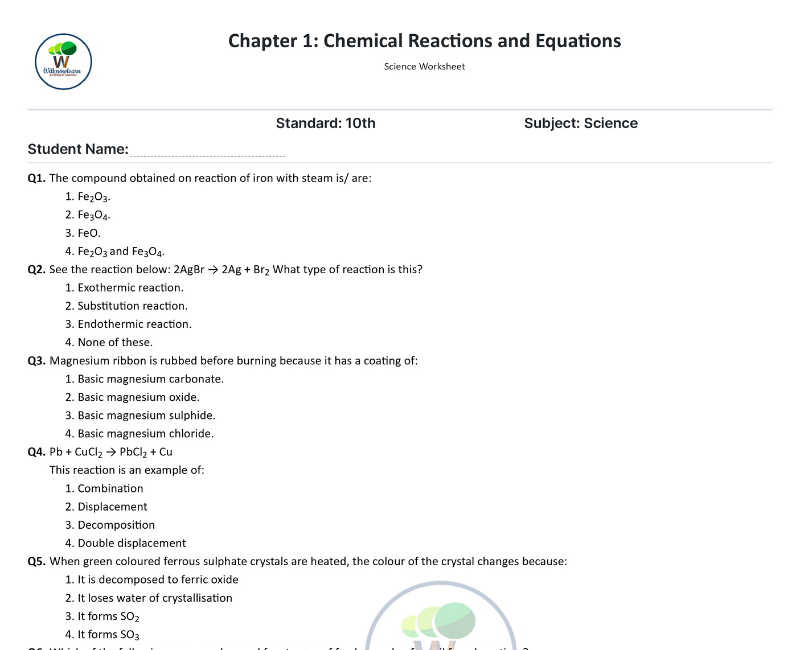
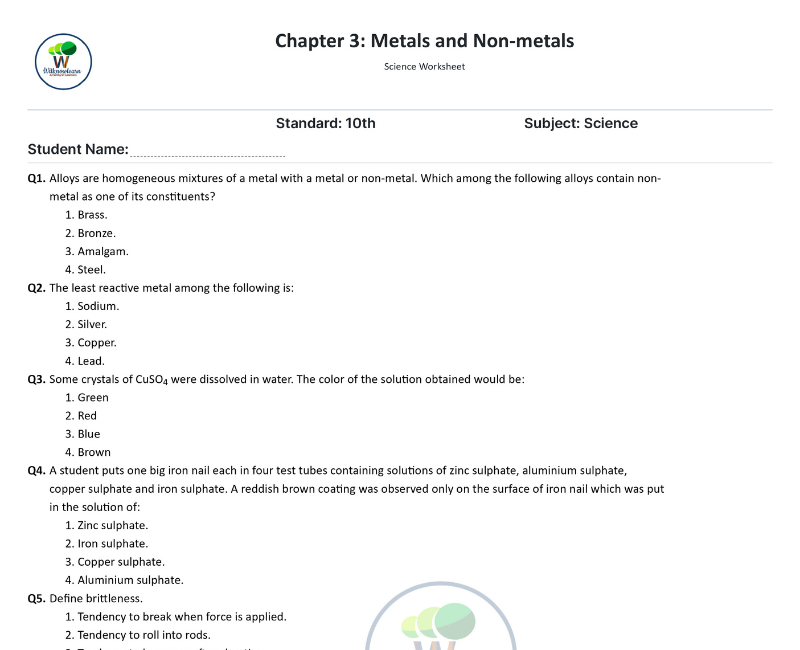
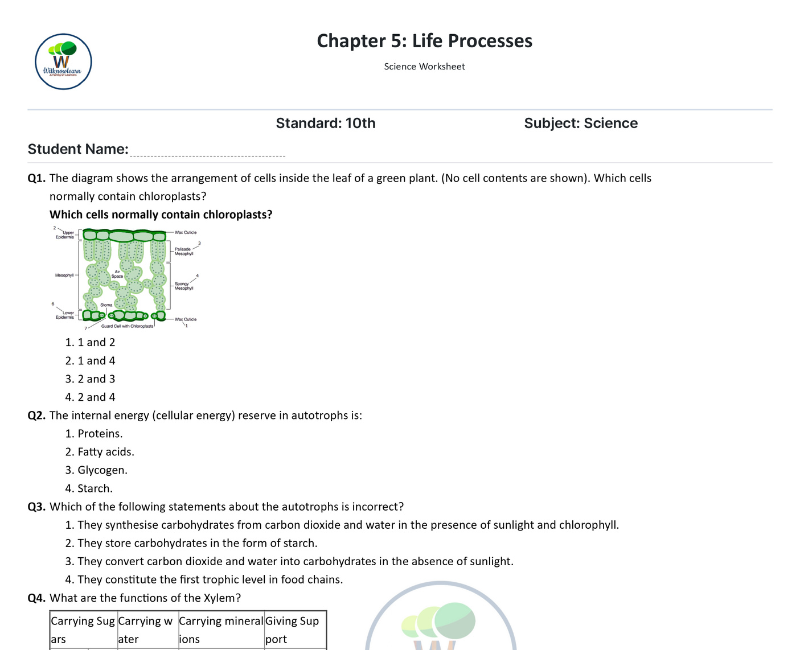
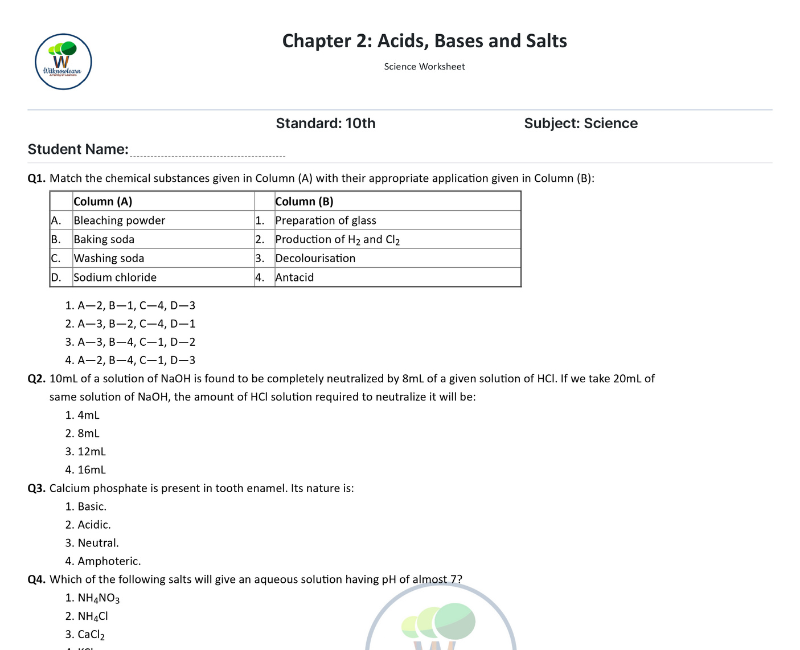
This Acids Bases and Salts Class 10 worksheet page combines written revision with a timed online quiz, interactive games and diagram-based activities. Practise indicators, pH, acid reactions, neutralisation, important salts and water of crystallisation. Use the existing worksheet download for written work, then check your reasoning through the activities above.
Acids Bases and Salts Class 10 Short Notes
In aqueous solutions, acids such as HCl form hydronium ions, H₃O⁺, often written as H⁺ in school equations. Bases such as NaOH furnish hydroxide ions, OH⁻. An alkali is a water-soluble base. Glucose contains hydrogen but does not ionise as an acid in water, so the presence of hydrogen in a formula is not enough to identify an acid.
Acids Bases and Salts Indicator Colour Chart
| Indicator | Acidic solution | Basic solution |
|---|---|---|
| Blue litmus | Turns red | Stays blue |
| Red litmus | Stays red | Turns blue |
| Phenolphthalein | Colourless | Pink in a sufficiently basic solution |
| Methyl orange | Red in sufficiently acidic solution | Yellow |
| Turmeric | Remains yellow | Reddish-brown |
Indicators have transition ranges. Methyl orange changes from red through orange to yellow around its acidic transition range; it is yellow in a neutral pH 7 solution. Neutral solution leaves red and blue litmus paper unchanged. An unchanged red strip alone does not prove neutrality.
pH Scale Class 10 Explained
At 25 °C, a neutral aqueous solution has pH 7. Lower values are acidic and higher values basic. For comparable solutions at the same temperature, a lower pH means a higher hydronium concentration. The usual school scale runs from 0 to 14, but this is not an absolute limit for every chemical solution. The slider colours are illustrative, not a calibrated indicator chart.
Worked pH Comparison
Samples A, B and C have pH 3, 7 and 11 at 25 °C.
A is acidic.
B is neutral.
C is basic.
A has the greatest hydronium concentration of these three.
The pH values alone do not tell us the total amount of acid in different volumes.
Strong and Weak Acids Versus Concentrated and Dilute Acids
Strength concerns the extent of ionisation under specified conditions. Concentration concerns how much solute is present per volume of solution. A weak acid can be concentrated and a strong acid can be dilute. Do not infer strength from concentration alone. Dilution with pure water reduces concentration; in the ideal school model acidic pH approaches 7 from below and basic pH approaches 7 from above.
Acids Bases and Salts Important Chemical Equations
| Reaction | Balanced example |
|---|---|
| Reactive metal and suitable dilute acid | Zn + 2HCl → ZnCl₂ + H₂ |
| Carbonate and acid | Na₂CO₃ + 2HCl → 2NaCl + H₂O + CO₂ |
| Hydrogencarbonate and acid | NaHCO₃ + HCl → NaCl + H₂O + CO₂ |
| Neutralisation | HCl + NaOH → NaCl + H₂O |
| Basic oxide and acid | CuO + 2HCl → CuCl₂ + H₂O |
| Heating baking soda | 2NaHCO₃ → Na₂CO₃ + H₂O + CO₂ |
The metal–acid rule has conditions and exceptions. Do not assume every metal reacts with every acid to release hydrogen. Final pH after an acid–base reaction depends on the substances, their concentrations and reacting amounts.
Carbon Dioxide and Limewater Case Study
Dilute acid reacts with sodium carbonate in a virtual gas-test model.
The gas formed is carbon dioxide.
CO₂ + Ca(OH)₂ → CaCO₃ + H₂O.
Insoluble calcium carbonate makes limewater milky.
With sufficient excess CO₂, soluble calcium hydrogencarbonate can form.
CaCO₃ + CO₂ + H₂O → Ca(HCO₃)₂.
The milkiness can then disappear.
Chlor Alkali Process Products and Uses
Electrolysis of brine, an aqueous sodium chloride solution, produces chlorine, hydrogen and sodium hydroxide.
2NaCl(aq) + 2H₂O(l) → 2NaOH(aq) + Cl₂(g) + H₂(g).
Anode, positive electrode, gives chlorine.
Cathode, negative electrode, gives hydrogen.
Sodium hydroxide is obtained in solution.
Industrial membrane cells keep products separated.
Examples of uses include sodium hydroxide in soap manufacture, chlorine in water treatment and hydrogen as a fuel or chemical feedstock.
Important Salts Class 10 Formula and Uses Table
| Common name | Formula | Example use |
|---|---|---|
| Baking soda | NaHCO₃ | Component of baking powder |
| Washing soda | Na₂CO₃·10H₂O | Softening hard water |
| Bleaching powder | Conventionally CaOCl₂ | Bleaching and disinfection |
| Plaster of Paris | CaSO₄·½H₂O | Moulds and plaster casts |
| Gypsum | CaSO₄·2H₂O | Starting material for Plaster of Paris |
Commercial bleaching powder has a more complex composition than its conventional school representation. Baking powder is a mixture containing baking soda and an edible acid; it is not another name for pure NaHCO₃.
Water of Crystallisation and Plaster of Paris
Water of crystallisation is the definite water content represented in a crystalline hydrate formula. Blue CuSO₄·5H₂O has five waters per formula unit; white anhydrous CuSO₄ has none. Washing soda has ten. Gypsum has two. Plaster of Paris has one-half per CaSO₄ unit, equivalent to one water for two CaSO₄ units.
Gypsum is heated under controlled conditions around 373 K.
CaSO₄·2H₂O → CaSO₄·½H₂O + 1½H₂O.
The product is Plaster of Paris.
On setting, the reverse hydration forms gypsum.
CaSO₄·½H₂O + 1½H₂O → CaSO₄·2H₂O.
Storage away from moisture prevents premature setting.
Acids Bases and Salts Important Questions and Scientific Reasons
- Why does dry HCl not affect dry blue litmus? Water is needed for the acidic ionic response.
- Why is acid added slowly to water during supervised dilution? Dilution releases heat, so adding water to concentrated acid can cause dangerous local heating and splashing.
- Why does a carbonate give a different gas from zinc with dilute HCl? The reaction products differ; carbonate gives CO₂ and zinc gives H₂.
- Why is every salt not neutral? Salt solutions depend on the acid and base from which the salt derives.
- Why does Plaster of Paris harden with water? Hydration forms gypsum.
Acids Bases and Salts Assertion and Reason Practice
Assertion says dry HCl does not change dry blue litmus to red. Reason says water enables HCl to produce hydronium ions. Both statements are true, and the reason explains the assertion. Always evaluate both statements before deciding whether the explanation follows.
Current Syllabus and Sample Paper Update
The official CBSE Science syllabus for 2026–27 lists indicators, acidic and basic ions, pH, neutralisation and the preparation and uses of important salts. The official Science sample paper includes a chlor-alkali product-and-use matching question. These original activities practise the underlying skills. No fixed chapter marks or question-repeat frequency is claimed here.
Related Class 10 Science Resources
Frequently Asked Questions
What is the difference between a base and an alkali?
A base can neutralise an acid. A water-soluble base is an alkali. Sodium hydroxide is an alkali; not every base dissolves in water.
What are the main indicator colour changes?
Acids turn blue litmus red; bases turn red litmus blue. Phenolphthalein is colourless in acid and pink in a sufficiently basic solution. Methyl orange is red in sufficiently acidic solution and yellow in basic solution.
What does pH 7 mean?
At 25 °C, pH 7 represents a neutral aqueous solution. Below 7 is acidic and above 7 basic. Neutral pH depends on temperature, so the stated condition matters.
Why does dry HCl not change dry blue litmus?
The dry test lacks water for the acidic ionic response. On moist litmus, HCl dissolves and forms hydronium ions, producing the red colour.
Are strong and concentrated acids the same?
No. Strength concerns ionisation, while concentration concerns solute amount per volume. A strong acid can be dilute and a weak acid concentrated.
What is the difference between baking soda and baking powder?
Baking soda is sodium hydrogencarbonate, NaHCO₃. Baking powder is a mixture containing baking soda and an edible acid that helps produce carbon dioxide.
What are the products of the chlor-alkali process?
Electrolysis of brine produces chlorine at the anode, hydrogen at the cathode and sodium hydroxide in solution.
Why does carbon dioxide turn limewater milky?
Carbon dioxide reacts with calcium hydroxide to form insoluble calcium carbonate. Sufficient excess carbon dioxide can form soluble calcium hydrogencarbonate and clear the milkiness.
What is water of crystallisation?
It is the definite water content represented in a crystalline hydrate formula. CuSO₄·5H₂O contains five waters per formula unit, while Na₂CO₃·10H₂O contains ten.
How is Plaster of Paris different from gypsum?
Plaster of Paris is CaSO₄·½H₂O and gypsum is CaSO₄·2H₂O. Controlled heating of gypsum makes Plaster of Paris; adding water during setting reforms gypsum.
Does neutralisation always produce a final pH of 7?
No. Final pH depends on acid and base strengths, concentrations and reacting amounts. Equal volumes alone do not guarantee neutrality.
Which questions should I practise in this chapter?
Practise indicator interpretation, pH comparisons, reaction equations, gas tests, chlor-alkali products, salt names and formulas, water of crystallisation and evidence-based explanations. Use verified examination papers for actual previous-year questions.
 Download