CLASS 10 SCIENCE • THE SIGNAL AND RESPONSE LAB
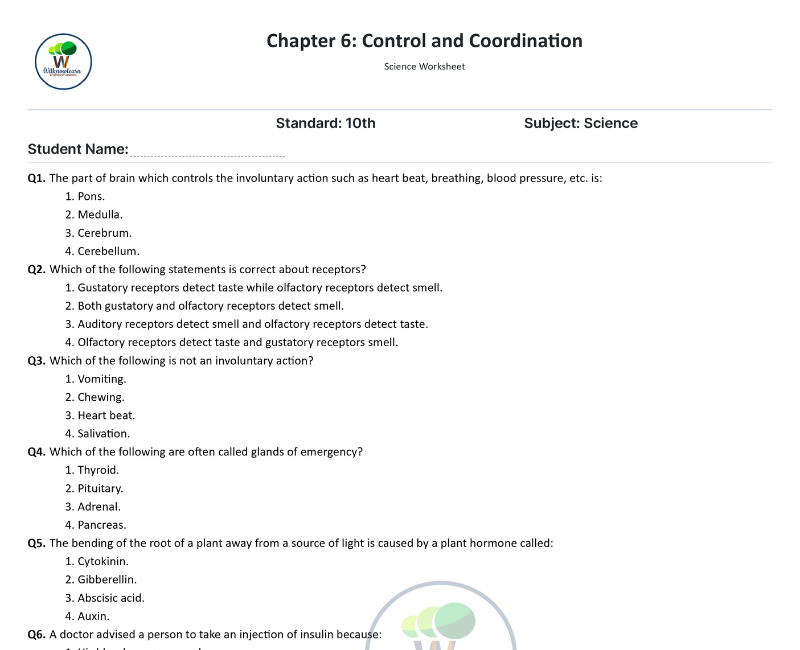
Control and Coordination Worksheet
with Online Quiz and Activities
Trace a nerve impulse, build a reflex pathway and bend a virtual shoot toward light. Connect the nervous system, plant responses and hormones through colourful diagrams and evidence-based challenges.
Follow the Signal
Explore neurons, synapses and a spinal withdrawal reflex.
🌱Explore the Response
Investigate shoot bending, brain functions and hormone feedback.
✓Explain the Evidence
Compare mechanisms and solve reasoning challenges.
Control and Coordination Class 10 Online Quiz
Question 1 of 20 • Easy • Answered 0/20
What is the basic signalling cell of nervous tissue?
Quiz instructions
Answer 10 easy, five average and five HOTS questions in 20 minutes. The timer starts with your first answer or navigation. Selecting an answer advances except on the last question. Review with Previous or the numbered buttons. One mark per correct answer, no negative marking. Submit or end the quiz to see every explanation. Timeout submits automatically.
Interactive Control and Coordination Games
Neuron and Reflex Feature Hunt
Tap a numbered diagram feature or its label button.
Find the branched region that usually receives incoming information.
Simplified learning schematic • not to scale
Nervous System Plant and Hormone Activities
How to use the biology activities
Tap the raised selector to choose a topic. The task, diagram and controls share one card. Games and learning activities share one active workspace; extra practice is independent. Your entries remain while this page stays open. Diagram switches reveal labels or a response. These are simplified learning models rather than measurements of an individual organism.
Control and Coordination Extra Questions
Compare the Coordination Systems
Choose the distinction that explains each pair.
Nervous and endocrine signalling.
Five games, five learning activities and five extra practice sets contain 75 tasks in total. Reset one question or an entire set using Reset options.
Eight Revision Tips for Students
- Label the neuron and trace the direction of information.
- Distinguish electrical impulses along neurons from chemical transmission at a typical synapse.
- Use the spinal cord as the reference for sensory input and motor output.
- Separate deciding on a movement from coordinating its precision.
- In the shoot model, connect shaded-side elongation with bending toward light.
- Compare rapid turgor movement with growth-related movement.
- Learn each hormone with its source and a main function.
- Explain feedback as a response that changes when the original stimulus changes.
Five Teaching Tips for Parents and Teachers
- Ask students to explain each arrow in a reflex circuit.
- Use the light selector to predict a shoot response before revealing it.
- Discuss why reflexes are involuntary but not all involuntary actions are spinal withdrawal reflexes.
- Match diagrams to functions rather than judging only drawing neatness.
- Keep hormone cases as explanations of mechanisms rather than diagnoses of classmates.
Control and Coordination Class 10 Notes Important Questions and Solutions
Use this Control and Coordination Class 10 worksheet with the online quiz and activities to revise nervous control, plant movements and chemical coordination. Practise diagrams, comparisons, case-based questions and explanations. Use the worksheet download already provided on this page for written work, then check the reasoning through the interactive tasks.
Control and Coordination Class 10 Important Questions
Useful preparation includes a labelled neuron, a reflex arc, functions of major brain regions, nervous versus hormonal coordination, plant hormone functions, tropic movements, and feedback regulation. Practise important questions, extra questions with answers and case-based reasoning using the worked explanations below.
Neuron Diagram and Nerve Impulse Pathway
Dendrites receive inputs in the standard school neuron model. The cell body integrates information, and an impulse can travel along the axon toward its terminals. At a typical chemical synapse, the arriving impulse triggers chemical messenger release. Messengers cross the synaptic cleft and bind appropriate receptors on the next cell. The two neurons do not share one continuous cytoplasm.
Dendrites → cell body.
Cell body → axon.
Axon → terminals.
Terminal release → chemical messenger in the cleft.
Receptor activation → response in the next cell.
Reflex Arc Diagram with Explanation
A reflex arc is the pathway involved in a reflex response. In the illustrated painful-stimulus withdrawal model, spinal circuitry connects sensory input with motor output through relay connections. The response can begin without waiting for conscious analysis, while information also reaches the brain. Some other reflexes involve brainstem circuits, so all reflexes should not be described as exclusively spinal.
Stimulus is detected by a skin receptor.
A sensory neuron carries information toward the spinal cord.
Spinal processing connects input to motor output.
A motor neuron carries a signal to a muscle.
The muscle contracts and the limb withdraws.
Human Brain Parts and Functions Class 10
| Region | Main school-level association |
|---|---|
| Cerebrum in the forebrain | Thinking, sensory interpretation and voluntary decisions |
| Cerebellum in the hindbrain | Balance, posture and precision of movement |
| Medulla in the lower brainstem | Important involuntary regulation, including breathing and blood pressure |
The forebrain, midbrain and hindbrain are the broad regions introduced in this chapter. Their functions depend on connected networks. The skull, protective coverings and fluid help protect the brain; the vertebral column protects the spinal cord.
Voluntary Involuntary and Reflex Actions
Writing deliberately is voluntary. Automatic digestive movement is involuntary. Pain-triggered limb withdrawal is a reflex and is also involuntary. These terms overlap: reflex is a particular automatic response to a stimulus, while involuntary is a wider description. Breathing has an automatic rhythm and can also be modified voluntarily for a time.
Nervous and Hormonal Coordination Difference
| Feature | Nervous coordination | Endocrine coordination |
|---|---|---|
| Communication | Impulses along neurons and transmission at synapses | Chemical hormones transported in blood |
| Targeting | Connected neural pathways | Cells with appropriate hormone receptors |
| Typical pattern | Often rapid and brief | Often more sustained; timing varies |
These are general comparisons rather than absolute speed rules. Adrenaline can produce rapid hormonal effects, and the two systems work together.
Plant Hormones Class 10 Table
| Hormone group | Useful function to remember |
|---|---|
| Auxins | Cell elongation and directional growth responses |
| Gibberellins | Promote stem growth and other developmental processes |
| Cytokinins | Promote cell division |
| Abscisic acid | Growth inhibition and stress-related responses |
Phototropism Explained with a Solved Example
An intact growing shoot receives light from the left.
In the school model, more auxin accumulates on its right shaded side.
Cells on that shaded side elongate more.
Unequal elongation curves the shoot toward the left.
The response is positive phototropism.
This explanation applies to a growing shoot under suitable conditions. Do not apply the same auxin response unchanged to every root or plant organ.
Tropic Movements and Sensitive Plant Response
| Response | Stimulus or example |
|---|---|
| Phototropism | Directional growth relative to light |
| Gravitropism or geotropism | Growth relative to gravity |
| Hydrotropism | Growth relative to water availability |
| Thigmotropism | Contact-related growth, such as tendril coiling |
| Chemotropism | Growth guided by chemicals, such as pollen-tube guidance |
Positive means toward the stimulus; negative means away. Rapid touch-induced folding in Mimosa is a nastic response involving changes in cell water content and turgor, without requiring new growth. Plants communicate between cells without animal nervous and muscle tissues.
Endocrine Glands and Hormones Class 10
| Source | Hormone | Main association |
|---|---|---|
| Pituitary | Growth hormone | Growth and development |
| Thyroid | Thyroxin or thyroxine | Metabolic regulation; iodine is needed for synthesis |
| Adrenal glands | Adrenaline | Alarm response preparation |
| Pancreatic islets | Insulin | Helps lower elevated blood glucose |
| Testes | Testosterone | Male reproductive development and puberty changes |
| Ovaries | Oestrogens | Female reproductive development and cycle regulation |
A hormone's presence in blood does not make every cell a target. Appropriate receptors matter. Textbook hormone-deficiency examples explain mechanisms; they are not enough to diagnose a person from appearance or one symptom.
Feedback Mechanism with Insulin Example
Blood glucose rises above its usual range.
Pancreatic beta cells increase insulin secretion.
Insulin promotes processes that lower the elevated glucose.
As the glucose stimulus declines, secretion reduces from its elevated level.
This illustrates negative feedback.
Basal insulin secretion continues under usual conditions. Low glucose suppresses insulin release, while other hormones and organs also contribute to regulation.
Control and Coordination Extra Questions with Answers
- Why can a hormone act on only some cells? Appropriate receptors and response machinery are required.
- Why is a root growing downward not enough to prove hydrotropism? Gravity is another directional cue and must be considered.
- How do skeletal muscles respond to motor signals? Specialised contractile proteins change arrangement, producing contraction.
- Does no bending under equal illumination prove auxin is absent? No. It indicates no one-sided light cue in that model.
- Why should height not be explained using only one hormone? Genetic, environmental and hormonal factors all contribute.
Current Syllabus and Exam Practice Update
The CBSE Science syllabus for 2026–27 includes tropic movements, plant hormones, the nervous system, voluntary, involuntary and reflex actions, and animal hormones. The official sample paper includes involuntary brain functions, sensitive-plant coordination and how muscles respond to messages. These are verified sample-paper themes, not claims about repeated questions in actual board exams.
Reference NCERT Control and Coordination. Reviewed on 22 October 2026. All interactive questions here are original practice material.
Related Class 10 Science Resources
Frequently Asked Questions
What is control and coordination in Class 10?
It is the detection of changes, processing of information and coordination of appropriate responses. Animals use nervous and hormonal systems; plants use chemical signals and other cellular mechanisms.
What is the correct nerve impulse pathway in a neuron?
The standard school model traces information from dendrites through the cell body and axon to axon terminals. A typical chemical synapse then uses chemical messengers.
What is a reflex arc?
It is the pathway involved in a reflex response. The illustrated spinal withdrawal pathway includes a receptor, sensory input, spinal processing, motor output and a muscle effector.
Does the brain have no role in a spinal reflex?
A spinal withdrawal can begin without waiting for conscious analysis, but information also reaches the brain. Some other reflexes are coordinated through brainstem circuits.
What is the difference between cerebrum and cerebellum?
The cerebrum is associated with thinking, interpretation and voluntary decisions. The cerebellum helps coordinate balance, posture and movement precision.
How does auxin cause a shoot to bend toward light?
In the school growing-shoot model, more auxin on the shaded side promotes greater elongation there, curving the shoot toward the light.
How are tropic and nastic movements different?
Tropic responses are directional growth responses relative to a stimulus. Nastic movement direction is not determined by stimulus direction; rapid Mimosa folding involves turgor changes.
Which plant hormone promotes cell division?
Cytokinins promote cell division. Auxins and gibberellins also have important growth-related functions.
Why is iodine needed for thyroid hormone?
The thyroid requires iodine to synthesise thyroxin, also spelled thyroxine. Iodine is an element used in synthesis rather than a hormone.
What is negative feedback in insulin regulation?
Raised glucose stimulates insulin release. As the elevated glucose stimulus declines, insulin secretion reduces from its elevated level rather than increasing indefinitely.
Are hormones always slow and nerve responses always short?
Those are broad textbook tendencies rather than absolute rules. Adrenaline can act rapidly, and nervous and endocrine systems cooperate.
Which important questions should I practise?
Practise neuron and reflex diagrams, brain functions, action comparisons, tropisms, plant hormones, endocrine sources, target specificity and feedback explanations. Use official papers for genuine previous-year questions.
 Download