CLASS 10 SCIENCE • THE INTERACTIVE MAGNETISM LAB
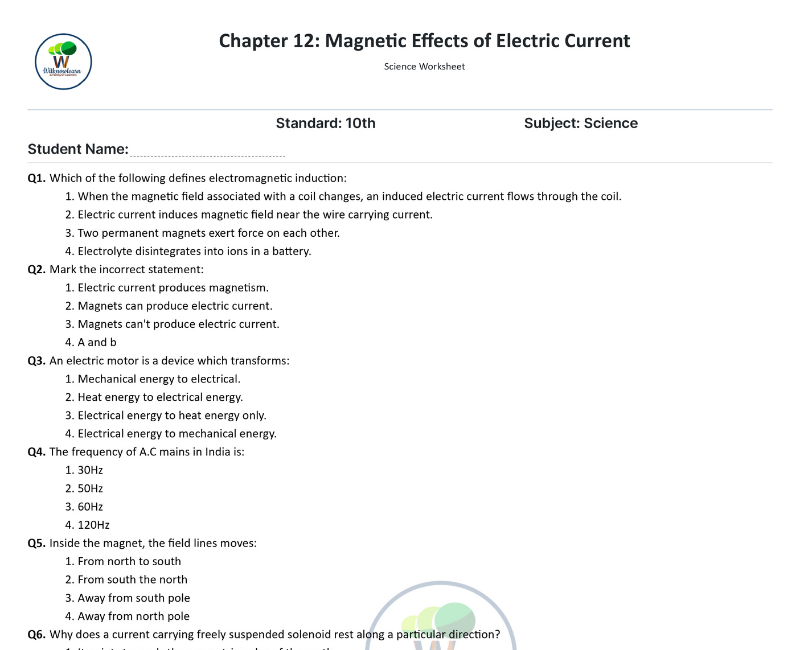
Magnetic Effects of Electric Current Worksheet
with Online Quiz and Activities
Follow a field line, reverse a current and predict a force. Explore wire fields, solenoids, electromagnets, AC/DC and domestic-circuit concepts with labelled diagrams and clear explanations.
Follow the Field
Read magnetic patterns and connect symbols with directions.
↗Reverse and Discover
Change current, coil polarity and the direction of force.
✓Explain the Evidence
Reason through experiments, protective functions and solenoid cases.
Magnetic Effects of Electric Current Class 10 Online Quiz
Question 1 / 20 • Easy
A compass needle deflects near a wire when current is switched on. This shows that current produces
Choose an answer to continue, or use the question numbers.
Quiz instructions
Answer 10 easy, five average and five HOTS questions in 20 minutes. The timer starts with your first answer or question-navigation action. Choosing an answer advances except at the final question. Review using Previous or the numbers. One mark per correct answer, no negative marking. Submission or timeout reveals the score and all explanations. Restart clears the answers and pauses the timer.
Interactive Magnetic Field and Direction Games
Choose a game from the raised selector. The topic, diagram and controls share one frame.
Field Diagram Detective
Read the labelled wire-field schematic and choose a letter.
Find the conductor viewed end-on.
Magnetism Solenoid Force and AC Activities
Choose a virtual lab, make a prediction and check each of its five missions.
How to use these virtual models
Five games, five activities and five extra-practice sets provide 75 tasks, separate from the quiz. Games and labs share one active main workspace; extra practice is independent. Entries remain while this page stays open. Views, current conventions and model assumptions are stated beside the controls. Magnetic strength settings are relative teaching comparisons, not calibrated field measurements. The compass model includes a fixed northward Earth field. Domestic-circuit examples are conceptual, not instructions for mains wiring.
Magnetic Effects Class 10 Extra Questions and Case Practice
AC Frequency and Supply Numericals
Enter values in the requested units. Fractions and two-decimal rounding are accepted.
A sinusoidal AC supply is 50 Hz. Find its period in milliseconds.
Write the known values, select a relationship and use consistent units. Check the requested unit in each field.
Accepts fractions or rounding to two decimal places. Tolerance ±0.0051 in the stated units.
Eight Revision Tips for Students
- State the viewing direction before writing clockwise or anticlockwise.
- Use conventional current in both direction rules.
- Learn the difference between a dot and a cross.
- Keep magnetic field direction separate from force direction.
- Compare solenoid strength at controlled current and geometry.
- Remember that a compass responds to the resultant local field.
- Count complete AC cycles separately from direction reversals.
- Explain earthing and overcurrent protection as complementary functions.
Five Teaching Tips for Parents and Teachers
- Ask students to predict before reversing a current.
- Keep the diagram viewpoint fixed while checking a rule.
- Compare reversing one vector with reversing both.
- Use the compass lab to separate wire field from Earth field.
- Discuss controlled variables when comparing electromagnets.
Magnetic Effects of Electric Current Class 10 Notes Important Questions and Solutions
Why does a compass turn when current flows through a nearby wire? How can a coil attract an iron bolt, and why does reversing current change a magnetic pole? This Magnetic Effects of Electric Current Class 10 worksheet helps you connect these observations with field diagrams and direction rules. Attempt the written worksheet, explore a model and use the online quiz to check your reasoning.
The guide includes Magnetic Effects of Electric Current Class 10 short notes, labelled diagrams, right-hand thumb rule examples, Fleming’s left-hand rule questions, solenoid explanations, AC and DC comparisons, domestic-circuit questions and solved practice. Each important question includes an explanation instead of only a topic name.
Magnetic Field and Magnetic Field Lines Class 10
A magnetic field describes the magnetic influence in a region. The north-seeking end of a small compass indicates the direction of the resultant local field. Near a current-carrying wire, this may combine the wire’s field with Earth’s field. A compass need not point along the wire’s field alone when other fields are significant.
Magnetic field lines are a representation. Outside a bar magnet they run from north to south; inside they return from south to north, forming continuous closed curves. A tangent indicates the local field direction. Closer lines represent a stronger field when drawn using a consistent convention.
Why do magnetic field lines not intersect? At a point where the magnetic field is nonzero, it has one direction. Two crossing field lines would assign two different directions at that point. The lines are not physical threads, and their density in an arbitrary drawing is not an instrument reading.
Magnetic Field Around a Straight Current-Carrying Conductor
A long straight conductor produces concentric circular field lines in planes perpendicular to the wire. Increasing current strengthens its field for the same geometry. At a fixed current, moving farther from the wire weakens the field. The field direction changes around the circle; it is not a single direction everywhere around the conductor.
Oersted’s experiment Place a compass near a suitable low-voltage current-carrying wire, compare its orientation with the current off and on, and then reverse the current. The deflection shows a magnetic effect. Its direction depends on the current, geometry, viewing direction and other fields. The virtual compass lab holds these conditions explicit so you can compare one change at a time.
Right-Hand Thumb Rule Class 10 with Examples
Imagine gripping the conductor with your right hand. Point your thumb along conventional current. Your curled fingers indicate the direction of the magnetic field around the conductor. In a metal, electron drift is opposite to conventional current, so do not point the thumb along electron drift unless you first reverse that direction.
| Current as you face the page | Symbol | Field circulation in that view |
|---|---|---|
| Towards you | ⊙, an arrow tip | Anticlockwise |
| Away from you | ⊗, an arrow tail | Clockwise |
Worked direction example Current comes out of the page. At a point to the right of the wire, the field points upwards; at a point above the wire, it points left. Reversing the current reverses both directions. State the view before using clockwise or anticlockwise.
Magnetic Field Due to a Circular Loop and Solenoid
Contributions from different parts of a circular current loop combine to give a field along its axis at the centre. Reversing the loop current reverses that field. With the same loop geometry and current, adding closely spaced turns increases the combined field at the centre.
A solenoid is a coil with many turns. Its field pattern resembles that of a bar magnet. Well inside the central region of a sufficiently long, closely wound solenoid, field lines are approximately straight, parallel and evenly spaced. This represents an approximately uniform field. A finite solenoid also has an outside field; it is not exactly zero everywhere outside.
How do you find a solenoid’s north and south poles? Face one end and observe current circulation. Anticlockwise current makes that face north; clockwise makes it south. Viewed from the opposite end, the apparent circulation reverses. Reversing the supplied current interchanges the poles.
Electromagnet Class 10 and the Role of a Soft Iron Core
A coil can form a controllable electromagnet. A suitable soft iron core becomes magnetised and can strengthen its magnetic action. Current magnitude, turns per unit length, core material and geometry affect the field. In a fair comparison, specify what remains constant.
Does adding turns always increase the field when connected to the same battery? Not automatically. More wire can increase resistance and change current. The usual classroom statement compares coils at the same current and otherwise controlled conditions. The sample-paper solenoid case is a useful reason to explain both the coil and the source conditions.
When current is switched off, the coil’s current-produced field disappears. Real core materials can retain some magnetisation. Soft magnetic materials are useful when a strong on–off response is wanted, but do not claim that every core has exactly zero remanence.
Fleming’s Left-Hand Rule Class 10 Explained
A current-carrying conductor can experience a force in an external magnetic field. Hold the left forefinger, middle finger and thumb mutually perpendicular. The forefinger indicates magnetic field, the middle finger conventional current, and the thumb force or motion.
The force is greatest for a given current, field and active conductor length when current is perpendicular to the field. It is zero for a straight segment parallel or antiparallel to a uniform field. Reversing only current or only field reverses force. Reversing both preserves force direction.
| Rule | What you know | What you find |
|---|---|---|
| Right-hand thumb | Current through a straight wire | Direction of the surrounding magnetic field |
| Fleming’s left hand | Current and external field | Direction of force on the conductor |
Do not interchange the rules. A current creates its own field, while a current in a suitable external field can experience force. The thumb has a different meaning in the two mnemonics.
Alternating Current and Direct Current Difference Class 10
| Feature | Direct current | Alternating current |
|---|---|---|
| Direction | One direction | Reverses periodically |
| Magnitude | May be steady or varying; the lab uses steady DC | Varies through positive and negative parts in the sinusoidal model |
| Example | A cell supplying a simple circuit | A typical AC electricity supply |
| Cycle description | No alternating-cycle frequency for steady DC | Frequency gives complete cycles per second |
For sinusoidal AC, T = 1/f. A frequency of 50 Hz means 50 complete cycles per second and 100 direction reversals per second. Each full cycle has a positive and a negative half. AC is useful in electricity distribution because its voltage can be changed using transformers, allowing transmission at higher voltage and lower current for a given power, reducing resistive losses.
Domestic Electric Circuits Fuse MCB and Earthing
Household appliances use parallel branches so they can receive the supply voltage and be controlled independently. The live conductor, neutral conductor and protective earth have different functions. Protective earth is not intended to be the normal load-current return. Wire colours and installation rules depend on the applicable standard and location; learn the functions rather than applying a colour mnemonic to real wiring.
Overloading occurs when a circuit carries more load current than intended. A short circuit involves an unintended low-resistance path, which can cause a large fault current. A suitable fuse or circuit breaker can interrupt excessive current according to its operating characteristics.
A protective earth connection to an exposed conductive case provides a fault-current path that supports protective disconnection if the case becomes live. Earthing does not replace fuses, breakers or other protective devices. These explanations are conceptual; the virtual tasks are not instructions for working on mains circuits.
Magnetic Effects of Electric Current Important Questions with Answers
- Why does a compass deflect near a current-carrying wire?
The wire creates a magnetic field. The compass responds to the resultant of that field and other local fields.
- What happens when the wire current is reversed?
The wire’s magnetic field reverses. The resulting compass position depends on its combination with the other fields.
- Why is the field strong near a solenoid’s centre?
Contributions from the turns reinforce along the axis. A sufficiently long solenoid has an approximately uniform central region.
- Can a reversed electromagnet still attract an iron bolt?
Yes. Swapping poles does not automatically produce repulsion of soft iron; induced magnetisation can lead to attraction at either pole.
- Why can no field-line intersection be drawn at a point with nonzero field?
It would assign two different field directions at one point.
- Why is a fuse connected in series with the protected path?
It must carry that path’s current and open the path when it operates. Bypassing it defeats the protection.
Magnetic Effects Class 10 Solved Examples and Numericals
Example 1 - predict force direction
Conventional current is rightwards and the magnetic field is upwards in the page.
Set the left forefinger upwards and middle finger rightwards.
The thumb points towards you, so the force is out of the page.
If only current is reversed, the force becomes into the page.
Example 2 - find an AC period
A sinusoidal supply has frequency 50 Hz.
T = 1/f = 1/50 s.
T = 0.02 s = 20 ms.
Direction reversals per second = 2f = 100.
Example 3 - count complete cycles
A 25 Hz sinusoidal current is observed for 4 seconds.
Number of cycles = f × t.
Number of cycles = 25 × 4 = 100.
Count full cycles rather than individual positive or negative halves.
Magnetic Effects Class 10 Case-Based Questions with Solutions
A powered solenoid pulls an iron bolt. A spring restores it when current is switched off.
Why include an iron core? A suitable core strengthens the magnetic action of the coil.
How can polarity be found? State the viewed end, identify conventional current circulation and apply the end-face rule.
What changes when current is increased? For the same geometry and suitable core conditions, the field generally becomes stronger.
What if current reverses? The poles interchange, but an iron bolt can still be attracted.
Assertion Reversing both current and external magnetic field preserves the force direction. Reason Reversing either one alone reverses force. Both statements are true, and two successive reversals explain the assertion for the same conductor geometry.
Motor Generator and Induction Enrichment
An electric motor uses magnetic forces to transfer electrical energy into mechanical motion. A simple DC motor model uses a split-ring commutator to reverse the coil current at appropriate points in its rotation. Electromagnetic induction concerns an induced emf when magnetic flux changes; a closed suitable circuit may then carry induced current. A generator transfers mechanical energy into electrical energy through induction.
These are useful related ideas, but they must not be mixed up with the right-hand thumb rule for a wire or Fleming’s left-hand force rule. The detailed current CBSE curriculum lists motor, electromagnetic induction and generator content for formative assessment. This page labels them enrichment rather than making them part of its core quiz.
Current CBSE Syllabus and Official Sample-Paper Update
The CBSE Science syllabus for 2026–27 details wire, coil and solenoid fields, force, Fleming’s left-hand rule, AC/DC and domestic circuits. Its detailed list separates motor, induction and generator material for formative assessment. A broader teacher note elsewhere is inconsistent with this detailed coverage and the sample paper, so do not infer that the entire chapter is deleted from that note alone.
Questions 36 and 38 of the official Science sample paper address the right-hand thumb rule, variation of field with distance and a solenoid lock or compass case. These are verified sample-paper themes, not claims of repeated past-board questions. Follow subsequent official clarifications and your school’s confirmed assessment guidance.
Reference NCERT Magnetic Effects of Electric Current. Reviewed 23 October 2026. The quiz and interactive tasks are original practice material; no fixed chapter marks or guaranteed examination questions are claimed.
Related Class 10 Science Resources
Frequently Asked Questions
What is the magnetic effect of electric current?
Current produces a magnetic field around a conductor. A nearby compass can reveal this effect by changing orientation when the current is switched on.
What does the right-hand thumb rule tell us?
Point the right thumb along conventional current. Curled fingers indicate the magnetic-field circulation around a straight wire. State the view before using clockwise or anticlockwise.
What do dot and cross symbols mean?
A dot means out of the page towards you. A cross means into the page away from you. They represent an arrow tip and tail.
Why do magnetic field lines never intersect?
At a point with a nonzero field there is one field direction. An intersection would assign two different directions there.
How do current and distance affect a straight wire’s field?
With the arrangement fixed, increasing current strengthens the field. At fixed current, increasing perpendicular distance weakens it. Reverse current to reverse field direction.
How can I find the poles of a solenoid?
Face the specified end. Anticlockwise current makes that face north; clockwise makes it south. Reversing current swaps the poles.
Why is a soft iron core used in an electromagnet?
A suitable core becomes magnetised and can strengthen the coil’s magnetic action. Soft magnetic behaviour is useful for switching applications.
How is Fleming’s left-hand rule different from the thumb rule?
The left-hand rule predicts force from current and an external field. The right-hand thumb rule predicts the surrounding field from current in a straight wire.
What happens if both current and magnetic field reverse?
For the same conductor geometry, the force direction stays the same. Reversing only one reverses force. Parallel or antiparallel current and field give zero force.
How often does 50 Hz AC change direction?
A sinusoidal 50 Hz AC completes 50 cycles and reverses direction 100 times per second. Its period is 0.02 s or 20 ms.
What is the difference between a fuse and earthing?
A fuse interrupts excessive current when it operates. Earthing provides a protective fault-current path from exposed conductive parts. Neither should be treated as a substitute for the full protection system.
Which important questions are supported by the current sample paper?
The official sample paper includes the right-hand thumb rule, how field varies with distance and a solenoid lock or compass case. Practise direction diagrams and controlled-variable explanations. Motor, induction and generator enrichment is identified separately in the detailed curriculum.
 Download