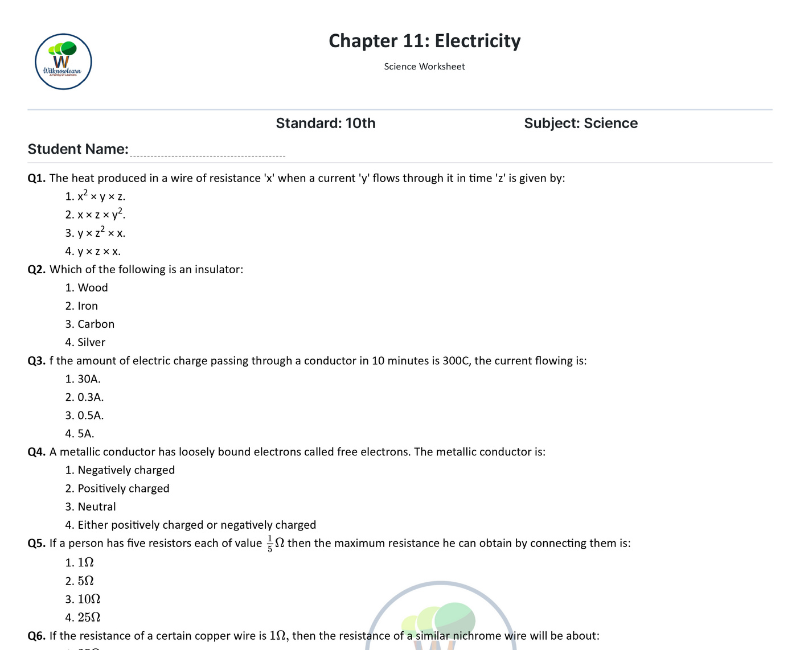
CLASS 10 SCIENCE • THE INTERACTIVE ELECTRICITY LAB
Electricity Class 10 Worksheet
with Online Quiz and Activities
Build a circuit, change the resistance and see the numbers respond. Explore current, voltage, resistor networks, heating and electrical energy through diagrams and practical challenges.
Read the Circuit
Identify symbols, match units and distinguish series from parallel.
↗Change and Discover
Adjust voltage, resistance and wire dimensions in virtual labs.
±Calculate with Confidence
Connect formulas, units and observations through worked reasoning.
Electricity Class 10 Online Quiz
Question 1 / 20 • Easy
Electric current is the rate of flow of
Choose an answer to continue, or use the question numbers.
Quiz instructions
Answer 10 easy, five average and five HOTS questions in 20 minutes. The timer starts with your first answer or question-navigation action. An answer advances to the next question except at the end. Use Previous or numbered buttons to review. One mark per correct answer, no negative marking. Submission or timeout reveals the score and all explanations. Restart clears answers and pauses the timer.
Interactive Electricity and Circuit Games
Choose a game from the raised selector. The topic and challenge stay together in one frame.
Circuit Symbol Detective
Choose the letter that identifies the requested component.
Find the meter that measures current.
Ohm’s Law Resistance Heating and Energy Activities
Select a lab, adjust its controls and check each of its five missions.
How to use the electricity models
Five games, five labs and five extra-practice sets provide 75 tasks, separate from the quiz. Games and labs share one active main workspace; extra practice is independent. Entries remain while this page stays open. Models assume ideal wires, ideal sources and constant ohmic resistances unless a task states otherwise. Heat bars show energy, not measured temperature. These are virtual experiments; use approved low-voltage equipment for supervised practical work.
Electricity Class 10 Extra Questions and Numericals
Current Voltage and Networks
Enter numerical answers in the requested units. Fractions and two-decimal rounding are accepted.
A charge of 180 C passes in 90 s. Find current.
Write the known values, select a relationship and use consistent units. Check the requested unit in each field.
Accepts fractions or rounding to two decimal places. Tolerance ±0.0051 in the stated units.
Eight Revision Tips for Students
- Write the quantity, symbol and unit together.
- Convert minutes to seconds for joule calculations.
- Use kilowatts and hours when calculating kWh.
- Trace nodes before deciding whether resistors are in parallel.
- Check whether a graph plots V against I or I against V.
- State what remains constant when comparing heating.
- Distinguish radius, diameter and cross-sectional area.
- Check results against series and parallel resistance limits.
Five Teaching Tips for Parents and Teachers
- Ask students to predict the direction of a change before adjusting a slider.
- Connect each meter symbol to the quantity it measures.
- Use node connections rather than drawing shape to classify networks.
- Compare fixed-current and fixed-voltage heating side by side.
- Ask students to explain an unreasonable numerical result before recalculating.
Electricity Class 10 Notes Important Questions and Numericals with Solutions
Why does a longer wire offer more resistance? Why do appliances work independently in a parallel circuit? How can a power rating help you calculate an electricity bill? This Electricity Class 10 worksheet connects these questions with circuit diagrams, an online quiz and interactive experiments. Use the worksheet for written practice, then test your understanding in the games and labs above.
This revision guide includes Electricity Class 10 short notes, a formula sheet, Ohm’s law graphs, series and parallel derivations, extra questions with answers, solved numericals and case-based questions. The examples show the units and intermediate steps so that you can check the method as well as the answer.
Electric Current and Potential Difference Class 10
Electric current is the rate at which charge crosses a section of a conductor. Write I = Q/t, with charge Q in coulombs and time t in seconds. One ampere means one coulomb per second. In a metal, electrons drift opposite to conventional current because their charge is negative. Conventional current follows the direction a positive charge would move.
Potential difference is energy transferred per unit charge between two points. Write V = W/Q. One volt means one joule per coulomb. A battery supplies energy to charges; it does not continually manufacture the electrons already present in a metal wire. In a steady series circuit, charge is conserved and the same current enters and leaves a resistor.
Electric Circuit Diagram with Ammeter and Voltmeter
An ammeter is connected in series with the path whose current is being measured. A voltmeter is connected in parallel across the component because it compares the potentials at the two ends. An ideal ammeter has zero resistance and an ideal voltmeter infinite resistance; real instruments approximate these properties.
To read a circuit, identify the source, trace a complete conducting path and mark the nodes at which branches meet. The positions on the page are less important than the connections. A voltmeter drawn above a resistor is still parallel if its terminals join the same two nodes. An open switch breaks the ideal steady-current path.
Ohm’s Law Class 10 Statement Experiment and V–I Graph
For an ohmic conductor at constant temperature and unchanged physical conditions, current is directly proportional to the potential difference across it. Therefore V = IR, where the constant R is the resistance. Doubling V doubles I only when R remains unchanged. A filament that heats substantially need not keep the same resistance.
In an Ohm’s law experiment, connect the ammeter in series and the voltmeter across the resistor. Vary the applied voltage with suitable low-voltage equipment, record paired readings and limit temperature changes. Calculate V/I for each pair. Approximately constant ratios support ohmic behaviour under the measured conditions.
How do you find resistance from a graph? If V is vertical and I horizontal, slope ΔV/ΔI equals R. If I is vertical and V horizontal, the slope is 1/R. For example, points (I = 0.5 A, V = 3 V) and (I = 1.0 A, V = 6 V) give R = (6 − 3)/(1.0 − 0.5) = 6 Ω. Always name the axes before interpreting steepness.
Resistance and Resistivity Difference Class 10
| Feature | Resistance | Resistivity |
|---|---|---|
| Meaning | Opposition to current for the particular component. | Material property under stated conditions such as temperature. |
| Symbol and unit | R, measured in Ω. | ρ, measured in Ω m. |
| Dimensions | Depends on the wire’s length and area. | Does not change merely because the same material is made longer or thicker at fixed temperature. |
| Relationship | R = ρL/A. | ρ = RA/L. |
For a uniform wire, increasing length increases resistance, while increasing cross-sectional area decreases it. Material and temperature must be controlled in a fair comparison. Convert area carefully: 1 mm² = 10⁻⁶ m². For a circular wire, A = πr², so radius and area factors are different.
Resistance of a Stretched Wire and a Cut Wire
If a wire is stretched to n times its length while its volume and resistivity remain constant, its area becomes A/n. Substituting in R = ρL/A gives a new resistance n²R. Doubling the length therefore makes resistance four times the original value under these assumptions.
If a uniform wire of resistance R is cut into n equal pieces, each piece has resistance R/n. Connecting all n pieces in parallel gives R/n². Keep this situation separate from stretching: cutting changes the network arrangement, while stretching changes the geometry of one wire.
Resistors in Series and Parallel Class 10 Derivations
Series combination The current I is common to each resistor. The total voltage is V = V₁ + V₂. Using V₁ = IR₁ and V₂ = IR₂ gives IRs = IR₁ + IR₂. Dividing by I for a nonzero test current gives Rs = R₁ + R₂. For more resistors, continue the sum.
Parallel combination Each branch has the same potential difference V. Total current is I = I₁ + I₂. Substituting I = V/Rp, I₁ = V/R₁ and I₂ = V/R₂ gives 1/Rp = 1/R₁ + 1/R₂. For two positive resistors, Rp = R₁R₂/(R₁ + R₂).
| Check | Series | Parallel |
|---|---|---|
| Common quantity | Current through one path. | Voltage across common nodes. |
| What adds? | Voltage drops. | Branch currents. |
| Equivalent resistance for two positive resistors | Greater than either resistor. | Less than the smaller resistor. |
Why are household appliances connected in parallel? Each branch can receive the supply voltage and can be switched independently. A single branch being opened does not normally break the other branches. This explanation assumes that the supply and protective devices continue to operate normally.
Joule’s Law of Heating Class 10
Current through a resistor transfers electrical energy into thermal energy. For constant current and resistance, H = I²Rt. Use seconds for t to obtain joules. Heating is useful in appliances such as irons and toasters; in other circuits it can be an unwanted energy transfer.
Does greater resistance always produce more heat? No. At the same current and time, H = I²Rt increases with R. At the same voltage and time, H = V²t/R decreases as R increases. State which quantity is fixed before comparing heat. The lab above lets you investigate both conditions without confusing heat energy with temperature.
Electric Power and Electrical Energy Formula Sheet
| Quantity | Relationship | Unit |
|---|---|---|
| Current | I = Q/t | A |
| Potential difference | V = W/Q | V |
| Ohmic resistance | R = V/I | Ω |
| Uniform-wire resistance | R = ρL/A | Ω |
| Electric power | P = VI | W |
| Ohmic-resistor power | P = I²R = V²/R | W |
| Electrical energy | E = Pt | J or kWh |
| Heat in a resistor | H = I²Rt | J |
A watt is one joule per second. A kilowatt-hour is energy, not power. One commercial unit of electrical energy is 1 kWh = 1000 W × 3600 s = 3.6 × 10⁶ J. Use kW multiplied by hours for kWh, or watts multiplied by seconds for joules.
Electricity Class 10 Numericals with Step-by-Step Solutions
Example 1 - current and time conversion
A charge of 240 C passes in 4 minutes. Find current.
t = 4 × 60 = 240 s.
I = Q/t = 240/240 = 1 A.
Using 4 directly would confuse minutes with seconds.
Example 2 - compare series and parallel
Find the equivalent resistance of 4 Ω and 12 Ω in each arrangement.
Series Rs = 4 + 12 = 16 Ω.
Parallel 1/Rp = 1/4 + 1/12 = 4/12.
Rp = 3 Ω.
The parallel result is below 4 Ω, which is a useful reasonableness check.
Example 3 - heating effect numerical
A 1.5 A current passes through 8 Ω for 2 minutes. Find heat.
t = 120 s.
H = I²Rt = 1.5² × 8 × 120.
H = 2160 J.
Do not omit the square on the current.
Example 4 - electricity bill numerical
A 750 W appliance operates for 2 hours daily for 20 days. Find energy and the energy charge at an assumed ₹7 per kWh.
P = 0.75 kW; total time = 2 × 20 = 40 h.
E = 0.75 × 40 = 30 kWh.
Energy charge = 30 × 7 = ₹210.
This is an illustrative energy charge, excluding fixed charges, taxes and other bill items.
Electricity Class 10 Important Questions with Answers
- Is current used up by a resistor?
No. The same steady current enters and leaves it in a series path. Electrical energy is transferred while charge is conserved.
- Why does a thicker wire have less resistance?
At fixed length, material and temperature, a larger cross-sectional area reduces R because R = ρL/A.
- Does doubling radius double area?
No. Since A = πr², doubling radius multiplies area by four and reduces resistance to one quarter when the other conditions stay fixed.
- Why should an ammeter not be connected directly across a cell?
Its low resistance would create a large-current path instead of measuring the intended load current.
- Which resistor gives more heat in a series pair?
For the same series current and elapsed time, the larger resistor gives more heat. Across the same fixed voltage, the comparison reverses.
- Do equal power ratings mean equal monthly energy use?
Only if the operating times and actual operating powers are also equal. Energy depends on both power and time.
Electricity Class 10 Case-Based and Assertion–Reason Questions
A 4 Ω and an 8 Ω resistor are parallel across 8 V.
Each branch receives 8 V.
I₁ = 8/4 = 2 A; I₂ = 8/8 = 1 A.
Total current = 2 + 1 = 3 A.
Equivalent resistance = 8/3 Ω.
If the 8 Ω branch is opened while the ideal source maintains its voltage, the 4 Ω branch still carries 2 A and total current falls to 2 A.
Assertion Adding a positive-resistance parallel branch lowers the equivalent resistance. Reason The additional branch increases total conductance. Both statements are true, and the reason explains the assertion for an ideal resistor network.
Assertion A kilowatt-hour measures power. Reason A kilowatt-hour is power multiplied by time. The assertion is false and the reason is true: the resulting quantity is energy.
Current CBSE Syllabus and Sample-Paper Practice
The CBSE Science syllabus for 2026–27 lists current, potential difference, resistance, resistivity, resistor combinations, heating and power. The official sample paper includes appliance current, Joule heating or resistivity, and circuit calculations in Questions 31, 34 and 37. These are sample-paper themes, not claims that the same questions repeatedly appeared in past board examinations.
The curriculum document also contains a broadly worded teacher note about electrical topics that is inconsistent with its detailed listing and the sample paper. Do not infer that this entire chapter is deleted from that note alone; follow any subsequent official clarification and your school’s confirmed assessment guidance.
Use the NCERT Electricity chapter alongside this original practice material. Reviewed 23 October 2026. No fixed chapter marks or guaranteed examination questions are claimed.
Related Class 10 Science Resources
Frequently Asked Questions
What is the difference between current and potential difference?
Current is charge per unit time, measured in amperes. Potential difference is energy transferred per unit charge, measured in volts. Use I = Q/t and V = W/Q.
When does Ohm’s law apply?
It describes an ohmic conductor at constant temperature and unchanged physical conditions. A fixed V/I ratio supports this behaviour; not every component has a constant resistance.
How are an ammeter and a voltmeter connected?
Connect the ammeter in series with the path being measured and the voltmeter in parallel across the component. The diagram and symbol game illustrate both connections.
How do I find resistance from a V–I graph?
With V vertical and I horizontal, R = ΔV/ΔI. If the axes are reversed, the slope gives 1/R. Check the axes and units first.
What is the difference between resistance and resistivity?
Resistance describes a specific wire or component and depends on its dimensions. Resistivity characterises the material at a given temperature. Their units are Ω and Ω m respectively.
What happens when the radius of a wire doubles?
At unchanged length, material and temperature, area becomes four times greater and resistance becomes one quarter. If the wire is stretched instead, you must account for the associated change in length too.
How do I identify series and parallel resistors?
Resistors are in series when the same current must pass through them without branching between them. They are parallel when both ends join the same two nodes.
Why is parallel resistance smaller than either branch resistance?
For two positive finite resistances, their conductances add: 1/Rp = 1/R₁ + 1/R₂. The added path increases total conductance and lowers equivalent resistance.
Does a larger resistance always produce more heat?
No. At fixed current and time, H increases with R. At fixed voltage and time, H decreases with R. State the constraint before comparing.
How do I calculate electricity consumption and cost?
Multiply appliance power in kW by hours of actual operation to obtain kWh. Multiply kWh by the applicable energy tariff for the energy charge. A full bill may include other charges.
How many joules are in one unit of electrical energy?
One commercial unit is 1 kWh = 3.6 × 10⁶ J. A kilowatt measures power; a kilowatt-hour measures energy.
Which Electricity Class 10 important questions should I practise?
Practise definitions, meter connections, Ohm’s law graphs, resistance and resistivity, series and parallel calculations, Joule heating, appliance ratings and energy use. The current official sample paper also includes power, resistivity or heating, and network calculations.
 Download