Class 3 Science · CBSE / NCERT
Sun Moon and Stars Class 3 Science Worksheet NCERT with Quiz and Activities
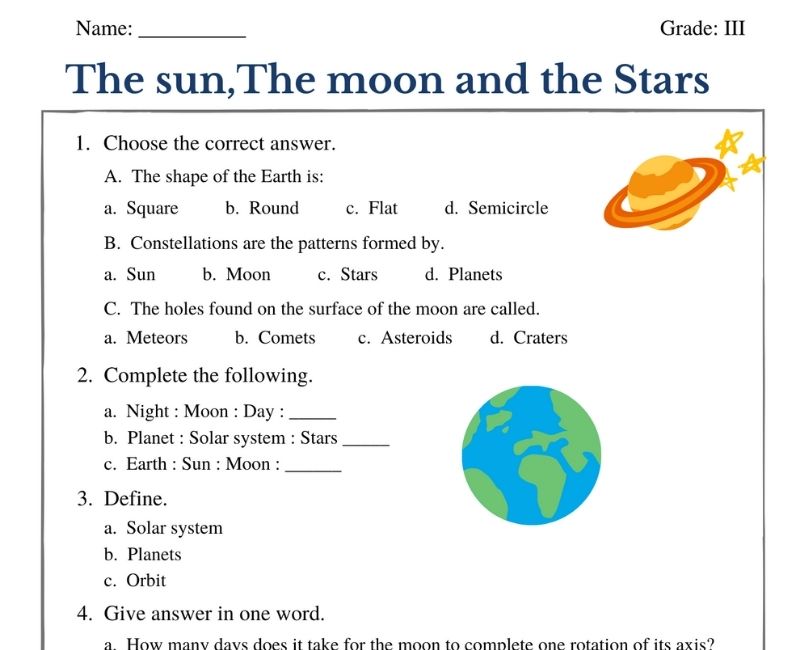
Why do we have day and night, why does the Moon change its shape and how many planets go round the Sun? Find out with this Sun Moon and Stars worksheet for Class 3: take the Sun Moon and Stars Class 3 quiz, try the space science labs and play the Sun Moon and Stars Class 3 activities online, in line with CBSE and the NCERT book Our Wondrous World.
Flip the cards and try the Day and Night Lab, then tap the Games, Labs or Challenges island.
Sun Moon and Stars Class 3 Online Quiz
20 questions · tap an answer to move on · full review at the end
Which of these is a star?
Sun Moon and Stars Class 3 Activities
Spin, orbit, join and build. Earn up to 3 stars in every activity.
This Sun Moon and Stars worksheet for Class 3 lets children explore like young astronauts. Flip the fact cards, spin the Earth in the Day and Night Lab, then play the games, do the labs and try the challenges.
Fact cards: tap a card to flip it
Day and Night Lab
Spin the Earth beside the Sun and watch the house in India go from day to night and back again.
🌍 Spin the Earth: drag across the Earth with your mouse or finger (or tap the arrows). Watch the 🏠 house in India.
- ☀️Step 1: Make it day in India
Spin the Earth until the house faces the Sun. - 🌙Step 2: Make it night in India
Keep spinning until the house is on the dark side. - 🔄Step 3: Spin one whole turn
Turned 0° of 360°. - ⬜Step 4: What did we find?
Finish steps 1 to 3 to unlock.
Challenge marks: 0 / 15 (0 of 5 challenges done)
Finish all 5 challenges to see your comment.
Practice sheet
Type your answers in the boxes. For word answers write in small letters. Press Check when you finish.
ALook and write day or night
BComplete the sentence with one word
CCount and write the number
DWrite true or false
Sun Moon and Stars Class 3 Complete Guide
Look up! The Sun lights our days, and the Moon and stars light our nights. This guide explains them in simple words for Class 3 students, parents and teachers. It goes with the Sun, Moon and Stars worksheet for Class 3 on this page and covers the Sun, day and night, the Earth's year, the Moon and its phases, stars and constellations, the eight planets and famous space travellers.
Introduction to NCERT Class 3 Science The Sun, Moon and Stars
Book: Our Wondrous World (The World Around Us), the NCERT textbook for Grade 3. Topic: The Sun, Moon and Stars (Our Earth and its Neighbours). Board: CBSE and other schools that follow NCERT. The new NCERT book builds this topic through watching the sky by day and by night. This page is built around the learning goals schools test for the topic; it is not a copy of a single chapter.
What is there in this topic
- The Sun: our nearest star, its heat, light and energy
- Day and night: the Earth spins
- A year: the Earth goes round the Sun
- The Moon, its craters and its phases
- Stars, the brightest star and constellations
- The eight planets of the solar system
- Space travel: astronauts and moon missions
Learning objectives
These objectives are written for this page from the topic's goals; they are not copied from the NCERT book.
- Explain why the Sun is important for life on Earth.
- Explain how day and night happen.
- Tell that the Moon reflects sunlight and name its phases.
- Describe stars and constellations.
- Name the eight planets in order from the Sun.
Learning outcomes
After this page a child can:
- Show day and night by turning a globe in front of a torch.
- Draw the new moon, half moon and full moon.
- Say that the Earth takes one day to spin and one year to go round the Sun.
- Recognise the Great Bear (Saptarishi) in a picture.
- Say which direction the Sun rises in and why shadows change during the day.
Sun, Moon and Stars Class 3 resources on this page
| Resource | What it does |
|---|---|
| Sun, Moon and Stars Class 3 quiz | 20 questions in three levels with a full answer review |
| Flip cards | Six cards: the Sun, the Moon, stars, the Earth, planets and space travel |
| Day and Night Lab | Spin the Earth beside the Sun and watch a house in India move from day to night |
| 5 games | Day sky or night sky, planet bubbles, space facts memory, moon phase line-up, join the stars |
| 5 science labs | Moon phases, Earth's year, sun and shadow clock, build the solar system, sun power |
| 5 challenges | Marked out of 3 each with a total out of 15 |
| Practice sheet | 16 questions with pictures, a word bank and a live score |
The Sun
The Sun is a star: a huge ball of very hot gases. It is the star nearest to the Earth. It gives us heat and light, helps plants make food and dries our clothes. Its energy, called solar energy, runs solar panels and solar cookers. The Sun rises in the east and sets in the west. We must never look straight at it.
The Earth: day, night and a year
| Movement | What happens | Time taken |
|---|---|---|
| Spinning on its axis (rotation) | Day on the side facing the Sun, night on the other side | About 24 hours (1 day) |
| Going round the Sun (revolution) | One full year passes | About 365 days (1 year) |
The Moon
The Moon goes round the Earth, so it is the Earth's natural satellite. It has no light of its own; it shines by reflecting sunlight. It has no air or water and its surface has many craters. Neil Armstrong was the first person to walk on the Moon, in 1969. India's Chandrayaan-3 landed near the Moon's south pole in 2023.
| Phase | What we see |
|---|---|
| New moon | The Moon is dark; we cannot see it |
| Crescent | A thin curved slice is lit |
| Half moon | Half the face is lit |
| Gibbous | More than half is lit |
| Full moon | The whole round face is lit |
Stars and planets
Stars are far-away suns that make their own light. They look tiny because they are very far away, and they seem to twinkle. Sirius is the brightest star in the night sky. Star patterns are called constellations, such as the Great Bear (Saptarishi). Eight planets go round the Sun: Mercury, Venus, Earth, Mars, Jupiter, Saturn, Uranus and Neptune. Planets do not make their own light.
Types of questions
- Fill in the blanks about the Sun, Moon and stars
- Name the phase of the Moon
- Order the planets
- True or false
- Day or night
- Reason questions about day, night and phases
Solved examples
Common mistakes
| Mistake | Correct idea |
|---|---|
| The Sun moves round the Earth | The Earth spins and goes round the Sun; the Sun only seems to move |
| The Moon makes its own light | The Moon reflects sunlight |
| The Sun is not a star | The Sun is a star, the one nearest to us |
| Stars disappear in the day | Stars are still there; sunlight hides them |
| The Moon really changes shape | We see different parts of its lit half |
| Planets twinkle like stars | Stars twinkle; planets shine steadily and do not make light |
Daily life
We wake with the sunrise, use solar lights and solar cookers, plan festivals by the Moon, watch the full moon at night and use calendars based on the Earth's year.
What your child learns from the Sun, Moon and Stars worksheet
- To observe the day and night sky
- To model space ideas with simple experiments
- To link the Earth's movements to day, night and a year
- To be curious about space travel
Tips for parents and teachers
- Turn a ball with a sticker in front of a torch to show day and night.
- Draw the Moon's shape every night for two weeks.
- Mark a stick's shadow on the ground in the morning, at noon and in the evening.
- Look for the Great Bear on a clear night.
- Let the child retry the challenges to earn 3 stars.
Related Science Worksheets
- Living and Non-Living Things Worksheet Class 3
- Eating Habits of Animals Worksheet Class 3
- Soil Worksheet Class 3
- Light Sound and Force Worksheet Class 3
- Parts of a Plant Worksheet Class 3
- Air Water and Weather Worksheet Class 3
- Nesting Habits of Birds Worksheet Class 3
- Human Body Worksheet Class 3
- Safety and First Aid Worksheet Class 3
- Science Measurement Worksheet Class 3
- States of Matter Worksheet Class 3
- Food and Feeding Habits of Animals Worksheet Class 3
Frequently Asked Questions
What is the Sun for Class 3?
The Sun is a star: a huge ball of very hot gases. It is the star nearest to the Earth and gives us heat and light.
How do day and night happen?
The Earth spins on its axis. The side facing the Sun has day and the side away from the Sun has night. One spin takes about 24 hours.
Why is the Moon called a satellite?
The Moon goes round the Earth, so it is the Earth's natural satellite.
Does the Moon have its own light?
No. The Moon reflects the light of the Sun. That is why it shines at night.
What are the phases of the Moon?
The changing shapes of the Moon: new moon, crescent, half moon, gibbous and full moon. A full set of phases takes about 30 days.
What is a constellation?
A group of stars that makes a pattern in the sky, such as the Great Bear, also called Saptarishi.
Name the eight planets of the solar system.
Mercury, Venus, Earth, Mars, Jupiter, Saturn, Uranus and Neptune, in order from the Sun.
Does this page have Sun Moon and Stars Class 3 questions and answers?
Yes. The 20-question Sun Moon and Stars Class 3 quiz shows the correct answer and a reason for every question at the end, and the practice sheet has a Show answers button for all 16 questions.
Is this worksheet based on CBSE and NCERT?
Yes. It follows the CBSE Class 3 Science syllabus and the NCERT approach used in the Grade 3 book Our Wondrous World.
What experiments can children do on this page?
They can spin the Earth to make day and night, move the Moon to see its phases, take the Earth round the Sun, move the Sun to change a shadow, build the solar system and use solar energy, all on the screen.
Can my child use these activities on a phone?
Yes. All drag activities work with a finger on phones and tablets and with a mouse on computers. Tapping also works.
What is included on this page?
A 20-question quiz with review, flip cards, the Day and Night Lab, 5 games, 5 science labs, 5 marked challenges, a 16-question practice sheet, a complete guide, 12 related Class 3 Science worksheets and these FAQs.
 Download