✏️ Tracing Worksheets for Preschool PDF
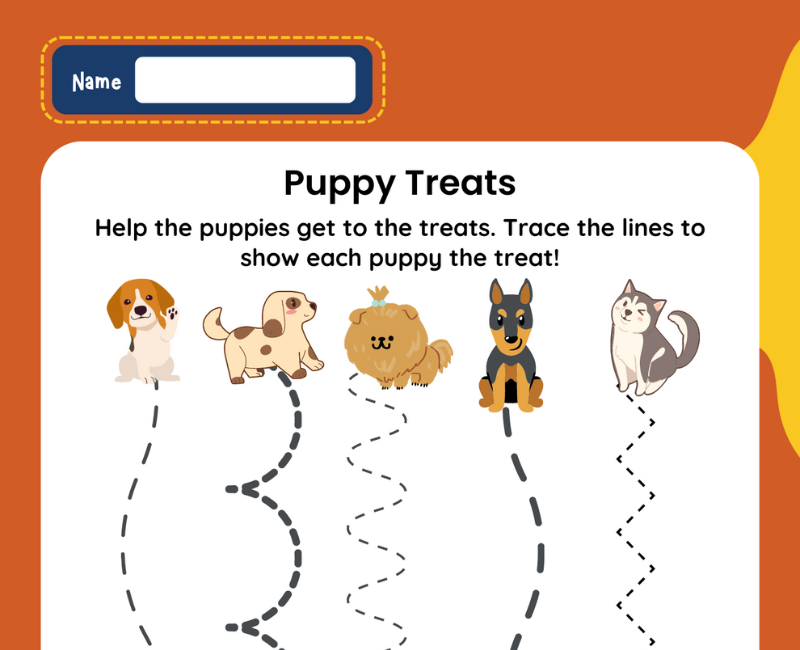
Help young children develop pencil control, hand-eye coordination and early handwriting skills with preschool tracing worksheets. Practise straight lines, curved lines, zigzags, waves, circles, squares and tracing dots through printable exercises and fun online tracing activities.
📝 Preschool Tracing Online Quiz
Identify lines, curves, shapes, patterns and drawing directions in this 20-question preschool online quiz. Each question has four answer options. The time limit is 20 minutes.
Which line goes from top to bottom?
Question Navigation
Green numbers indicate answered questions.
✍️ Interactive Preschool Line and Pattern Tracing
Select a tracing pattern and draw over the dotted guide using your finger, mouse or touchscreen pen. Start with simple strokes and gradually practise more challenging patterns.
This is freehand tracing practice. The activity does not automatically grade handwriting accuracy.
🎮 Preschool Tracing Online Activities and Games
Use these interactive games to recognise basic lines, shapes, patterns and directions before practising them on tracing worksheets.
1. 📏 Identify the Line
Which line lies flat?
2. 🔺 Recognise the Shape
Which shape has three sides?
3. ➡️ Follow the Direction
Which direction does → show?
4. 🧩 Complete the Pattern
Up, Down, Up, Down, __
5. 🔊 Listen and Choose
Listen to a shape or line name and choose the matching answer.
6. 🎨 Draw a Pattern Challenge
Trace a standing line from top to bottom.
Use the tracing board above to practise the challenge.
📚 About Preschool Tracing Worksheets PDF
Preschool tracing worksheets are early handwriting resources designed to help young learners practise controlled hand movements. Before children begin forming letters and numbers independently, they benefit from activities that involve following straight lines, curves, dots and simple shapes. These activities can support fine motor development, visual attention and confidence with drawing tools.
✏️ Pencil Control Worksheets for Preschool
Pencil control is an important early writing skill. Preschoolers learn to guide a pencil across a page by tracing standing lines, sleeping lines and slanting lines. Repeated practice helps children become familiar with movement and direction. Teachers can begin with large tracing patterns and gradually introduce smaller ones.
📏 Straight Line Tracing Worksheets
Straight line tracing activities include vertical, horizontal and diagonal strokes. These basic movements are used when children begin writing many letters and numbers. Standing line worksheets encourage top-to-bottom movements, while sleeping line worksheets introduce left-to-right pencil movement.
🌊 Curved Lines and Wave Tracing
Curved line tracing worksheets introduce rounded and flowing movements. Children may practise tracing arches, waves and loops. These activities encourage smooth hand movement and help prepare learners for rounded letter shapes such as C, O and S.
⚡ Zigzag Tracing Worksheets
Zigzag tracing helps children practise changing direction while keeping the pencil on a path. A simple zigzag combines slanting lines and turns. It can be introduced after children become comfortable with straight-line tracing.
🔵 Shape Tracing Worksheets for Preschool
Shape tracing activities introduce circles, squares, triangles and rectangles. Children can follow dotted outlines, identify the shapes and then attempt to draw them independently. Combining tracing with shape recognition makes early learning more meaningful.
🔸 Dot-to-Dot and Tracing Dots Worksheets
Tracing dots activities encourage children to connect points carefully. Beginners can start with two or three large dots and progress to longer paths. These exercises support visual tracking and hand-eye coordination.
🖐️ Pencil Grip and Handwriting Readiness
A comfortable pencil grip helps children draw and write without unnecessary strain. Adults can demonstrate how to hold a pencil and provide short, enjoyable practice sessions. Activities involving crayons, play dough, building blocks and colouring may also support the small hand movements used in handwriting.
📝 Preschool Tracing Online Quiz
The tracing online quiz helps children identify lines, shapes, patterns and directions. It complements practical tracing rather than replacing it. Younger children may need a parent or teacher to read the questions aloud.
🎮 Interactive Tracing Online Activities
Digital tracing games provide additional opportunities to practise drawing with a finger or mouse. Children can trace patterns, clear the board and try again. Printable tracing worksheets remain useful for practising pencil grip and paper-based handwriting.
🖨️ Download Tracing Worksheets for Preschool PDF
The downloadable tracing resource on this page can be used for preschool handwriting practice at home or in the classroom. Combine printed tracing exercises with interactive line and shape activities for varied learning opportunities.
📝 Five Preschool Tracing Practice Exercises
Exercise 1: Standing and Sleeping Lines
1. Draw five standing lines.
2. Draw five sleeping lines.
3. Trace three lines from top to bottom.
4. Trace three lines from left to right.
5. Draw one standing line and one sleeping line.
Show Guidance
Standing lines are vertical. Sleeping lines are horizontal. Encourage steady movements without rushing.
Exercise 2: Curves and Waves
1. Draw a big curve.
2. Trace three small curves.
3. Draw a wave pattern.
4. Trace a semicircle.
5. Draw a loop.
Show Guidance
Curves should be rounded and continuous. Waves move smoothly up and down. Loops form rounded turns.
Exercise 3: Zigzag and Slanting Lines
1. Draw a slanting line.
2. Draw a zigzag with three peaks.
3. Trace a diagonal line from top left to bottom right.
4. Draw a second diagonal in the opposite direction.
5. Make a zigzag mountain pattern.
Show Guidance
Slanting lines are diagonal. Zigzags combine alternating diagonal strokes and sharp turns.
Exercise 4: Trace the Shapes
1. Trace a circle.
2. Trace a square.
3. Trace a triangle.
4. Trace a rectangle.
5. Draw one shape independently.
Show Guidance
A circle is round. A square has four equal sides. A triangle has three sides. A rectangle has four sides with opposite sides equal.
Exercise 5: Connect the Dots
1. Connect two dots with a straight line.
2. Connect three dots to form a triangle.
3. Connect four corner dots to make a square.
4. Connect dots along a curved path.
5. Connect dots to create a simple house drawing.
Show Guidance
Encourage children to follow the dots in order. The goal is careful movement and recognition of the completed pattern.
👨👩👧 Tips for Parents and Teachers
- Begin with finger tracing in the air or on a large surface.
- Introduce standing and sleeping lines before complex patterns.
- Demonstrate the direction of each stroke.
- Use thick crayons or suitable pencils for comfortable practice.
- Keep activities short and positive.
- Combine tracing with colouring, play dough and shape recognition.
- Encourage children to try again without focusing only on perfect lines.
- Use printable worksheets for pencil practice and online activities for additional revision.
🔗 More Preschool Learning Worksheets
❓ Frequently Asked Questions
What are tracing worksheets for preschool?
They are early writing practice sheets that help children follow lines, curves, shapes and dotted patterns.
Which tracing patterns should preschoolers learn first?
Standing lines, sleeping lines and simple slanting lines are useful starting points. Curves, waves and zigzags can follow.
How do tracing worksheets help pencil control?
Tracing provides opportunities to practise directing a pencil along a path while coordinating hand movement with visual guidance.
Can children practise tracing online?
Yes. The interactive tracing board allows children to follow patterns using a finger, mouse or touchscreen pen.
Are tracing worksheets suitable for nursery children?
Yes. Large, simple patterns can be used with nursery learners, with adult guidance when needed.
What is the difference between line tracing and letter tracing?
Line tracing focuses on basic strokes and movements. Letter tracing applies those movements to the shapes of alphabet letters.
How often should preschool children practise tracing?
Short, enjoyable sessions based on the child's interest and comfort are generally more useful than long repetitive sessions.
 Download