
Where Is It? Move, Explore and Learn! 🧭
Scroll down for 20 quiz questions and 10 clickable games and activities. Move the ball, follow a garden maze, copy a picture and build a position tower.
👇 Your position-word adventure starts below! 😊
📝 Spatial Reasoning Quiz for LKG
20 questions: 5 easy, 7 average and 8 thinking questions. An adult can read aloud and demonstrate turns. Tap an answer to move automatically to the next question. Use numbered buttons or Previous/Next to revisit any question. The 20-minute timer starts with the first answer or question change.
⏱ Time left: 20:00
Question 1 of 20 • Easy • Answered 0/20
Where is the ball?
Question navigation — green means answered.
🎮 Spatial Reasoning Online Games for LKG
Move objects, follow directions, copy arrangements and match position pictures. Choose one game at a time. 😊
1. 🟠 Move the Ball
Tap a position to move the ball. Say where it is compared with the box.
Ready to play!
2. 🎯 Place the Ball at the Target
Tap a marked spot in the picture or use its button. Follow each instruction.
Put the ball above the box.
3. 🐰 Follow the Garden Maze
Move the rabbit from START to the carrot. Green squares are bushes. Directions refer to your screen.
Moves: 0. Find a clear route.
4. 🧩 Copy the Dot Arrangement
Look at the model. Tap cells in your board to place or remove dots, then check.
Copy model 1 of 3.
5. 🃏 Position Picture Memory
Find pairs of pictures with the same ball position.
Find four matching pairs.
✏️ Spatial Reasoning Online Activities for JR KG
Plan routes, stamp inside and outside, construct a tower, hunt for stars and turn arrows.
6. 🧠 Plan the Route Before Moving
Add direction steps to guide the rabbit to the carrot. Test your plan, then change it if a bush blocks the route. Directions refer to the screen.
Plan a route around the green bush.
7. ⭐ Stamp Inside and Outside
Follow each instruction to stamp a star. The two buttons place stars in different areas.
Stamp the next star inside the box.
8. 🏗️ Build the Position Tower
Copy the model: red at the top, gold in the middle and blue at the bottom. Choose a block, then a tower slot.
Ready to play!
9. 🔎 Find Stars Above or Below
Find the three stars above the blue line. Then switch to below for a new hunt.
Find stars above the line: 0 of 3.
10. 🧭 Turn the Arrow
Turn your arrow to match the model. Each click turns it a quarter turn.
Ready to play!
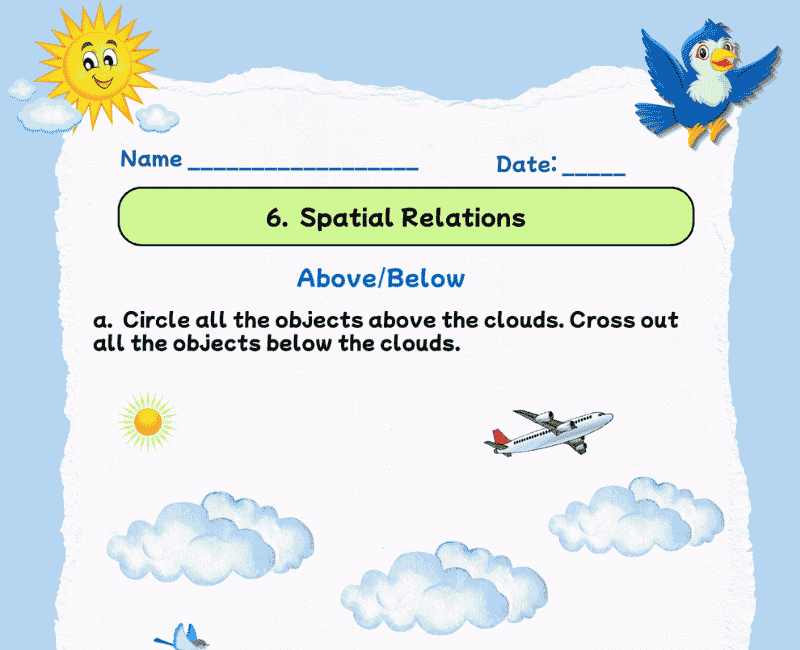
📄 Spatial Reasoning Worksheet for LKG
Use the existing download option near the top of this page for the printable worksheet. Practise position words with the online games, then connect the pictures with real objects.
📖 Read the spatial reasoning learning guide
A spatial reasoning worksheet for LKG helps children think about where things are, how they move and how an arrangement can be copied. Junior Kindergarten, also called JR KG, is a useful stage for exploring these ideas through objects, pictures and movement. Position words give children a way to describe relationships rather than simply naming objects.
Begin with inside and outside. Put a toy within a box, then take it beyond the box boundary. Ask your child to explain what changed. Repeat with a basket or a drawn outline. This makes the meaning visible before children identify the same relationship in a printable inside outside worksheet.
Explore above and below using a clear reference object. Hold a ball higher than a box, then lower than it. Compare above with on: a ball resting on the box touches its surface, while the picture of a ball above it shows a gap. An above below worksheet becomes easier when children have acted out the positions.
Near and far describe distance in relation to something. Two balls can be compared with the same house or chair: one is nearer and the other farther away. Beside means next to, while between describes an object in the space separating two others. Always name the reference objects so that the instruction is clear.
Spatial understanding also includes following a route and copying an arrangement. A child can move a toy along a path, place blocks to match a model or turn an arrow towards a target. These tasks encourage careful observation and planning. For screen activities, left and right refer to the edges of the displayed picture. Real-life direction games need a clearly agreed viewpoint.
The spatial reasoning quiz contains 20 original LKG-level questions: five easy, seven average and eight thinking questions. Pictures support identifying positions and comparing distances. Thinking questions ask children to predict swaps, changes in a tower, arrow turns and a missing dot in an arrangement. Children automatically move to the next question after choosing an answer and can return with numbered buttons. The timer and Submit button remain inside the quiz.
Ten online games and activities provide different ways to explore space. Children move a ball, place it at targets, navigate a garden maze, copy dot arrangements and match position pictures. They can also plan three routes before testing their direction steps, stamp stars inside and outside a box, build a tower, find stars above or below a line and rotate an arrow. Ask children to explain their choices and revise a plan when it does not work.
Parents and teachers can extend these activities with simple instructions during play: put a block beside a book, hide a toy under a chair or build a tower with a chosen colour at the top. Demonstrate one relationship at a time, allow children to point before speaking and invite them to give instructions too. Use nursery spatial worksheets for simpler practice and related UKG or Class 1 resources when children are ready.
💬 Spatial Reasoning FAQs for LKG
😊 What is spatial reasoning in simple words?
Spatial reasoning means thinking about where objects are, how they fit together and how their positions change. A child uses it when copying a block arrangement or moving a toy along a route.
🧭 Why is spatial reasoning important for JR KG children?
It supports understanding positions, following directions and solving visual problems. These experiences also build foundations for learning about shapes, space and measurement in maths.
📍 Which position words should LKG children learn?
Start with inside, outside, on, under, above and below. Add beside, between, near and far through play. Introduce left and right with a clear viewpoint and plenty of demonstrations.
🧸 How can parents teach spatial reasoning at home?
Use toys, boxes and blocks. Ask your child to put a toy inside a box, place a block beside a book or copy a small tower. Let your child give you position instructions too.
⬆️ What is the difference between above and on?
Above describes a higher position relative to something. On describes contact with a surface, such as a book resting on a table. A balloon above the table may have a gap beneath it.
📦 How do I teach inside and outside to my child?
Place a familiar toy inside a box and then outside it. Say the words as you move it. Next, ask your child to move the toy and describe its new position.
🧩 Which activities help children develop spatial skills?
Block building, simple puzzles, copying arrangements, toy routes and movement games offer useful practice. Talk about positions while children explore rather than asking them to memorise definitions.
↔️ What should I do if my child confuses position words?
Practise one contrasting pair at a time using real objects. Demonstrate, use gestures and let your child point or act before answering aloud. Keep the reference object and viewpoint clear.
📄 Are worksheets enough to teach spatial reasoning?
Worksheets provide picture practice, but children also benefit from handling objects and moving through space. Combine printable tasks with blocks, toys, drawing and everyday position talk.
 Download


