Joyful Mathematics • Class 1 • Chapter 1
Finding the Furry Cat Class 1 Worksheet
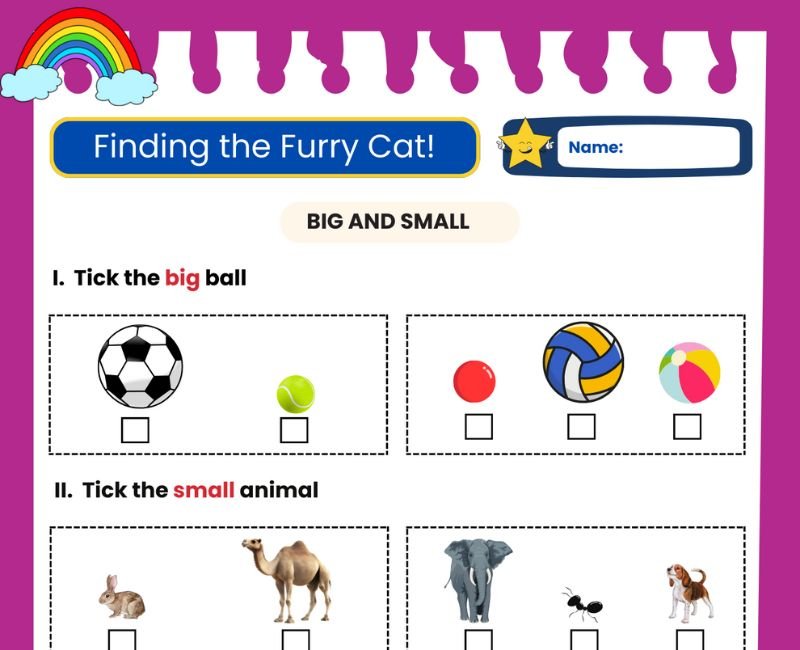
Explore position words through observation, conversation and hands-on practice with this Finding the Furry Cat Class 1 worksheet. Use this resource alongside NCERT Class 1 Maths Chapter 1 – Finding the Furry Cat! (Pre-number Concepts) in the Joyful Mathematics textbook.
Where is the cat? Is it inside a box, under a chair or near a basket? Simple questions help children describe where objects are. The original activities below provide extra practice with positional language before or after completing the downloadable worksheet.
What Are Pre-number Concepts?
Pre-number concepts are early ideas that help children describe, compare and organise their surroundings. In Finding the Furry Cat, the focus is on understanding positions and relationships through familiar situations.
Children practise words such as inside, outside, on, under, above, below, near, far, top and bottom. They also explore order using before and after. These activities encourage children to listen to directions, observe carefully and explain what they see.
Begin with actual objects and short instructions. A child can show understanding by placing an object correctly, even before being able to read or write the position word independently.
Inside and Outside: Try It with a Box
Use an open box and a small toy. Place the toy inside the box, then move it outside. Ask the child to describe each position in a complete sentence.
- Put the toy inside the box.
- Place a pencil outside the box.
- Point to the object that is inside.
- Tell an adult where the pencil is.
Use the box as the reference object throughout the activity. Changing the reference without explaining it can confuse children. Once the words are familiar, repeat with a basket or school bag.
On, Under, Above and Below
Place a book on a table and a ball under it. Ask the child to identify each object's position. “On” usually describes contact with a surface, while “above” can describe something higher without touching it.
For example, a book may be on a shelf, while a picture hangs above the shelf. A mat can be below a chair. Invite children to point to the reference object whenever they describe a position.
Draw a box. Draw a ball above it and a small circle below it. Explain where each drawing is. These are additional practice instructions, not answers to a textbook picture.
Near, Far, Top and Bottom
Place two objects at clearly different distances from a chair. Ask which object is near the chair and which is far from it. Keep the reference point fixed, because an object can be near one thing and far from another.
For top and bottom, use a cupboard, a drawing or a page. Ask the child to point to the top of the page and then the bottom. Follow with a drawing task: write or draw one item near the top and another near the bottom.
Use clear differences first. Avoid making children guess between objects that are almost equally distant.
Before and After: Make a Paper Train
Arrange three labelled cards from left to right: Red coach, Green coach, Yellow coach. Explain that the train's front is on the left. Ask which coach comes before the green coach and which comes after it.
The red coach is before the green coach, and the yellow coach is after it. Rearrange the cards and ask again. This helps children understand the relationship rather than memorising one answer.
Keep the direction and starting point clear. Position words describe relationships, so the reference coach must be identified in each question.
Finding the Furry Cat: Original Practice Questions
Read each situation and choose the correct word. All the information needed is given in the sentence.
- A toy cat is placed within an open basket. It is inside / outside the basket.
- A book rests on the tabletop. It is on / under the table.
- A ball lies on the floor beneath a chair. It is above / under the chair.
- A picture hangs higher than a shelf. It is above / below the shelf.
- A pencil is placed beside a bag, very close to it. It is near / far from the bag.
- Three cards read A, B, C from left to right. Which card is immediately before B? A / C
Show Answers to These Practice Questions
1. Inside
2. On
3. Under
4. Above
5. Near
6. A
How to Use the Class 1 Chapter 1 Worksheet
Use the worksheet download option on this page for practice alongside the NCERT textbook. Begin by discussing the pictures and reading directions aloud. Let children point, move objects or answer orally before asking them to write.
Complete a small set of questions at a time. If an answer is incorrect, ask the child to identify the reference object and describe the position again. Give clear directions such as “Place the block under the chair” rather than “Put it there”.
Teachers can use a short find-the-object activity, while parents can practise with everyday household objects. The activities on this page are supplementary revision examples; answers to picture-based worksheet questions depend on the actual picture shown.
Continue with NCERT Joyful Mathematics Worksheets
Explore related chapters as your child develops early mathematical understanding.
Chapter 2: What Is Long? What Is Round?Explore shapes and the properties of familiar objects. Chapter 3: Mango Treat
Practise counting and numbers from 1 to 9. Chapter 13: So Many Toys
Count groups and compare quantities.
Related General Grade 1 Maths Practice
These topic-based resources provide additional practice alongside chapter learning.
Spatial Understanding Worksheet for Class 1Continue practising position and spatial relationships. Numbers from 1 to 9 Worksheet
Move from positional activities to early counting practice. Browse All Grade 1 Maths Worksheets
Find general topic worksheets and NCERT chapter resources.
Finding the Furry Cat Class 1 FAQs
Which chapter is Finding the Furry Cat in Class 1 Maths?
Finding the Furry Cat! is Chapter 1 of the NCERT Joyful Mathematics Class 1 textbook. It introduces pre-number concepts through positional language and activities.
What are positional words?
Positional words describe where something is in relation to something else. Examples include inside, outside, on, under, above, below, near and far.
How can I teach inside and outside?
Use a box and an object. Move the object inside and outside while saying the words. Then ask the child to follow the same directions independently.
What is the difference between on and above?
“On” usually indicates contact with a surface, as in a book on a table. “Above” describes a higher position and does not require contact, as in a picture above a shelf.
How do I explain near and far?
Choose a reference object and place two objects at clearly different distances from it. Identify the nearer and farther object without changing the reference point.
Can children complete these activities without reading?
Yes. An adult can read the directions, and children can respond by pointing, speaking, drawing or moving objects. Independent reading is not required for practising the concepts.
How can I practise before and after?
Arrange cards or objects in a line, explain the direction and identify a reference item. Ask which item comes immediately before or after it.
Are answers included for the questions on this page?
Yes. Open “Show Answers to These Practice Questions” below the original practice activity. Those answers apply to the situations described on this page.
 Download