Little Groups, Big Discoveries! ➕🌟
Scroll down for 20 picture-addition quiz questions and 10 clickable games and activities. Build totals, balance groups and solve addition clues with numbers up to ten.
👇 Your addition adventure starts below! 😊
📝 Addition with Pictures Quiz for LKG
20 questions: 5 easy, 7 average and 8 thinking questions. An adult can read aloud. Tap an answer to move automatically to the next question. Use numbered buttons or Previous/Next to revisit any question. The 20-minute timer starts with the first answer or question change.
⏱ Time left: 20:00
Question 1 of 20 • Easy • Answered 0/20
Join the two groups. How many balls altogether?
Question navigation — green means answered.
🎮 Addition with Pictures Online Games for LKG
Run an addition machine, feed penguins, plan number hops, design dominoes and match memory pairs. Choose one game at a time. 😊
1. 🤖 Run the Addition Machine
Choose two inputs to make the target. Try more than one way.
Target 6.
Target 6. Your inputs: 0 and 0.
2. 🐧 Feed the Penguin Team
Give each penguin exactly two fish. Tap a penguin’s button to add a fish.
Two fish each. Total delivered: 0.
3. 🐰 Jump Along the Number Path
Start at 2. Add hops to land exactly on 8. You can try different hop plans.
Current number: 2. Target: 8.
4. 🎲 Design a Domino Total
Add dots to the two halves to make seven. Save two different combinations.
Target: 7. Dots: 0 + 0. Different combinations saved: 0.
5. 🃏 Addition Pair Memory
Match a number sentence with its total. An adult can read the cards aloud.
Find four sentence–total pairs.
🧠 Picture Addition Online Activities for JR KG
Build missing groups, keep a total unchanged, balance two sides, pack a school bag and solve two clues together. An adult can read each short prompt.
6. 💎 Complete the Treasure Chest
Some gems are already in the chest. Build the missing group to reach the target total.
Already 3 gems. Make 7 altogether.
Already 3. Target 7. Extra gems built: 0.
7. 🔄 Change the Parts, Keep the Total
Move counters between groups. Make six in A and two in B without changing the total of eight.
Goal: A = 6, B = 2. Now A: 4, B: 4.
8. ⚖️ Balance the Addition Sides
Left has 2 + 3 counters. Right has one counter already. Add the missing right-side group to balance the totals.
Left total: 5. Right total: 1. Extra group: 0.
9. 🎒 Pack the School Bag
The bag already has books. Add pencils so the total number of items matches the packing ticket.
Packing ticket: 8 items, including 3 books.
Ticket: 8 items. Books: 3. Pencils added: 0.
10. 🧠 Solve Two Addition Clues
Build two groups that satisfy both clues. You can revise each group before checking.
Total 9. B has exactly one more than A.
Total 9. B has exactly one more than A. Now A: 0, B: 0.
📄 Addition with Pictures Worksheet for LKG
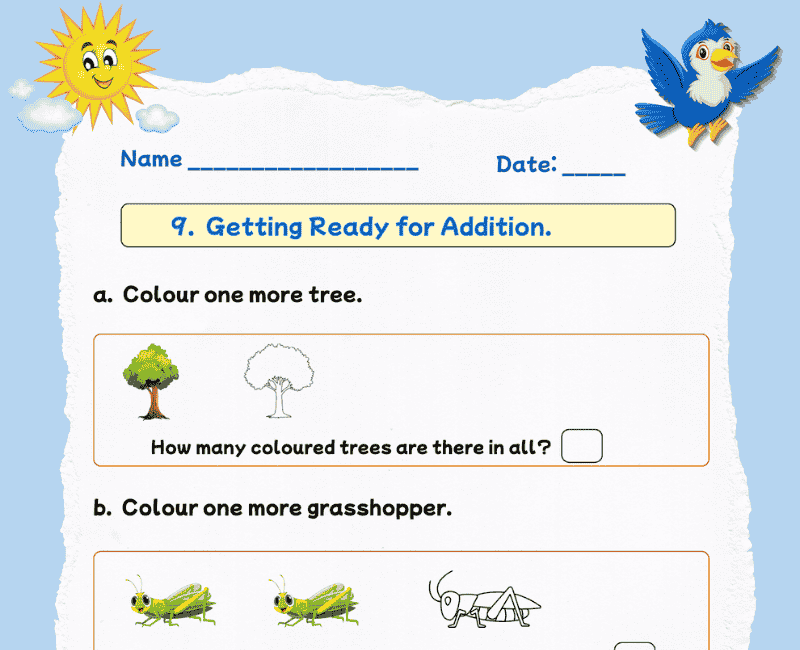
Use the existing download option near the top of this page for the printable worksheet. Count each picture group, join the groups and write the total on paper.
📖 Read the LKG picture-addition learning guide
An addition with pictures worksheet for LKG helps children understand what happens when two groups are joined. Instead of learning number sentences alone, children can see the objects, count them and connect the combined quantity to a numeral. Junior Kindergarten, also called JR KG, is a good stage for exploring this idea with small groups and familiar materials.
Begin with real objects such as blocks or counters. Put two objects in one group and one in another. Ask the child to bring the groups together and count all three objects. Say the addition story aloud: two and one more make three. Move from real objects to pictures when the child can explain what joining the groups means.
Introduce the plus sign as a way to show adding or joining. The equals sign means that the quantities on both sides have the same value. Connect 2 + 1 = 3 to the objects rather than treating the symbols as a copying exercise. Let children say the number sentence and point to each group before recording an answer.
Keep early totals small and gradually explore quantities up to ten. Children may count every object at first. Later, they can count on from a known group: with five objects already counted and two extra objects, say six, seven. If a child begins again at five, model touching only the new objects while saying the next number words.
Picture addition also develops reasoning. Rearrange two groups and ask whether the total changes. Move one counter from one group to the other without adding or removing any. Children can check that the parts change while the whole stays the same. Swapping the order of two groups also keeps their combined total unchanged.
Missing-group tasks connect addition to finding an unknown part. If a treasure chest needs seven gems and already contains three, let the child add gems until there are seven. Ask how many were added and how the child checked. Counters and pictures provide support without requiring abstract methods before the idea is understood.
The quiz has five easy, seven average and eight thinking questions. It begins with joining visible groups, then explores zero, counting on, missing parts and changes to a total. Selecting an answer moves to the next question. Number buttons and Previous and Next controls allow children to revisit questions before submitting.
The ten online games and activities give different kinds of practice. Children create inputs for an addition machine, share fish among penguins, plan hops and construct domino combinations. Thinking activities involve building a missing group, preserving a total, balancing two expressions and satisfying two clues. Parents and teachers can read prompts, encourage predictions and invite children to explain their choices. Use short sessions and return to simpler counting when a child needs support.
💬 Addition with Pictures FAQs for LKG
😊 What does addition mean for an LKG child?
Addition means finding the total when groups are joined or more objects are added. Begin with small groups the child can handle and count.
🧱 How can I teach addition with pictures in JR KG?
Start with real counters, join two groups and count the total. Then show matching picture groups and connect them to a number sentence such as 2 + 1 = 3.
🔢 Which numbers should I use for beginning addition?
Use very small groups first, with totals the child can count confidently. Gradually explore totals up to ten as understanding develops. Avoid increasing the numbers just to make a task harder.
➕ How do I explain the plus and equals signs?
Use plus to describe adding or joining. Explain equals as having the same value. Show that the objects on the left of 2 + 1 = 3 have the same quantity as the total on the right.
🐰 What is the difference between counting all and counting on?
Counting all means counting every object in both groups from one. Counting on starts with a known quantity and counts only the extra objects. For five and two more, count six, seven.
🤔 Why does my child start from five again when adding two to five?
The child may still be learning to hold the first quantity in mind. Keep the group of five visible, say that it is already counted and touch each new counter while saying six, seven. Counting all remains a useful way to check.
💎 How can I teach missing-number addition?
Use a visible starting group and a target total. If there are three counters and the target is seven, let the child add counters until seven are present, then count the added group.
🔄 Does changing the order of the groups change the answer?
No. Joining two and five makes the same total as joining five and two. Use two coloured groups, swap their positions and count to check.
🧠 Which addition activities develop thinking skills?
Ask children to build a target in different ways, predict what happens when a counter moves between groups, balance two totals or solve a total-and-group clue together. Encourage explanations supported by objects.
 Download