Count, Build and Play with Numbers 0 to 50! 🔢🌈
20 quiz questions and 10 interactive counting games. Touch apples, build tens, deliver number mail and trace your favourite numbers!
📝 0 to 50 Counting Quiz for LKG
⏱ Time Left: 20:00
Question 1 of 20 • Answered: 0/20
How many apples?
Question navigation
🎮 Counting Games for LKG
1. 🔢 Number Explorer
Choose a number. See its name and groups of ten.
0 — Zero
0 tens and 0 ones.
2. 🍎 Touch and Count
Tap each apple once. Then check that every apple has been counted.
Count this apple group.
Ready to play!
3. 🃏 Number-name Memory
Match 0, 10, 20 and 50 with their names. Reveal two cards at a time.
Find four pairs.
4. 🚂 Cross-the-Twenty Train
Tap tickets in counting order from 19 to 24.
🚂 Empty train
Ready to play!
5. 📮 Deliver Tens Mail
Select a number envelope, then the matching groups-of-ten mailbox.
Ready to play!
🧠 Number Activities for Junior KG
6. 🧺 Make an Empty Basket
Remove every orange. What number describes the empty basket?
6 oranges
Ready to play!
7. 🏗️ Build Tens and Ones
Use tens and ones to build the target number.
Build 24. Current total: 0
Ready to play!
8. 🐸 Number-path Hops
Help the frog hop from 27 to 32. Select the next number each time.
🐸 27
Ready to play!
9. 🔧 Repair Missing Numbers
Complete all three number strips.
9 → ? → 11
29 → ? → 31
48 → ? → 50
Ready to play!
10. ✍️ Trace Numbers 0–50
Choose a number, then trace with the red pen. Undo removes the latest stroke. Clear keeps the guide.
Ready to play!
📄 14 Pages 0 to 50 Counting Numbers Worksheet for LKG
Use the existing download option on this page for the printable worksheet. Add short paper practice to the online counting games.
📖 Read the 0 to 50 counting learning guide
A 0 to 50 counting numbers worksheet for LKG brings together number recognition, counting order and quantity. LKG is also called Junior KG or JR KG. The range gives families a resource to revisit gradually. Start with groups the child can count accurately and extend towards larger numbers when ready.
Reciting number names is different from counting objects. Invite a child to touch or move one object for each spoken number. The last number tells how many objects are in the whole group. The touch-and-count activity records each apple once so repeated taps do not increase the count.
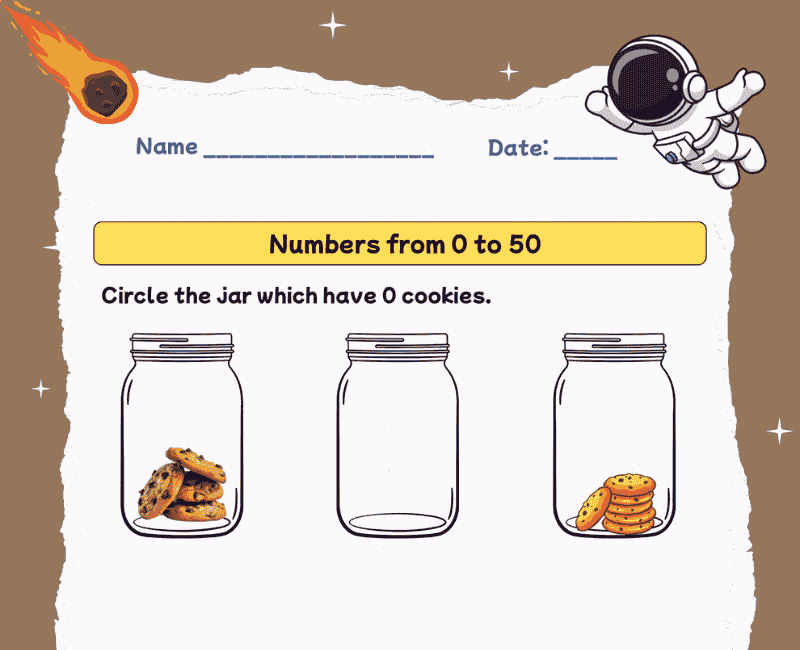
Introduce zero with an empty group. Place a few objects in a basket, remove them and describe what remains: none, or zero. A written 0 represents this quantity. Compare an empty basket with a basket containing one object before introducing larger totals.
Practise number order in small sections. The train crosses from 19 to 20, and the frog path crosses from 29 to 30. These transitions help children notice how counting continues beyond a familiar group of ten. Missing-number strips ask them to check both neighbours rather than choose a numeral only because it looks familiar.
Groups of ten make larger quantities easier to organise. The number explorer displays complete groups of ten and any remaining ones. In 34, three tens make 30 and four ones make 34. Children can build these groups with classroom counters or bundled sticks, then compare the concrete total with the numeral.
Number names, numerals and quantities offer different representations of the same value. Show 20, say twenty and arrange two groups of ten. The memory and mail games revisit these connections. An adult can read number names aloud so the learning task stays focused on numbers rather than independent reading.
Use the quiz results to choose what to revisit: zero, order, quantity or tens and ones. Rearranging a group does not change its number of objects, while adding or removing objects does. Ask a child to explain a count and check it by counting again.
Optional number tracing includes every numeral from 0 to 50 with a red pen, Undo and Clear. Follow the handwriting model taught in class on paper. Pair recognition with meaningful counting instead of relying only on repeated copying. Keep practice short and responsive to interest and current confidence.
💬 0 to 50 Counting Worksheet FAQs
😊 How do I teach counting 0 to 50 to an LKG child?
Start with small familiar groups. Match one spoken number to each object, then extend number order gradually. Use larger ranges when the child is ready.
😊 What is one-to-one correspondence in counting?
It means matching one number word to one object. Touch or move each object once so none is skipped or counted twice.
😊 Why can my child recite numbers but not count objects?
Reciting a sequence and tracking objects are different skills. Slow down and practise touching one object for each number word.
😊 How do I explain zero to a child?
Use an empty basket. Remove all the objects and explain that none remain, so the total is zero.
😊 How can I teach the change from 19 to 20 or 29 to 30?
Arrange a short sequence of number cards across the change. Say each number and use a group of ten to show the completed ten.
😊 What does the last counting number tell us?
It tells the total number of objects in the group. After counting, ask how many altogether.
😊 How do I introduce tens and ones?
Bundle ten counters or sticks as one group of ten. Keep the extra ones separate. Two tens and four ones make 24.
😊 Does moving objects apart change how many there are?
No, if no objects are added or removed, the total stays the same. Count the group before and after moving it.
😊 Should every LKG child count 50 objects independently?
Use the range according to current readiness and classroom goals. Accurate small-group counting is a useful foundation for larger quantities.
😊 How do I download the 14-page counting worksheet?
Use the existing download option on this page. The online quiz and games provide additional practice alongside the printable worksheet.
 Download