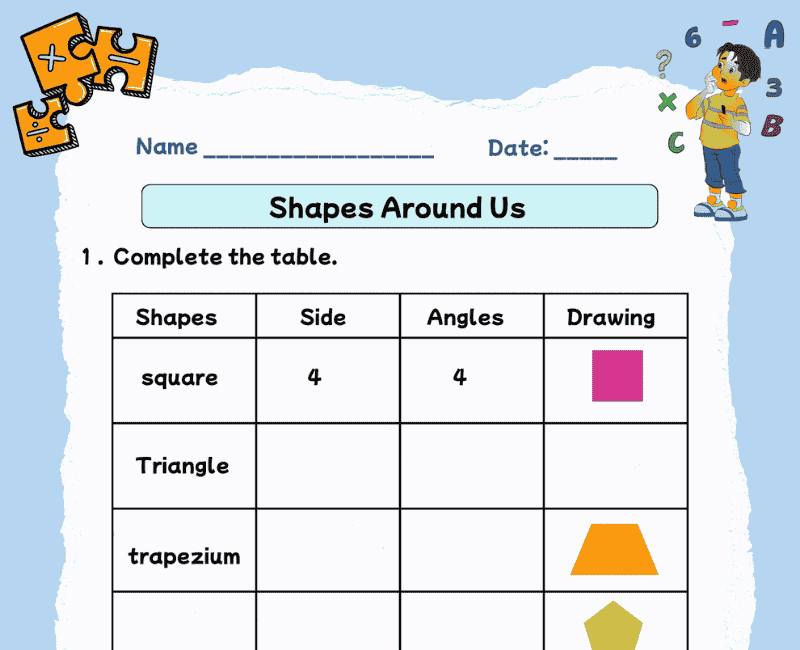
NCERT Class 4 Maths
Shapes Around Us Class 4 Maths Worksheet with Quiz and Activities
NCERT Maths Mela Chapter 1: count the faces, edges and corners of cubes, cuboids, cylinders, cones, spheres, prisms and pyramids, fold nets and see why triangles are strong. On WitKnowLearn you get the Shapes Around Us Class 4 online quiz, online activities and interactive games, maths labs and a practice sheet, all on one page.
Flip the cards and try the Shadow Lab, then tap the Games, Labs or Challenges square.
Shapes Around Us Class 4 Online Quiz
20 questions · tap an answer to move on · full review at the end
Flip the cards, try the Shape Counter Lab, then play the games, do the labs and take the challenges. Earn up to 3 stars in every activity.
Fact cards: tap a card to flip it
Shape Counter Lab
Count the faces, edges and corners of a cube, a square pyramid and a triangular prism. Dotted lines show the hidden edges at the back. Drag a number into each box. A wrong number shows a hint for counting.
Challenge marks: 0 / 15 (0 of 5 challenges done)
Finish all 5 challenges to see your comment.
Practice sheet
Shapes Around Us Class 4 Activities
Count faces, edges and corners, sort rolling shapes, fold nets and name angles. Earn up to 3 stars in every activity.
What are 3D shapes?
3D shapes are solid shapes that have length, breadth and height, like a cube, cuboid, cylinder, cone, sphere, prism and pyramid. We describe them by their faces, edges and corners.
Look at a train 🚂: its carriages are like cuboids, its wheels are cylinders and its funnel is like a cone!
Shapes and their parts
| Shape | Faces | Edges | Corners |
|---|---|---|---|
| 🎲 Cube | 6 | 12 | 8 |
| 🔺 Square pyramid | 5 | 8 | 5 |
| ⛺ Triangular prism | 5 | 9 | 6 |
| 🥫 Cylinder | 2 flat + 1 curved | 2 | 0 |
| ⚽ Sphere | 1 curved | 0 | 0 |
How to count faces, edges and corners
- Hold a real object, like a dice or a box.
- Count the faces: top, bottom, then around the sides.
- Count the edges: top, bottom, then the ones standing up.
- Count the corners: top, then bottom. Mark each one as you count.
More examples
This Shapes Around Us worksheet for Class 4 (NCERT Maths Mela Chapter 1) turns 3D shapes into a train ride with online activities and interactive games. Flip the cards, count in the Shape Counter Lab, then play the games, do the maths labs and try the challenges.
Maths Shapes Around Us Class 4
Shapes Around Us is Chapter 1 of the new NCERT Maths Mela textbook for Class 4. It looks at the shapes we see in buildings, monuments and everyday objects, and teaches children to describe solid (3D) shapes by their faces, edges and corners. Children learn about cubes, cuboids, cylinders, cones, spheres, prisms and pyramids, make and fold nets, see why triangles make strong structures, and revise circles and angles. This guide explains each idea in simple language for Class 4 students, parents and teachers. It goes with the Shapes Around Us worksheet for Class 4 on WitKnowLearn, which also gives an online quiz, online activities and interactive games on the same page.
Introduction to NCERT Class 4 Maths Chapter 1: Shapes Around Us
Book: NCERT Maths Mela, Class 4 (new syllabus). Chapter: 1, Shapes Around Us. The activities on this page follow the ideas of the chapter in our own words and examples; they are not copied from the textbook.
What is there in this chapter
- Shapes in buildings, monuments and objects around us
- 3D shapes: cube, cuboid, cylinder, cone, sphere, prism and pyramid
- Faces (flat and curved), edges and corners
- Nets that fold into 3D shapes
- Why triangles make strong structures
- Circles (centre, radius, diameter) and angles
Learning objectives
These objectives are written for this page from the chapter's goals; they are not copied from the book.
- Name 3D shapes and find them in everyday objects.
- Count the faces, edges and corners of solid shapes.
- Match a net with the shape it makes.
- Use the link between the radius and the diameter of a circle.
Learning outcomes
After this page a child can:
- Say that a cube has 6 faces, 12 edges and 8 corners.
- Tell that a cylinder has 2 flat faces, 1 curved face and 2 edges.
- Pick the net of 6 squares that folds into a cube.
- Explain why a triangle of sticks does not bend when pushed.
Shapes Around Us Class 4 resources on this page
| Resource | What it does |
|---|---|
| Shapes Around Us Class 4 online quiz | 20 questions in three levels with a full answer review |
| Flip cards | Six cards on 3D shapes, faces and edges, curved shapes, pyramids, nets and strong triangles |
| Shape Counter Lab | Count the faces, edges and corners of a cube, a square pyramid and a triangular prism |
| 5 interactive games | Roll or not, curved face bubbles, shape memory, shape gaps, shape pick |
| 5 maths labs | Counting, circles, nets, angles, flat or curved |
| 5 challenges | Marked out of 3 each with a total out of 15 |
| Practice sheet | 16 questions with answer boxes and a live score |
Faces, edges and corners
| Shape | Faces | Edges | Corners | Example |
|---|---|---|---|---|
| Cube | 6 | 12 | 8 | Dice |
| Cuboid | 6 | 12 | 8 | Brick |
| Square pyramid | 5 | 8 | 5 | Pyramids of Egypt |
| Triangular pyramid | 4 | 6 | 4 | A paper pyramid |
| Triangular prism | 5 | 9 | 6 | A tent |
| Cylinder | 2 flat, 1 curved | 2 | 0 | Tin can |
| Cone | 1 flat, 1 curved | 1 | 1 tip | Ice cream cone |
| Sphere | 1 curved | 0 | 0 | Ball |
Types of questions
- Name the shape of an object
- Count faces, edges and corners
- Which net makes this shape?
- Roll or slide?
- Radius, diameter and angles
Solved examples
Common mistakes
| Mistake | Correct |
|---|---|
| A cube has 8 faces | A cube has 6 faces and 8 corners. |
| Forgetting hidden edges at the back | Count the dotted (hidden) edges too. |
| A sphere has 1 edge | A sphere has no edges or corners. |
| Any 6 squares make a cube net | Only some arrangements fold into a cube. |
Daily life
Boxes are cuboids, cans are cylinders, balls are spheres and tents are prisms. Builders use triangles in bridges, towers and roofs because they are strong.
Tips for parents and teachers
- Collect boxes, cans and balls and sort them by shape.
- Count faces, edges and corners using a real dice or box.
- Cut open an empty box to see its net.
- Build shapes with straws or matchsticks and clay.
- Let the child retry the challenges to earn 3 stars.
Related NCERT Maths Mela Class 4 Worksheets
- Chapter 2: Hide and Seek Class 4
- Chapter 3: Patterns Around Us Class 4
- Chapter 4: Thousands Around Us Class 4
- Chapter 5: Sharing and Measuring Class 4
- Chapter 6: Measuring Length Class 4
- Chapter 7: The Cleanest Village Class 4
- Chapter 8: Weigh it, Pour it Class 4
- Chapter 9: Equal Groups Class 4
- Chapter 10: Elephants, Tigers and Leopards Class 4
- Chapter 11: Fun with Symmetry Class 4
- Chapter 12: Ticking Clocks and Turning Calendar Class 4
- Chapter 13: The Transport Museum Class 4
Frequently Asked Questions
 Download