Class 4 Maths
Factors and Multiples Class 4 Maths Worksheet with Quiz and Activities
Find factors and multiples, tell prime from composite numbers, grow factor trees, climb the ladder method and find common factors and multiples. On WitKnowLearn you get the Factors and Multiples Class 4 online quiz, online activities and interactive games, maths labs and a practice sheet, all on one page.
Flip the cards and try the Shadow Lab, then tap the Games, Labs or Challenges square.
Factors and Multiples Class 4 Online Quiz
20 questions · tap an answer to move on · full review at the end
Flip the cards, grow trees in the Factor Tree Lab, then play the games, do the labs and take the challenges. Earn up to 3 stars in every activity.
Fact cards: tap a card to flip it
Factor Tree Lab
Grow factor trees for 24, 36 and 60. On each branch, drop the smallest prime factor on the left and the other factor on the right. Keep going until every branch ends in a prime. A wrong number shows a hint.
Challenge marks: 0 / 15 (0 of 5 challenges done)
Finish all 5 challenges to see your comment.
Practice sheet
Factors and Multiples Class 4 Activities
Grow factor trees, climb the ladder method, sort primes and pop multiples. Earn up to 3 stars in every activity.
What are factors and multiples?
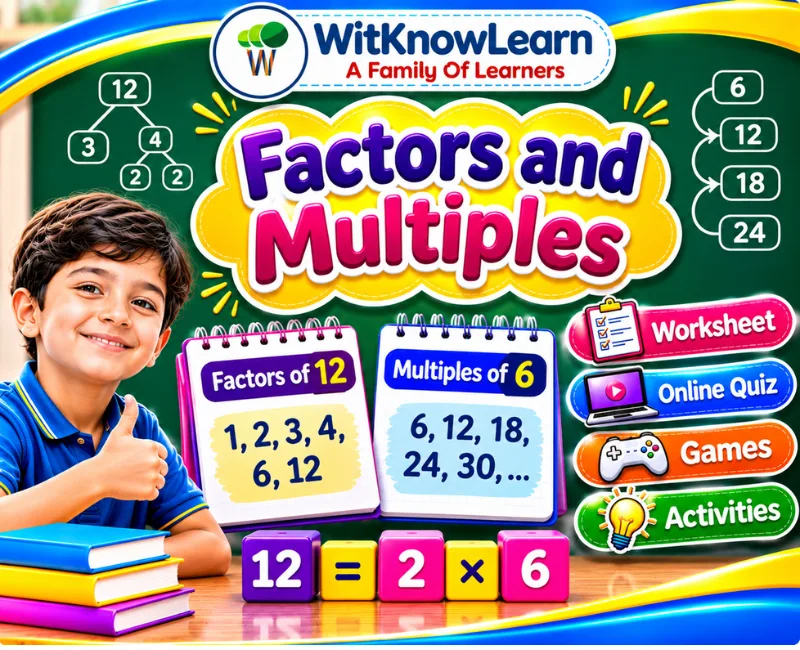
A factor is a number that divides another number exactly. A multiple is what we get when we multiply a number by 1, 2, 3 and so on. Since 3 × 4 = 12, the numbers 3 and 4 are factors of 12, and 12 is a multiple of 3 and of 4.
Think of a train 🚂 with 12 seats in each carriage: the seat numbers at the end of each carriage, 12, 24, 36, are multiples of 12!
Words to know
| Word | Meaning | Example |
|---|---|---|
| 🔢 Factor | divides exactly | 1, 2, 3, 4, 6, 12 for 12 |
| 🦘 Multiple | in the times table | 5, 10, 15, 20 for 5 |
| 🔍 Prime | exactly 2 factors | 2, 3, 5, 7, 11 |
| 🧱 Composite | more than 2 factors | 4, 6, 8, 9, 10 |
Two ways to find prime factors
- 🌳 Factor tree: split the number into two factors, and keep splitting until every branch is a prime.
- 🪜 Ladder method: divide by the smallest prime that fits, write the answer below, and repeat until you reach 1.
- Both ways give the same answer: 36 = 2 × 2 × 3 × 3.
More examples
This Factors and Multiples worksheet for Class 4 turns factor trees and the ladder method into a train ride with online activities and interactive games. Flip the cards, grow trees in the Factor Tree Lab, climb the ladder in the labs and challenges, and play the games.
Maths Factors and Multiples Class 4
Factors and multiples are two ideas that come from multiplication. A factor is a number that divides another number exactly, and a multiple is what we get when we multiply a number by 1, 2, 3 and so on. In Class 4, children find factors and factor pairs, list multiples, tell prime numbers from composite numbers, break numbers into prime factors using a factor tree and the ladder (division) method, and find common factors and common multiples. This guide explains each idea in simple language for Class 4 students, parents and teachers. It goes with the Factors and Multiples worksheet for Class 4 on WitKnowLearn, which also gives an online quiz, online activities and interactive games on the same page.
Introduction to Class 4 Maths: Factors and Multiples
Subject: Maths, Class 4. Topic: Factors and multiples. This page is built around the learning goals schools test for the topic in any board; it is not a copy of a single textbook chapter.
What is there in this topic
- Factors and factor pairs
- Multiples and skip counting
- Prime and composite numbers; 1 is neither
- Prime factors using a factor tree
- Prime factors using the ladder (division) method
- Common factors and common multiples
Learning objectives
These objectives are written for this page from the topic's goals; they are not copied from any one book.
- Find all the factors of a number using factor pairs.
- List the multiples of a number.
- Tell prime numbers from composite numbers.
- Write a number as a product of primes with a factor tree or the ladder method.
Learning outcomes
After this page a child can:
- List the factors of 18: 1, 2, 3, 6, 9, 18.
- Write the first five multiples of 4: 4, 8, 12, 16, 20.
- Draw a factor tree to show 24 = 2 × 2 × 2 × 3.
- Use the ladder method to show 36 = 2 × 2 × 3 × 3.
Factors and Multiples Class 4 resources on this page
| Resource | What it does |
|---|---|
| Factors and Multiples Class 4 online quiz | 20 questions in three levels with a full answer review |
| Flip cards | Six cards on factors, multiples, prime numbers, factor trees, the ladder method and arrays |
| Factor Tree Lab | Grow factor trees for 24, 36 and 60 by dropping numbers onto each branch |
| 5 interactive games | Prime or composite, multiples of 4 bubbles, factor pair memory, factor gaps, quick check |
| 5 maths labs | Factor pairs, factor tree for 40, multiples, ladder method for 36, factor or multiple |
| 5 challenges | Including a ladder climb for 48, marked out of 3 each with a total out of 15 |
| Practice sheet | 16 questions with answer boxes and a live score |
Factors and multiples
| Idea | Meaning | Example |
|---|---|---|
| Factor | Divides a number exactly | Factors of 12: 1, 2, 3, 4, 6, 12 |
| Multiple | The number × 1, 2, 3… | Multiples of 5: 5, 10, 15, 20… |
| Prime number | Exactly 2 factors | 2, 3, 5, 7, 11, 13 |
| Composite number | More than 2 factors | 4, 6, 8, 9, 10, 12 |
Factor tree method
| Step | Example: 24 |
|---|---|
| 1. Split into two factors | 24 = 2 × 12 |
| 2. Split any composite branch | 12 = 2 × 6 |
| 3. Keep going | 6 = 2 × 3 |
| 4. Stop when every branch is prime | 24 = 2 × 2 × 2 × 3 |
Ladder (division) method
| Divide by | Number |
|---|---|
| 2 | 36 |
| 2 | 18 |
| 3 | 9 |
| 3 | 3 |
| 1 → so 36 = 2 × 2 × 3 × 3 |
Types of questions
- List the factors or multiples
- Prime or composite
- Factor tree
- Ladder method
- Common factors and multiples
Solved examples
Common mistakes
| Mistake | Correct |
|---|---|
| 1 is a prime number | 1 has only one factor, so it is neither prime nor composite. |
| Mixing up factors and multiples | Factors divide the number; multiples come from the times table. |
| Stopping a factor tree too early | Keep going until every branch is a prime. |
| Missing a factor pair | Test 1, 2, 3… in order and write each pair. |
Daily life
We use factors when we arrange chairs in equal rows or pack sweets in equal packets, and multiples when we work out when two buses or bells will meet again.
Tips for parents and teachers
- Arrange counters in rectangles to find factor pairs.
- Skip count aloud to practise multiples.
- Draw factor trees for house numbers or dates.
- Practise the ladder method with small numbers first.
- Let the child retry the challenges to earn 3 stars.
Related Class 4 Maths Worksheets
- Addition Worksheet Class 4
- Large Numbers Worksheet Class 4
- Subtraction Worksheet Class 4
- Multiplication Worksheet Class 4
- Geometry Worksheet Class 4
- Division Worksheet Class 4
- Fractions Worksheet Class 4
- Measurement Worksheet Class 4
- Thousands Around Us Worksheet Class 4
- Tables and Shares Worksheet Class 4
- Smart Charts Worksheet Class 4
- Equal Groups Worksheet Class 4
Frequently Asked Questions
 Download