NCERT Class 4 Maths
Patterns Around Us Class 4 Maths Worksheet with Quiz and Activities
NCERT Maths Mela Chapter 3: tell even from odd numbers, use the adding rules, count equal groups and continue growing patterns like 1, 3, 5, 7 and 1, 4, 9, 16. On WitKnowLearn you get the Patterns Around Us Class 4 online quiz, online activities and interactive games, maths labs and a practice sheet, all on one page.
Flip the cards and try the Shadow Lab, then tap the Games, Labs or Challenges square.
Patterns Around Us Class 4 Online Quiz
20 questions · tap an answer to move on · full review at the end
Flip the cards, try the Pattern Train Lab, then play the games, do the labs and take the challenges. Earn up to 3 stars in every activity.
Fact cards: tap a card to flip it
Pattern Train Lab
Complete three number trains: an odd number train, an even number train and a train made by adding odd numbers. Find the rule and drag the next numbers into the empty carriages. A wrong number shows a hint.
Challenge marks: 0 / 15 (0 of 5 challenges done)
Finish all 5 challenges to see your comment.
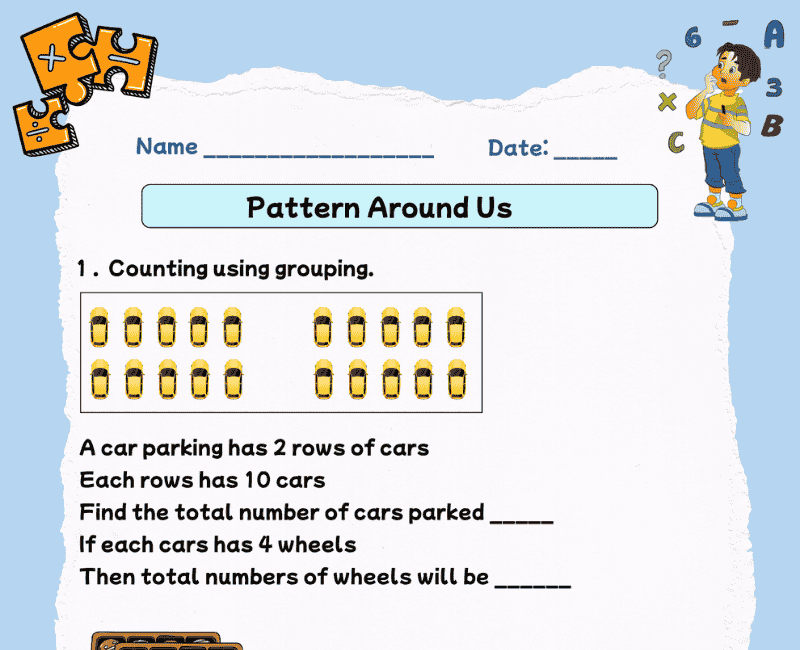
Practice sheet
Patterns Around Us Class 4 Activities
Fill pattern trains, sort even and odd numbers, pop even sums and grow coin patterns. Earn up to 3 stars in every activity.
What are number patterns?
A pattern follows a rule. In 2, 4, 6, 8 the rule is add 2. Numbers can be even (they make pairs with none left over) or odd (one is left over). Even and odd numbers take turns: 1 odd, 2 even, 3 odd, 4 even and so on.
Think of a train 🚂 where every carriage number goes up by 2: 11, 13, 15, 17 are all odd, and 20, 22, 24, 26 are all even!
Patterns to know
| Pattern | Rule | Next |
|---|---|---|
| 👫 2, 4, 6, 8 | add 2 (even) | 10 |
| ☝️ 1, 3, 5, 7 | add 2 (odd) | 9 |
| 🖐️ 5, 10, 15, 20 | add 5 | 25 |
| 🟩 1, 4, 9, 16 | add 3, 5, 7, 9… | 25 |
How to find the rule
- Look at two numbers next to each other.
- Find the gap by subtracting the smaller from the bigger.
- Check that the same gap works for the whole pattern.
- Use the rule to find the next number.
More examples
This Patterns Around Us worksheet for Class 4 (NCERT Maths Mela Chapter 3) turns even, odd and growing patterns into a train ride with online activities and interactive games. Flip the cards, fill trains in the Pattern Train Lab, then play the games, do the maths labs and try the challenges.
Maths Patterns Around Us Class 4
Patterns Around Us is Chapter 3 of the new NCERT Maths Mela textbook for Class 4. It helps children notice patterns in numbers and objects around them. They learn to tell even numbers from odd numbers by making pairs, see how odd and even numbers take turns on a number chart, discover the rules for adding odd and even numbers, count things arranged in equal groups and continue growing patterns such as 1, 3, 5, 7 and 1, 4, 9, 16. This guide explains each idea in simple language for Class 4 students, parents and teachers. It goes with the Patterns Around Us worksheet for Class 4 on WitKnowLearn, which also gives an online quiz, online activities and interactive games on the same page.
Introduction to NCERT Class 4 Maths Chapter 3: Patterns Around Us
Book: NCERT Maths Mela, Class 4 (new syllabus). Chapter: 3, Patterns Around Us. The activities on this page follow the ideas of the chapter in our own words and examples; they are not copied from the textbook.
What is there in this chapter
- Even and odd numbers by making pairs
- Odd and even numbers on a number chart
- Rules for adding odd and even numbers
- Counting things in equal groups
- Growing patterns of objects and numbers
- Adding odd numbers in order to make square numbers
Learning objectives
These objectives are written for this page from the chapter's goals; they are not copied from the book.
- Tell whether a number is even or odd.
- Use the rules for adding odd and even numbers.
- Find the rule of a pattern and continue it.
- Count things in equal groups by multiplying.
Learning outcomes
After this page a child can:
- Say that 43 is odd and 58 is even.
- Explain why odd + even is always odd.
- Continue 1, 3, 5, 7, 9, 11 and 1, 4, 9, 16, 25.
- Count 8 trees with 5 coconuts each as 8 × 5 = 40.
Patterns Around Us Class 4 resources on this page
| Resource | What it does |
|---|---|
| Patterns Around Us Class 4 online quiz | 20 questions in three levels with a full answer review |
| Flip cards | Six cards on even and odd, the number chart, growing patterns, square patterns, equal groups and adding rules |
| Pattern Train Lab | Fill the next carriages of an odd train, an even train and a square-number train |
| 5 interactive games | Even or odd, even sum bubbles, pattern memory, pattern gaps, even or odd quick |
| 5 maths labs | Skip counting, equal groups, even and odd rules, growing patterns, pattern rules |
| 5 challenges | Marked out of 3 each with a total out of 15 |
| Practice sheet | 16 questions with answer boxes and a live score |
Even and odd numbers
| Kind | Pairs | Last digit | Examples |
|---|---|---|---|
| Even | All in pairs, none left | 0, 2, 4, 6, 8 | 14, 36, 100 |
| Odd | One left without a pair | 1, 3, 5, 7, 9 | 23, 47, 91 |
Adding rules
| Sum | Answer | Example |
|---|---|---|
| Even + even | Even | 4 + 6 = 10 |
| Odd + odd | Even | 7 + 5 = 12 |
| Odd + even | Odd | 3 + 4 = 7 |
Types of questions
- Even or odd?
- Continue the pattern
- Find the rule
- Equal groups
- Growing patterns
Solved examples
Common mistakes
| Mistake | Correct |
|---|---|
| Checking the first digit | Check the last digit to tell even from odd. |
| Odd + odd is odd | Odd + odd is even (7 + 5 = 12). |
| Guessing the next number | Find the rule from the gaps first. |
| Thinking 0 at the end means odd | Numbers ending in 0 are even. |
Daily life
Patterns are everywhere: house numbers with even numbers on one side of the street, tiles on a floor, rangoli designs, seats in rows at a function, and laddoos arranged in trays.
Tips for parents and teachers
- Pair up buttons or beans to check if a number is even or odd.
- Colour even numbers on a 1 to 100 chart and look at the pattern.
- Build growing patterns with coins or matchsticks.
- Ask the child to invent a pattern and say its rule.
- Let the child retry the challenges to earn 3 stars.
Related NCERT Maths Mela Class 4 Worksheets
- Chapter 1: Shapes Around Us Class 4
- Chapter 2: Hide and Seek Class 4
- Chapter 4: Thousands Around Us Class 4
- Chapter 5: Sharing and Measuring Class 4
- Chapter 6: Measuring Length Class 4
- Chapter 7: The Cleanest Village Class 4
- Chapter 8: Weigh it, Pour it Class 4
- Chapter 9: Equal Groups Class 4
- Chapter 10: Elephants, Tigers and Leopards Class 4
- Chapter 11: Fun with Symmetry Class 4
- Chapter 12: Ticking Clocks and Turning Calendar Class 4
- Chapter 13: The Transport Museum Class 4
Frequently Asked Questions
 Download