NCERT Class 4 Maths
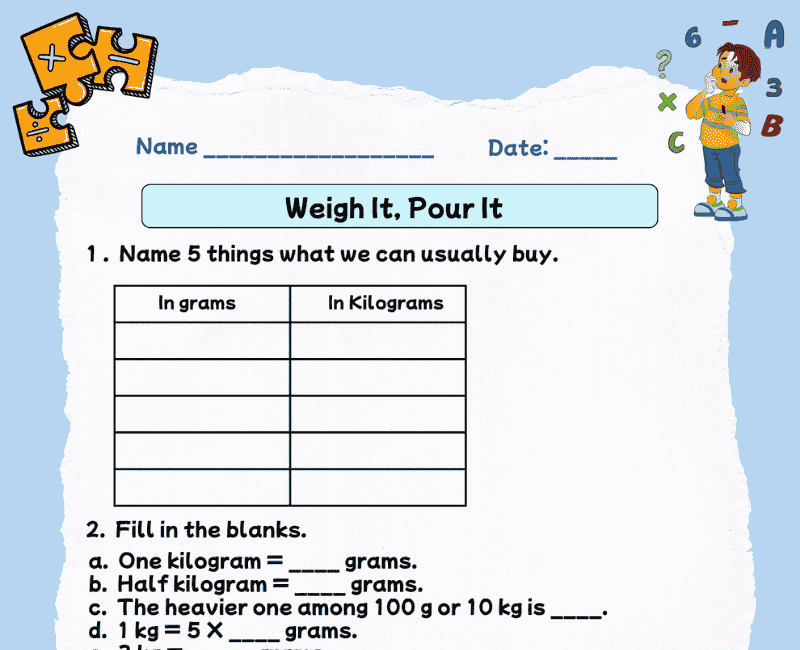
Weigh It, Pour It Class 4 Maths Worksheet with Quiz and Activities
NCERT Maths Mela Chapter 8: compare weights on a balance, change kilograms to grams and litres to millilitres, and find how many packets or bottles fill 1 kg or 1 litre. On WitKnowLearn you get the Weigh It, Pour It Class 4 online quiz, online activities and interactive games, maths labs and a practice sheet, all on one page.
Flip the cards and try the Shadow Lab, then tap the Games, Labs or Challenges square.
Weigh It, Pour It Class 4 Online Quiz
20 questions · tap an answer to move on · full review at the end
Flip the cards, try the Weigh and Pour Lab, then play the games, do the labs and take the challenges. Earn up to 3 stars in every activity.
Fact cards: tap a card to flip it
Weigh and Pour Lab
Stock three shop shelves: find how many sweet boxes make 1 kg, how many oil bottles fill 1 litre and how many glasses or cups fill other amounts. A wrong number shows a counting hint.
Challenge marks: 0 / 15 (0 of 5 challenges done)
Finish all 5 challenges to see your comment.
Practice sheet
Weigh It, Pour It Class 4 Activities
Weigh, pour, pack sweet boxes and fill bottles. Earn up to 3 stars in every activity.
What are weight and capacity?
Weight tells how heavy something is. We measure it in grams (g) and kilograms (kg). Capacity tells how much liquid something holds. We measure it in millilitres (ml) and litres (l).
A train 🚂 carries tonnes of goods, but a train ticket weighs only a few grams!
Amounts to know
| Amount | Equal to | Example |
|---|---|---|
| ⚖️ 1 kg | 1000 g | a bag of sugar |
| 📦 1/2 kg | 500 g | a packet of daal |
| 🥛 1 l | 1000 ml | a big water bottle |
| 🥄 1 teaspoon | about 5 ml | a dose of syrup |
How to change units
- Kilograms to grams: multiply by 1000 and add the grams.
- Litres to millilitres: multiply by 1000 and add the millilitres.
- To compare, change both amounts to the same unit.
- Write the unit: g, kg, ml or l.
More examples
This Weigh It, Pour It worksheet for Class 4 (NCERT Maths Mela Chapter 8) turns grams and litres into a train ride with online activities and interactive games. Flip the cards, stock the shelves in the Weigh and Pour Lab, then play the games, do the maths labs and try the challenges.
Maths Weigh It, Pour It Class 4
Weigh It, Pour It is Chapter 8 of the new NCERT Maths Mela textbook for Class 4. Children compare weights on a pan balance, learn that 1 kilogram is 1000 grams and 1 litre is 1000 millilitres, find how many small packets or bottles fill a bigger amount, estimate everyday weights and amounts of water, and think about saving water. This guide explains each idea in simple language for Class 4 students, parents and teachers. It goes with the Weigh It, Pour It worksheet for Class 4 on WitKnowLearn, which also gives an online quiz, online activities and interactive games on the same page.
Introduction to NCERT Class 4 Maths Chapter 8: Weigh It, Pour It
Book: NCERT Maths Mela, Class 4 (new syllabus). Chapter: 8, Weigh it, Pour it. The activities on this page follow the ideas of the chapter in our own words and examples; they are not copied from the textbook.
What is there in this chapter
- Comparing weights with a pan balance
- Kilograms and grams: 1 kg = 1000 g
- Litres and millilitres: 1 l = 1000 ml
- How many small packs or bottles make 1 kg or 1 l
- Estimating weights and amounts of liquid
- Weighing machines and saving water
Learning objectives
These objectives are written for this page from the chapter's goals; they are not copied from the book.
- Choose grams, kilograms, millilitres or litres for a measurement.
- Change kilograms to grams and litres to millilitres.
- Find how many small amounts fill a bigger amount.
- Solve simple weight and capacity word problems.
Learning outcomes
After this page a child can:
- Say that four 250 g packets make 1 kg.
- Say that 2 kg 300 g = 2300 g.
- Find that 1 l of oil fills five 200 ml bottles.
- Find that 8 glasses of 250 ml make 2 l.
Weigh It, Pour It Class 4 resources on this page
| Resource | What it does |
|---|---|
| Weigh It, Pour It Class 4 online quiz | 20 questions in three levels with a full answer review |
| Flip cards | Six cards on the pan balance, kg and g, l and ml, weighing scales, small amounts and saving water |
| Weigh and Pour Lab | Find how many sweet boxes, oil bottles and glasses fill 1 kg, 1 l and other amounts |
| 5 interactive games | Weigh it or pour it, one kilogram bubbles, litre memory, gaps, which is more |
| 5 maths labs | Kilograms to grams, litres to millilitres, how many fit, stories, light or heavy |
| 5 challenges | Marked out of 3 each with a total out of 15 |
| Practice sheet | 16 questions with answer boxes and a live score |
Packs that make 1 kg or 1 litre
| Pack size | Packs in 1 kg or 1 l |
|---|---|
| 500 g or 500 ml | 2 |
| 250 g or 250 ml | 4 |
| 200 g or 200 ml | 5 |
| 100 g or 100 ml | 10 |
| 50 g or 50 ml | 20 |
Types of questions
- Choose the unit
- Change kg to g and l to ml
- How many packs fill an amount
- Compare weights and amounts
- Word problems on weight and water
Solved examples
Common mistakes
| Mistake | Correct |
|---|---|
| 1 kg = 100 g | 1 kg = 1000 g. |
| 2 kg 50 g = 250 g | 2 kg 50 g = 2050 g. |
| Measuring milk in kilograms | Milk is poured, so use litres or millilitres. |
| Thinking the side that goes up is heavier | The heavier side goes down. |
Daily life
We buy vegetables, rice and sugar by weight and milk, oil and juice by the litre. Doctors weigh babies, cooks measure oil and medicine is given in small spoons of 5 ml. A dripping tap can waste many litres of water, so we close taps tightly.
Tips for parents and teachers
- Read the weights and amounts printed on packets in the kitchen.
- Pour 1 litre of water into 250 ml glasses and count them.
- Lift two objects and guess which is heavier, then check on a scale.
- Put a jug under a dripping tap for an hour and measure the water.
- Let the child retry the challenges to earn 3 stars.
Related NCERT Maths Mela Class 4 Worksheets
- Chapter 1: Shapes Around Us Class 4
- Chapter 2: Hide and Seek Class 4
- Chapter 3: Patterns Around Us Class 4
- Chapter 4: Thousands Around Us Class 4
- Chapter 5: Sharing and Measuring Class 4
- Chapter 6: Measuring Length Class 4
- Chapter 7: The Cleanest Village Class 4
- Chapter 9: Equal Groups Class 4
- Chapter 10: Elephants, Tigers and Leopards Class 4
- Chapter 11: Fun with Symmetry Class 4
- Chapter 12: Ticking Clocks and Turning Calendar Class 4
- Chapter 13: The Transport Museum Class 4
Frequently Asked Questions
 Download