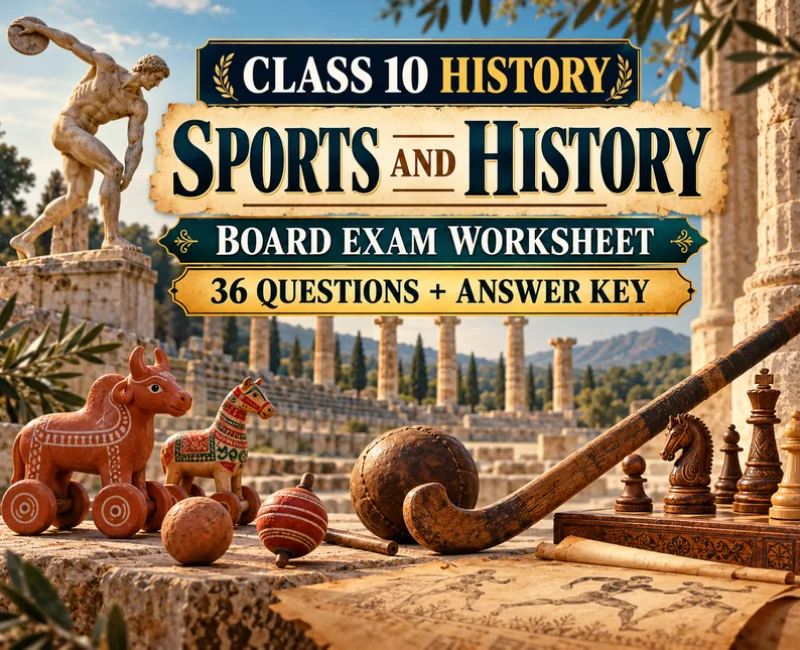
Maharashtra State Board · Class 10 · History Chapter 7
Sports and History Worksheet
Explore what ancient games, toys, equipment, competitions and sporting records tell us about the past. Practise board-pattern questions and written answers, then check your work against the complete answer key.
About the chapter: Sports have a history of changing rules, equipment and competitions. Toys and games also reveal materials, skills, social life and cultural connections. This Class 10 History Chapter 7 worksheet connects ancient Olympic events and Indian games with modern sport, commentary and professional opportunities.
Some questions carry an examination month and year in the worksheet. Textbook and board-style questions provide additional practice. Work through every section before reading the answer key so you can identify the topics you need to revise.
What is included in the Sports and History worksheet?
MCQs and objective questions
Eight MCQs cover ancient Olympia, Thaki dolls, Major Dhyan Chand, Sagargote, Mallakhamb and cricket commentary. Further objective questions ask you to fill a blank, judge a statement about toys as evidence and complete a sportsperson–sport correlation.
Wrong pairs, map and table
Correct mismatched sports, players and categories. Complete a concept map of sports with examples, a hockey timeline and a table comparing indoor games, Indian outdoor games, water sports and adventurous games.
Short notes and reasons
Write about toys and festivals, sports films, Major Dhyan Chand and careers. Explain why toys can tell us about cultural history, how the sports economy has changed and why historical knowledge improves commentary.
Passage and long answers
Read a passage about Greek sporting competitions at Olympia. Longer responses cover ancient Indian toys and sports equipment, the connection between sports and history, indoor and outdoor games, social benefits, globalisation and sports careers.
Previous-year questions and board-style practice
The worksheet marks its ancient Olympics MCQ with March 2019 and its question on the sports economy with March 2022. A reason question on Major Dhyan Chand is marked March 2023, while a corrected-pair question on Khashaba Jadhav is marked March 2026. Read the label printed beside each question: other items are textbook or board-style practice.
For written answers, connect the example to the historical point. A clay toy may tell us about craft and daily life. A doll found far from where it was made can also suggest trade and cultural contact. A scorebook, photograph or recording preserves information about a sporting event for later study.
How to use this worksheet for revision
- Sort the examples. Make short lists of indoor games, outdoor games, water sports, toys and famous sportspersons.
- Try the objective sections independently. Complete the MCQs and corrected pairs before checking the answer key.
- Finish the map, timeline and table. Include suitable examples and the main requirement of each sports category.
- Answer in distinct points. When comparing indoor and outdoor games, address the setting, activity, skills and examples rather than giving only a definition.
- Review your mistakes. Check the key after finishing and retry questions in which you confused a sportsperson, game or historical example.
Passage tip: For the Olympia passage, take the place and ancient events directly from the text. For the final part, explain how modern competitions can give athletes recognition and career opportunities.
Important topics to revise
- Ancient games and toys: Learn how literary references and excavated objects help reconstruct recreation in the past.
- Indian traditional games: Know examples such as Sagargote, Kabaddi, Kho-kho and Mallakhamb and their broad categories.
- Sportspersons: Connect Major Dhyan Chand with hockey, Khashaba Jadhav with wrestling and Mary Kom with boxing.
- Sports as historical evidence: Think about equipment, written records, photographs, films, toys and the memories preserved in festivals.
- Modern sports economy: Explain the roles of global audiences, broadcasting, sponsorship, professional leagues and employment.
Answer key and textbook solutions
The complete answer key follows the 36 questions. Attempt the worksheet first, then compare your answers with the key for correct facts and sufficient explanation. Descriptive answers can be written in your own words when they include accurate information and relevant examples.
Continue with Chapter 7 solutions
Read the Sports and History Class 10 solutions for textbook exercise answers. You can also browse all Maharashtra State Board Class 10 History solutions.
Frequently asked questions
How many questions are in the Sports and History worksheet?
It contains 36 questions and a complete answer key. The sections cover MCQs, corrected pairs, a concept map, timeline and table, short notes, reasons, a passage, brief answers and long answers.
Does the Chapter 7 worksheet include board questions?
Yes. Selected questions have examination months and years marked beside them. Textbook and board-style questions offer further practice. The label on each question shows how it is presented in the worksheet.
Where were the ancient Olympic competitions held?
They were held at Olympia in ancient Greece. The worksheet also asks about events such as wrestling, boxing, discus throw and horse or chariot races in its passage-based section.
How can toys help historians?
Toys may show what people made, the materials and techniques they used, and the activities children imitated. A toy found far from its place of manufacture can also provide a clue about trade or cultural contact.
Who is known as the “Wizard of Hockey”?
Major Dhyan Chand received that title for his extraordinary skill and control in hockey. For a reason-based answer, connect the title with his playing ability and contributions to India's Olympic hockey achievements.
What is the difference between indoor and outdoor games?
Indoor games are generally played in a room or enclosed setting; chess and carrom are examples. Outdoor games take place on grounds or other open spaces and often involve greater physical movement; Kabaddi and hockey are examples. Explain the setting, activity and skills when comparing them.
Why does a sports commentator need historical knowledge?
Past matches, records, rules, players and venues help a commentator explain the present game accurately. Relevant comparisons and anecdotes also make the commentary more informative for listeners and viewers.
How has globalisation changed the sports economy?
Broadcasting allows competitions to reach audiences in many countries. That wider audience can attract sponsorship, advertising and professional work for players, coaches, journalists, commentators and production teams.
Where can I find the Chapter 7 textbook solutions?
Open the Sports and History solutions page. The Class 10 History solutions collection includes the remaining chapters.
 Download