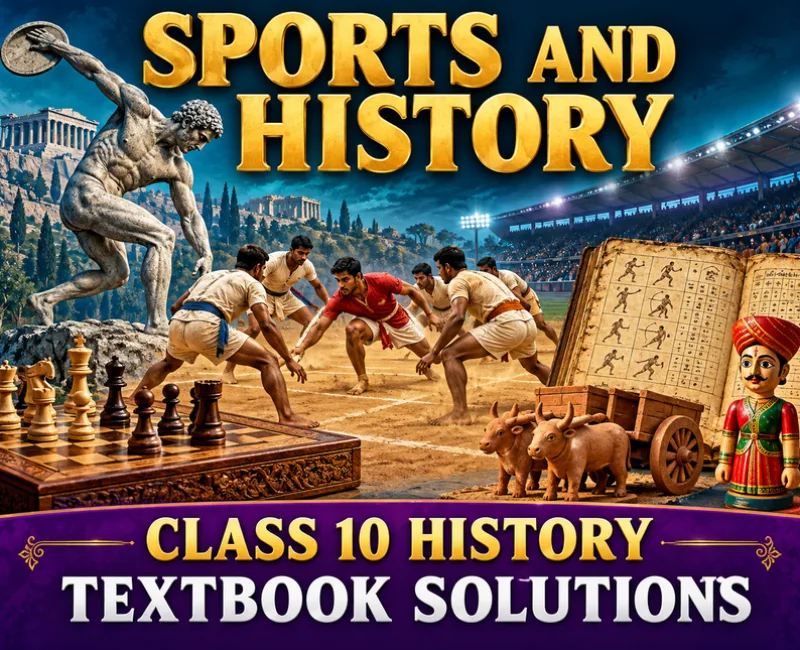
Sports and History
Complete Textbook Exercise Solutions
Ancient games • Toys • Sports economy • Detailed answers • Projects • Mind map
Study Class 10 History Chapter 7: Sports and History with complete Maharashtra State Board textbook solutions. This chapter explores the development of games, sporting equipment and toys. It also explains how sports records, films and objects help us study changes in society, technology and culture.
The answers follow the textbook exercise in order. They cover the correct options and wrong pair, short notes, statements with reasons and detailed questions. The PDF also includes a sports classification diagram, two project models and a final-page mind map for revision.
Answers on ancient Olympic competitions, Thaki dolls and the corrected chess pair; notes on toys, festivals and sports films; reasons explaining the sports economy and toys as historical sources; detailed answers on ancient sports equipment, the connection between sports and history, and indoor versus outdoor games; two projects; and a mind map.
How are sports and history connected?
Every sport has a past. Its rules, equipment, playing spaces and competitions may change over time. Records tell us who played, how games were organised and what achievements people valued. A scorebook, old photograph, film recording or piece of equipment can become evidence for a sports historian.
For example, comparing equipment from different periods can show improvements in materials and manufacturing. Comparing older and newer records can reveal changes in participation, including opportunities for women and young people. Sports also reflect wider developments in travel, communication, business and national identity.
The ancient Olympic competitions were held at Olympia in Greece. The chapter uses this fact to show that organised sporting events have a long history. In India, literature and archaeological discoveries provide evidence of games, toys and physical activities enjoyed in earlier times.
Ancient games, equipment and toys
Ancient Indian sources refer to dice games, wrestling, races and other forms of recreation. Games used objects suited to their rules: boards and pieces for indoor play, or larger equipment and open spaces for physical contests. As materials and skills changed, the design of sporting equipment also developed.
Archaeological excavations have revealed clay toys such as carts, animals and dolls. Craftspeople made toys from materials available to them, including clay, wood, cloth and ivory. A toy can therefore tell us about craft techniques as well as the interests of children and families.
Thaki dolls
The wooden dolls made in Maharashtra are known as Thaki. This is the answer to a correct-option question. Their form also represents a regional tradition of making toys from wood.
Toys as historical sources
A miniature cart may reveal the appearance of transport, while a doll’s clothes may suggest a style of dress. The materials and method used to make a toy provide clues about technology and trade. Historians interpret such clues alongside written and archaeological evidence.
Festival traditions keep some older forms of play and craft alive. During Diwali in Maharashtra, children may build model forts and place figures on them. The activity connects play with memories of forts and Maratha history. The PDF’s short note explains how toys and festivals can support informal learning about the past.
Indoor and outdoor games
Indoor games are generally played in a room or other enclosed space. Chess and carrom are familiar examples. Many indoor games emphasise planning, memory and concentration. Outdoor games are played on fields, courts, tracks or other open spaces and often involve greater physical movement. Kabaddi, kho-kho, football and hockey are examples.
The categories describe where and how a game is commonly played; both can require skill and strategy. A chess player plans several moves ahead, while a kabaddi team combines physical agility with careful planning. In the textbook’s wrong-pair question, chess is incorrectly called an outdoor game. The correct pair is chess — indoor game.
The PDF’s sports classification diagram groups games and activities for quick revision. Its detailed answer compares indoor and outdoor games by place, movement, skills, examples, space and equipment. Use these comparison points when writing an examination answer.
How has the sports economy changed?
Broadcasting allows large audiences to watch sporting events beyond the stadium. Advertising, sponsorship, tickets, equipment, subscriptions and professional competitions have created economic activity around sports. A single competition may involve players, coaches, referees, commentators, camera operators and event organisers.
History helps us understand this change. Earlier sporting events reached smaller audiences through local attendance or limited reporting. Modern communication and travel allow international competitions to reach viewers in many places. When answering the textbook’s “explain with reasons” question, connect global audiences, broadcasting, sponsorship and professional work rather than mentioning advertising alone.
Sports films, records and careers
Films about sportspersons can introduce audiences to training, family support, social barriers and the effort behind a result. The chapter discusses films such as Mary Kom and Dangal. A film makes a story accessible, but a researcher should still check its details against records because scenes may be dramatised.
Sports commentators and writers need historical knowledge. They refer to previous matches, records, players and changes in rules to explain the significance of a current event. For example, a commentator comparing two performances needs accurate statistics and an understanding of the conditions in which each record was made.
Sports history can support work in journalism, research, archives, museums, documentary production and commentary. Coaches and analysts also study earlier performances to understand a player’s strengths, difficulties and progress.
Projects and chapter mind map
The PDF contains a model project on a favourite sport and its players, using cricket as an example. It also discusses the physical, financial, social and emotional hardships that sportspersons may face, along with ways to support them.
The final-page mind map connects types of games, toys as historical sources, globalisation, films, records and careers. Use it to test your recall after reading the detailed answers.
Frequently asked questions
These questions explain how sports can be studied as history and address important points from the textbook exercise.
What is the connection between sports and history?
Sports have changed over time, and records help us trace those changes. Rules, equipment, competitions, photographs and player biographies show how games developed. For example, old and new match records can be compared to study changes in a sport’s organisation and popularity.
Where were the ancient Olympic competitions held?
They were held at Olympia in Greece. The question reminds us that organised sports competitions existed in ancient societies and have histories of their own.
What are the wooden dolls of Maharashtra called?
They are called Thaki. The dolls are part of a regional craft tradition and show how materials and local artistic skills were used to make toys.
How can toys tell us about cultural history?
Toys can show clothing, animals, transport, occupations, craft methods and beliefs in miniature. A clay cart, for example, may suggest the form of a vehicle and the technique used to make the toy. Historians compare it with other evidence before drawing conclusions.
Why do children build model forts during Diwali in Maharashtra?
Making and decorating model forts is a festival tradition that connects play with the memory of forts and Maratha history. Children may place figures of people and animals on the model, learning about a historical setting through an activity.
Is chess an indoor or outdoor game?
Chess is an indoor game. It is the corrected pair in the textbook exercise. Chess mainly tests planning and concentration, although it is also played in organised competitions.
What is the difference between indoor and outdoor games?
Indoor games are commonly played in enclosed spaces with compact equipment, as with chess or carrom. Outdoor games generally use larger playing spaces and involve more physical movement, as with kabaddi or hockey. Both kinds require rules, practice and skill.
Why has the sports economy grown and changed?
Large broadcast audiences attract advertising and sponsorship. Professional competitions also create income from tickets, subscriptions, equipment and related services. This supports work for athletes and many other people involved in organising and presenting sports.
Why does a sports commentator need historical knowledge?
A commentator uses earlier records, player achievements and the history of a competition to explain a current match. For example, accurate information about previous finals helps viewers understand why a new result is significant.
Can a sports film be used as a historical source?
It can introduce a player’s story and show how a period is represented, but a film may combine or dramatise events. Check important details against interviews, records and other reliable sources before treating every scene as a fact.
What hardships may sportspersons face?
They may face demanding training, injury, travel, equipment costs, selection uncertainty and pressure after defeat. Some also encounter limited facilities or social barriers. The project in the PDF explains these difficulties and suggests practical forms of support.
 Download