Alphabetical Order Worksheet for Class 1 with Online Quiz
Learn to arrange letters and words from A to Z with colourful examples, fun ABC sequencing activities and beginner-friendly exercises.
🔤 26 Letters | 📝 20 Quiz Questions | ⏱️ 20 Minutes
Question 1 of 20
Alphabetical Order Worksheet for Class 1 with Answers
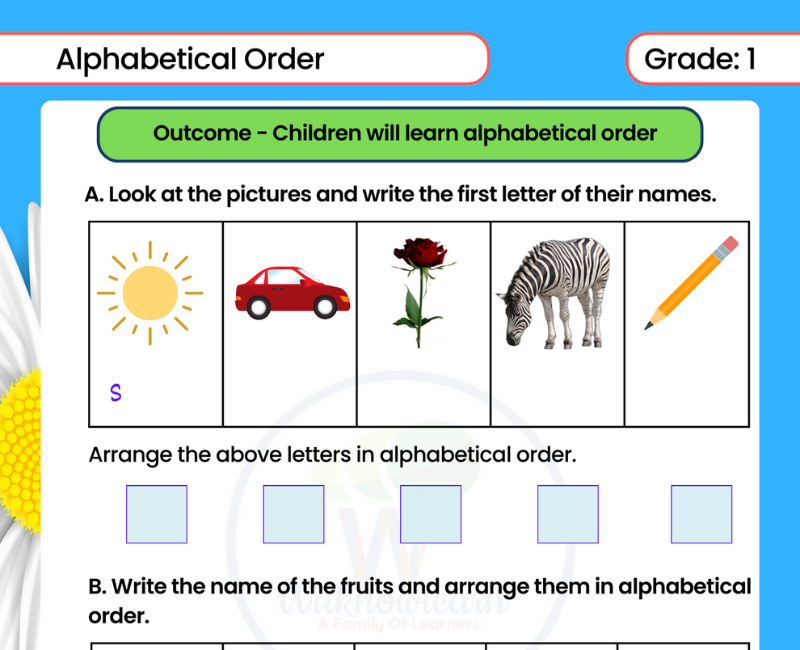
Alphabetical order is an important early English language skill that helps children arrange letters and words in the correct sequence. Our Alphabetical Order Worksheet for Class 1 introduces young learners to the English alphabet, the concept of ABC order and simple methods for arranging words from A to Z.
Children often recognise individual alphabet letters before they understand how to organise them. Through engaging examples and guided activities, they can learn which letter comes first, which letter comes next and how to arrange groups of words according to their starting letters. This skill supports reading, spelling, vocabulary development and the ability to find information in alphabetically organised lists.
The worksheet is designed for CBSE Class 1 English Grammar and is suitable for classroom practice, homework, revision and learning at home. It includes alphabet sequencing, missing letters, before-and-after exercises, arranging three or four words, identifying the first word and simple alphabetical ordering challenges.
Along with written practice, children can attempt the 20-question alphabetical order online quiz. The quiz includes a 20-minute countdown, question navigation, automatic scoring, explanations and an option to try again. Parents and teachers can use these activities to assess how confidently children recognise and arrange letters and words.
What Is Alphabetical Order for Class 1?
Alphabetical order means arranging letters or words in the same sequence as the English alphabet, from A to Z.
The English alphabet has 26 letters. Here they are in the correct order:
When we arrange words alphabetically, we usually look at the first letter of each word. The word beginning with the earliest letter comes first.
Example: Dog, Apple, Cat, Ball
Correct alphabetical order: Apple, Ball, Cat, Dog.
A comes before B, B comes before C and C comes before D.
How to Arrange Words in Alphabetical Order
Step 1: Read the Words Carefully
Start by reading the given words. For example: Mango, Apple, Banana.
Step 2: Identify the First Letter
Mango begins with M, Apple begins with A and Banana begins with B.
Step 3: Check the Alphabet Sequence
In the alphabet, A comes before B, and B comes before M.
Step 4: Write the Words in Order
The correct answer is Apple, Banana, Mango.
Step 5: Check Your Answer
Look at the first letters again to make sure the words follow A to Z order.
Extra tip: If two words begin with the same letter, compare their second letters. For example, Bag comes before Bat because G comes before T.
Alphabetical Order Examples for Class 1
| Mixed-Up Words | Correct ABC Order |
|---|---|
| Cat, Apple, Ball | Apple, Ball, Cat |
| Dog, Fish, Egg | Dog, Egg, Fish |
| Sun, Moon, Star | Moon, Star, Sun |
| Rose, Apple, Lily | Apple, Lily, Rose |
| Pen, Book, Chair | Book, Chair, Pen |
| Yellow, Blue, Green | Blue, Green, Yellow |
| Tiger, Elephant, Lion | Elephant, Lion, Tiger |
| Bus, Train, Car | Bus, Car, Train |
| Milk, Water, Juice | Juice, Milk, Water |
| Grapes, Mango, Apple | Apple, Grapes, Mango |
These examples help children recognise that alphabetical order depends on letters, not on the size, colour or meaning of an object.
Before, After and Between Letters
Before arranging words, Class 1 students should practise identifying which letter comes before, after or between other letters.
Which letter comes before D?
Answer: C
Which letter comes after H?
Answer: I
Which letter comes between M and O?
Answer: N
Complete P, Q, __, S.
Answer: R
Practising these patterns helps children memorise the alphabet and prepare for arranging words in the correct order.
Alphabetical Order Worksheet for Class 1 – Practice Exercises
Exercise 1: Fill in the Missing Letters
- A, B, __, D, E
- F, __, H, I, J
- K, L, __, N, O
- P, Q, __, S, T
- U, V, __, X, Y
- B, C, __, E, F
- H, I, __, K, L
- R, S, __, U, V
Show Exercise 1 Answers
1. C; 2. G; 3. M; 4. R; 5. W; 6. D; 7. J; 8. T.
Exercise 2: Write the Letter That Comes Before
- __ D
- __ G
- __ M
- __ P
- __ T
- __ Z
Show Exercise 2 Answers
1. C; 2. F; 3. L; 4. O; 5. S; 6. Y.
Exercise 3: Write the Letter That Comes After
- C __
- H __
- L __
- O __
- R __
- W __
Show Exercise 3 Answers
1. D; 2. I; 3. M; 4. P; 5. S; 6. X.
Exercise 4: Arrange Three Words Alphabetically
- Dog, Cat, Apple
- Pen, Ball, Fish
- Rose, Lily, Daisy
- Tiger, Lion, Bear
- Sun, Moon, Earth
- Car, Train, Bus
- Yellow, Red, Blue
- Mango, Banana, Apple
Show Exercise 4 Answers
- Apple, Cat, Dog
- Ball, Fish, Pen
- Daisy, Lily, Rose
- Bear, Lion, Tiger
- Earth, Moon, Sun
- Bus, Car, Train
- Blue, Red, Yellow
- Apple, Banana, Mango
Exercise 5: Arrange Four Words Alphabetically
- Fish, Apple, Dog, Ball
- Rose, Mango, Cat, Elephant
- Tiger, Rabbit, Lion, Bear
- Water, Juice, Tea, Milk
- Yellow, Blue, Red, Green
- Pen, Chair, Book, Table
Show Exercise 5 Answers
- Apple, Ball, Dog, Fish
- Cat, Elephant, Mango, Rose
- Bear, Lion, Rabbit, Tiger
- Juice, Milk, Tea, Water
- Blue, Green, Red, Yellow
- Book, Chair, Pen, Table
Exercise 6: Which Word Comes First?
- Dog or Cat?
- Orange or Apple?
- Moon or Sun?
- Pen or Book?
- Tiger or Zebra?
- Rabbit or Lion?
Show Exercise 6 Answers
1. Cat; 2. Apple; 3. Moon; 4. Book; 5. Tiger; 6. Lion.
Exercise 7: Words Beginning with the Same Letter
Arrange these words in ABC order. Look at the second letter when the first letters match.
- Bat, Bag, Ball
- Cat, Car, Cap
- Sun, Sit, Sad
- Pen, Pig, Pot
Show Exercise 7 Answers
1. Bag, Ball, Bat; 2. Cap, Car, Cat; 3. Sad, Sit, Sun; 4. Pen, Pig, Pot.
Alphabetical Order Activities for Class 1 Kids
Alphabet Card Sorting
Prepare cards with the letters A to Z. Mix them and ask children to arrange them in the correct sequence. Begin with five letters and gradually increase the number.
Word Card Challenge
Write familiar words such as apple, ball, cat, dog and egg on separate cards. Children arrange them alphabetically and read the completed list aloud.
Find the Missing Letter
Write short alphabet sequences on the board and leave one letter blank. Students identify and write the missing letter.
Alphabet Train
Draw a train with empty compartments. Children write one letter in each compartment, starting with A and ending with Z.
Alphabetical Name Game
Give children a list of fictional names such as Aman, Riya, Kabir and Neha. Ask them to put the names in alphabetical order.
Picture Sorting
Show pictures of a ball, apple, dog and cat. Children identify the object names and arrange them in ABC order.
Classroom Word Hunt
Ask students to name objects they see in the classroom, such as a bag, desk, pencil and chair. Write the words and arrange them alphabetically.
Why Is Alphabetical Order Important for Class 1?
Alphabetical order helps children understand the structure and sequence of the English alphabet. Recognising the position of letters improves letter identification, spelling awareness and early literacy skills. It also develops the ability to organise information in a predictable way.
When students arrange words alphabetically, they practise reading the first letters carefully. This encourages attention to detail and strengthens the connection between letter recognition and word identification. More advanced exercises involving words with the same first letter introduce children to comparing second and later letters.
Alphabetical sequencing is useful beyond English grammar. Children encounter ordered lists in classroom registers, dictionaries, indexes, libraries and other everyday situations. Understanding how these lists are organised can help them find words and information more efficiently as they grow.
Worksheets provide structured practice through missing letters, word sorting, before-and-after activities and simple sequencing tasks. These activities are especially useful for young learners who benefit from repetition and visual examples. A child who can confidently recite the alphabet may still need practice arranging unfamiliar letters or words.
The interactive quiz offers an additional way to revise these skills. Students can answer multiple-choice questions, track their progress and review explanations after submitting. Teachers and parents can use the results to identify whether a child needs more practice with letter sequence, word ordering or comparing words that begin with the same letter.
Combining alphabet charts, oral practice, word cards and written worksheets makes the learning process more engaging. Short daily practice sessions can help children build confidence without overwhelming them.
Common Mistakes While Arranging Words in Alphabetical Order
Writing Words in the Given Order
Children sometimes copy the words without rearranging them. Encourage them to check the first letter of every word before writing.
Forgetting the Alphabet Sequence
Students may confuse the order of letters such as M, N and O. An alphabet chart can help them check their answers.
Choosing Words by Length
Alphabetical order is not based on word length. For example, Elephant comes before Sun because E comes before S, even though Elephant is longer.
Ignoring the Second Letter
When words begin with the same letter, students must compare the next letters. For example, Bag comes before Ball because A is the same and G comes before L.
Confusing Before and After
Use a number line-style alphabet strip to show that before means to the left and after means to the right when the alphabet is written from A to Z.
Skipping Letters
Ask children to say the alphabet slowly while arranging letters to avoid missing or repeating any letters.
Tips for Parents and Teachers
Begin alphabetical order practice with letters rather than full words. Once children can identify the letters before and after a given letter, introduce groups of two or three familiar words.
Use objects and pictures that children recognise. Familiar words reduce reading difficulty and allow students to focus on alphabetical sequencing. Encourage them to say the first letter of each word aloud.
Gradually increase the challenge by using four-word groups and then words that share the same starting letter. Allow children to refer to an alphabet chart when necessary, particularly during early practice.
Keep lessons interactive with flashcards, classroom games and short quizzes. Praise careful checking rather than speed alone. Regular revision will help children become more independent when arranging words alphabetically.
Related Class 1 English Worksheets
Frequently Asked Questions About Alphabetical Order
What is alphabetical order for Class 1?
Alphabetical order means arranging letters or words according to the English alphabet from A to Z.
How many letters are in the English alphabet?
There are 26 letters in the English alphabet, beginning with A and ending with Z.
How do you arrange words in alphabetical order?
Look at the first letter of each word and arrange the words according to A to Z order. If the first letters match, compare the next letters.
What is an example of alphabetical order?
Apple, Ball, Cat and Dog are in alphabetical order because their first letters follow A, B, C and D.
Which letter comes after M?
The letter N comes after M.
Which letter comes before P?
The letter O comes before P.
Which letter comes between R and T?
The letter S comes between R and T.
Which comes first alphabetically, cat or dog?
Cat comes first because C comes before D.
How do you arrange words beginning with the same letter?
Compare the second letters. For example, Bag comes before Bat because G comes before T.
Why do children learn alphabetical order?
It helps develop letter recognition, word organisation, spelling awareness and early dictionary skills.
How can parents teach ABC order at home?
Parents can use alphabet flashcards, picture sorting, word cards and simple missing-letter games.
Can Class 1 students practise alphabetical order online?
Yes. This page includes a 20-question quiz with a timer, question navigation, automatic scoring, explanations and a retake option.
Practise Alphabetical Order with Worksheets and Online Questions
Develop confident ABC sequencing skills with this Alphabetical Order Worksheet for Class 1 with Answers and Online Quiz. Children can revise the alphabet, identify missing letters, arrange words from A to Z and practise ordering words with matching first letters. The exercises are useful for CBSE Class 1 English Grammar, school assignments, revision and learning at home. Complete the written activities and then attempt the online quiz to check your understanding.
 Download