Singular and Plural Nouns Worksheet for Class 1
Learn One and Many through colourful examples, word-changing exercises and an exciting English grammar quiz.
🍎 One Apple → 🍎🍎 Many Apples
20 Questions | 20 Minutes | Instant Results
Question 1 of 20
Free Singular and Plural Nouns Worksheets for Class 1 with Answers
Understanding the difference between one and many is an essential part of learning English grammar. Our Singular and Plural Nouns Worksheet for Class 1 helps children recognise whether a naming word refers to one person, animal, place or thing, or to more than one. Through familiar examples, children discover how a word such as cat changes to cats and how book becomes books.
Singular and plural nouns are commonly introduced in Class 1 English as one and many words. A singular noun names one person or thing, while a plural noun names more than one. Children can understand the difference by looking at pictures, counting objects and comparing words in simple sentences.
This learning resource includes one-and-many examples, plural noun rules, fill-in-the-blanks, matching activities, word sorting, sentence completion, irregular plural examples and answer keys. Students can also attempt a 20-question online quiz with automatic scoring, explanations and a retake option.
The activities are suitable for CBSE Class 1 English Grammar, classroom lessons, school homework and revision at home. Teachers can use picture cards and real objects to demonstrate singular and plural forms. Parents can practise with everyday items such as pencils, cups, toys, books and fruits. Regular practice helps children improve spelling, vocabulary, reading and sentence formation.
What Are Singular and Plural Nouns for Class 1?
A singular noun names one person, animal, place or thing. A plural noun names more than one.
One apple
One book
One cat
One flower
Three apples
Two books
Four cats
Five flowers
Easy rule: one= Singular. More than one= Plural.
One dog → Two dogs
One pencil → Three pencils
One tree → Many trees
Singular and Plural Nouns Examples for Class 1
| Singular (One) | Plural (Many) |
|---|---|
| Cat | Cats |
| Dog | Dogs |
| Book | Books |
| Pen | Pens |
| Bag | Bags |
| Apple | Apples |
| Ball | Balls |
| Chair | Chairs |
| Tree | Trees |
| Flower | Flowers |
| Car | Cars |
| Bird | Birds |
| Table | Tables |
| Girl | Girls |
| Boy | Boys |
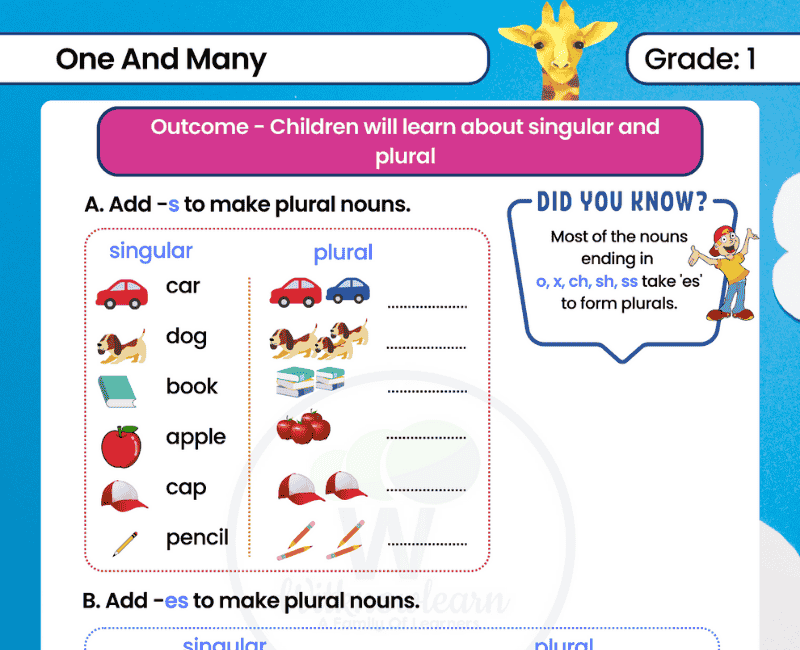
In these examples, we make the plural by adding -s to the singular noun. This is the most common pattern children learn first.
Rules of Singular and Plural Nouns for Class 1
Rule 1: Add -s to Make Many
Most common nouns form their plural by adding the letter s.
Book → Books
Pen → Pens
Cat → Cats
Dog → Dogs
Apple → Apples
Rule 2: Add -es to Some Words
Many nouns ending in sounds written with s, ss, sh, ch or x form their plural by adding es.
Bus → Buses
Box → Boxes
Brush → Brushes
Dish → Dishes
Watch → Watches
Rule 3: Change Consonant + y to -ies
When a noun ends in a consonant followed by y, we often change the y to ies.
Baby → Babies
City → Cities
Story → Stories
But when a vowel comes before y, we usually add only s: Boy → Boys and Toy → Toys.
Rule 4: Some Plural Words Change Completely
Some nouns do not follow the usual -s or -es rules. These are called irregular plural nouns.
Man → Men
Woman → Women
Child → Children
Foot → Feet
Tooth → Teeth
Mouse → Mice
For Class 1, introduce irregular plurals gradually after students understand simple one-and-many words.
Singular and Plural Nouns Chart for Class 1
| One | Many | Rule |
|---|---|---|
| Bird | Birds | Add s |
| Box | Boxes | Add es |
| Bus | Buses | Add es |
| Baby | Babies | Change y to ies |
| Toy | Toys | Add s |
| Child | Children | Irregular plural |
| Man | Men | Irregular plural |
| Foot | Feet | Irregular plural |
Children can use this chart during revision to identify different ways of forming plural nouns.
Singular and Plural Nouns Worksheet for Class 1 – Practice Exercises
Exercise 1: Write the Plural Forms
Change each singular noun into a plural noun.
- Cat → ______
- Dog → ______
- Pen → ______
- Book → ______
- Ball → ______
- Apple → ______
- Tree → ______
- Flower → ______
- Chair → ______
- Car → ______
Show Exercise 1 Answers
1. Cats; 2. Dogs; 3. Pens; 4. Books; 5. Balls; 6. Apples; 7. Trees; 8. Flowers; 9. Chairs; 10. Cars.
Exercise 2: Write the Singular Forms
- Books → ______
- Pencils → ______
- Dogs → ______
- Apples → ______
- Birds → ______
- Toys → ______
- Boxes → ______
- Buses → ______
Show Exercise 2 Answers
1. Book; 2. Pencil; 3. Dog; 4. Apple; 5. Bird; 6. Toy; 7. Box; 8. Bus.
Exercise 3: Add -s or -es
Write the correct plural form.
- Box → ______
- Brush → ______
- Bus → ______
- Watch → ______
- Dish → ______
- Pen → ______
- Tree → ______
- Book → ______
Show Exercise 3 Answers
1. Boxes; 2. Brushes; 3. Buses; 4. Watches; 5. Dishes; 6. Pens; 7. Trees; 8. Books.
Exercise 4: Choose the Correct Word
- I have two (pen / pens).
- There is one (cat / cats) on the chair.
- Three (bird / birds) are flying.
- She has one (bag / bags).
- Five (apple / apples) are in the basket.
- The boy has two (toy / toys).
- One (dog / dogs) is barking.
- There are four (box / boxes).
Show Exercise 4 Answers
1. pens; 2. cat; 3. birds; 4. bag; 5. apples; 6. toys; 7. dog; 8. boxes.
Exercise 5: Match One with Many
Match the singular words with their plural forms.
| Singular | Plural Options |
|---|---|
| 1. Mouse | A. Feet |
| 2. Child | B. Mice |
| 3. Foot | C. Men |
| 4. Man | D. Children |
| 5. Tooth | E. Teeth |
Show Exercise 5 Answers
1-B, 2-D, 3-A, 4-C, 5-E.
Exercise 6: Complete the Sentences
- One apple, three ______.
- One book, five ______.
- One box, two ______.
- One baby, two ______.
- One child, many ______.
- One foot, two ______.
Show Exercise 6 Answers
1. apples; 2. books; 3. boxes; 4. babies; 5. children; 6. feet.
Exercise 7: Identify Singular or Plural
Write S for singular and P for plural.
- Chair
- Flowers
- Dog
- Boxes
- Children
- Apple
- Toys
- Woman
Show Exercise 7 Answers
1. S; 2. P; 3. S; 4. P; 5. P; 6. S; 7. P; 8. S.
Singular and Plural Nouns in Simple Sentences
Children should practise using one-and-many words in complete sentences.
| Singular Sentence | Plural Sentence |
|---|---|
| This is a cat. | These are cats. |
| I have one pencil. | I have three pencils. |
| That is a flower. | Those are flowers. |
| The boy is playing. | The boys are playing. |
| There is one bird. | There are two birds. |
| This is a box. | These are boxes. |
Notice that some other words in a sentence may also change. For example, is often changes to are when we talk about more than one person or thing.
Fun One and Many Activities for Class 1
1. Picture Counting Game
Show one picture of an apple and then a picture of three apples. Ask children to say apple and apples. Repeat with balls, books, flowers and toys.
2. Classroom Object Hunt
Ask students to find one pencil and then several pencils. Encourage them to say complete sentences such as "I have one pencil" and "I have three pencils".
3. Singular and Plural Sorting
Prepare word cards with cat, cats, dog, dogs, book and books. Children sort them into One and Many groups.
4. Add -s Challenge
Write simple singular nouns on the board. Students take turns changing them into plural nouns by adding s.
5. -es Word Hunt
Ask children to identify words such as box, bus and dish. Explain how these words become boxes, buses and dishes.
6. One and Many Drawing
Students draw one flower on one side of a page and three flowers on the other. They label the pictures flower and flowers.
7. Sentence Building
Give children words such as cats, dogs and books. Ask them to make short sentences using the plural nouns.
How to Teach Singular and Plural Nouns to Class 1 Students
Step 1: Begin with One and Many
Use real objects such as a book, pencil or toy. Show one object and then two or more objects.
Step 2: Introduce the Word Singular
Explain that a singular noun means one. Give examples such as cat, dog, book and ball.
Step 3: Introduce the Word Plural
Explain that a plural noun means more than one. Use examples such as cats, dogs, books and balls.
Step 4: Teach the -s Rule
Start with simple words that become plural by adding s. Let students practise writing the new forms.
Step 5: Introduce Other Plural Patterns
Gradually introduce -es words and a few irregular plurals. Avoid presenting too many exceptions at once.
Step 6: Use Worksheets and Games
Provide matching, sorting, fill-in-the-blank and picture-counting activities.
Step 7: Check Understanding with the Online Quiz
Let students attempt the 20-question quiz and review the explanations for any incorrect answers.
Common Mistakes in Singular and Plural Nouns
Adding -s to Every Noun
Children may write boxs instead of boxes. Explain that some words require es.
Forgetting the Plural Ending
Students may write "three book" instead of "three books". Remind them that three means more than one.
Using the Wrong Irregular Plural
Words such as child and foot do not form plurals by simply adding s. The correct forms are children and feet.
Confusing Singular and Plural Sentences
Children may write "The boys is playing". Explain that we usually say "The boys are playing".
Changing -y Incorrectly
Baby becomes babies, but toy becomes toys. The letter before y helps determine the spelling pattern.
Thinking Every Plural Ends in -s
Some plurals end differently, such as men, children and mice. Children can learn these forms through repeated examples.
Benefits of Singular and Plural Nouns Worksheets for Class 1
Singular and plural noun worksheets help children understand how English words change when they refer to one or more than one person, animal, place or thing. This knowledge is important for early grammar, reading and sentence writing.
One-and-many exercises improve observation and counting skills. When children see one apple and several apples, they connect the number of objects with the correct word form. Picture-based activities make the concept easier to understand, especially for learners who are beginning to read independently.
Written exercises strengthen spelling patterns. Students learn that many plural nouns end in s, while some require es or a different spelling. By practising familiar words first, children gain confidence before learning irregular forms.
Sentence-completion activities also introduce the connection between singular and plural nouns and other words in a sentence. For example, students learn to say "This is a book" and "These are books". Such practice supports clear communication and grammatical accuracy.
Teachers can use these worksheets for classroom revision, homework and informal assessment. Parents can reinforce the lesson with toys, books, fruits and household objects. Children benefit from short, regular practice sessions that combine speaking, writing and identifying objects.
The online quiz provides another way to revise singular and plural nouns. Students can answer 20 multiple-choice questions, navigate between questions and view their scores and explanations after submission. Repeating the quiz can help reinforce common plural patterns and identify topics that need more attention.
Related Class 1 English Grammar Worksheets
Frequently Asked Questions About Singular and Plural Nouns
What is a singular noun for Class 1?
A singular noun names one person, animal, place or thing. Examples include cat, dog, book and apple.
What is a plural noun for Class 1?
A plural noun names more than one person, animal, place or thing. Examples include cats, dogs, books and apples.
What is the difference between singular and plural nouns?
Singular means one, while plural means more than one. For example, one flower is singular and three flowers is plural.
What are 10 examples of singular and plural nouns?
Cat–Cats, Dog–Dogs, Pen–Pens, Book–Books, Ball–Balls, Apple–Apples, Chair–Chairs, Tree–Trees, Bird–Birds and Car–Cars.
How do we change singular nouns into plural nouns?
Most nouns form their plural by adding s. Some take es, change y to ies or have irregular forms.
What are examples of nouns that take -es?
Box–Boxes, Bus–Buses, Dish–Dishes, Brush–Brushes and Watch–Watches.
What are irregular plural nouns?
Irregular plural nouns do not follow the usual s or es patterns. Examples include Child–Children, Man–Men, Foot–Feet and Mouse–Mice.
What is the plural of child?
The plural of child is children.
What is the plural of box?
The plural of box is boxes.
What is the plural of baby?
The plural of baby is babies.
How can parents teach one and many words at home?
Parents can use toys, fruits, books and other household objects to show one item and several items, then practise the correct singular and plural words.
Can children practise singular and plural nouns online?
Yes. This page includes a 20-question interactive quiz with a timer, question navigation, scoring, explanations and a retake option.
Practise One and Many Words with Worksheets and Online Quiz
Improve early English grammar skills with this Singular and Plural Nouns Worksheet for Class 1 with Answers. Children can practise one-and-many words, identify singular and plural nouns, complete sentences, add s or es, recognise irregular plurals and learn spelling patterns. These activities support CBSE Class 1 English Grammar revision, classroom practice, homework and learning at home. After completing the written exercises, students can attempt the online quiz and review their answers.
 Download