Class 3 Science · CBSE / NCERT
Measurement Class 3 Science Worksheet NCERT with Quiz and Activities
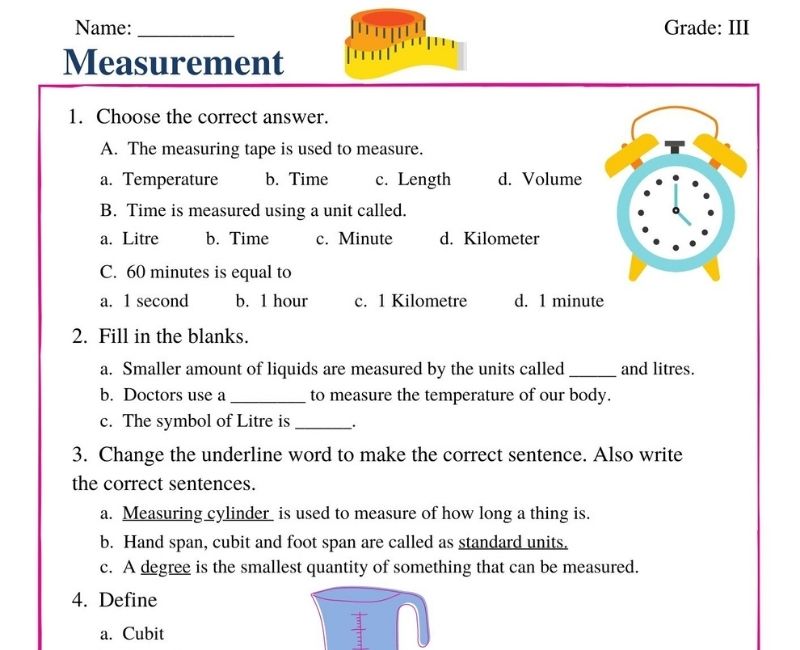
How long is a pencil, how heavy is a pumpkin and how much water fills a jug? Find out with this Science Measurement worksheet for Class 3: take the Measurement Class 3 quiz, try the measuring labs and play the Measurement Class 3 activities online, in line with CBSE and NCERT.
Flip the cards and try the Ruler Lab, then tap the Games, Labs or Challenges island.
Measurement Class 3 Online Quiz
20 questions · tap an answer to move on · full review at the end
Which tool do we use to measure length?
Measurement Class 3 Activities
Measure, weigh, fill and time. Earn up to 3 stars in every activity.
This Science Measurement worksheet for Class 3 lets children measure like real scientists. Flip the fact cards, measure objects in the Ruler Lab, then play the games, do the labs and try the challenges.
Fact cards: tap a card to flip it
Ruler Lab
Drag a pencil, crayon or eraser onto the ruler (or tap it). Then drag the red arrow to where it ends and read its length in centimetres.
📏 Measure like a scientist: drag an object onto the ruler. It starts at 0. Then drag the red arrow to where the object ends and read the length.
- 📏Step 1: Measure the pencil
Drag it onto the ruler, then move the red arrow to its end. - 📏Step 2: Measure the crayon
Drag it onto the ruler, then move the red arrow to its end. - 📏Step 3: Measure the eraser
Drag it onto the ruler, then move the red arrow to its end. - ⬜Step 4: What did we find?
Finish steps 1 to 3 to unlock.
Challenge marks: 0 / 15 (0 of 5 challenges done)
Finish all 5 challenges to see your comment.
Practice sheet
Type your answers in the boxes. For word answers write in small letters. Press Check when you finish.
AWhich unit would you use? Write it
BWhich tool would you use? Write it
CWrite the number
DWrite more or less
Measurement Class 3 Complete Guide
How long, how heavy, how much and how hot? Measurement helps us answer these questions. This guide explains measurement in simple words for Class 3 students, parents and teachers. It goes with the Science Measurement worksheet for Class 3 on this page and covers non-standard and standard units, length, weight, capacity, time and temperature, the tools we use and simple conversions.
Introduction to NCERT Class 3 Science Measurement
Book: Our Wondrous World (The World Around Us), the NCERT textbook for Grade 3. Topic: Measurement. Board: CBSE and other schools that follow NCERT. The new NCERT books build measurement through hands-on activities with everyday objects. This page is built around the learning goals schools test for the topic; it is not a copy of a single chapter.
What is there in this topic
- Why we measure, and non-standard units like hand spans
- Standard units and why we need them
- Length: cm, m, km with a ruler and measuring tape
- Weight: g, kg with a beam balance or scale
- Capacity: mL, L with a measuring jug
- Time: minutes, hours, days with a clock and calendar
- Temperature: °C with a thermometer
Learning objectives
These objectives are written for this page from the topic's goals; they are not copied from the NCERT book.
- Explain why standard units are better than hand spans.
- Choose the right unit and tool for length, weight, capacity, time and temperature.
- Measure length with a ruler starting from 0.
- Read a beam balance, measuring jug, clock and thermometer.
- Use simple conversions: 1 m = 100 cm, 1 kg = 1000 g, 1 L = 1000 mL, 1 hour = 60 minutes.
Learning outcomes
After this page a child can:
- Measure a pencil correctly with a ruler.
- Balance an object with weights on a beam balance.
- Fill a jug to 250 mL or 1 L.
- Set a clock to o'clock and half past times.
- Order temperatures from coldest to hottest.
Science Measurement Class 3 resources on this page
| Resource | What it does |
|---|---|
| Science Measurement Class 3 quiz | 20 questions in three levels with a full answer review |
| Flip cards | Six cards: length, weight, capacity, time, temperature and non-standard units |
| Ruler Lab | Place a pencil, crayon and eraser on a ruler and mark where each ends |
| 5 games | What do we measure, tool bubbles, tool memory, shortest to longest, hand span measure |
| 5 science labs | Beam balance, measuring jug, clock, thermometer, my day timeline |
| 5 challenges | Marked out of 3 each with a total out of 15 |
| Practice sheet | 16 questions with word banks and a live score |
Units and tools
| We measure | Units | Tools | Remember |
|---|---|---|---|
| Length | cm, m, km | Ruler, measuring tape | 1 m = 100 cm; 1 km = 1000 m |
| Weight | g, kg | Beam balance, weighing scale | 1 kg = 1000 g |
| Capacity | mL, L | Measuring jug, measuring cup | 1 L = 1000 mL |
| Time | seconds, minutes, hours, days | Clock, watch, calendar | 1 hour = 60 minutes; 1 day = 24 hours |
| Temperature | degrees Celsius (°C) | Thermometer | Water freezes at 0 °C and boils at 100 °C; body is about 37 °C |
Types of questions
- Choose the right unit or tool
- Read a ruler, clock or thermometer
- Convert between units
- More or less
- Order from smallest to biggest
- Word problems on length, weight, capacity and time
Solved examples
Common mistakes
| Mistake | Correct idea |
|---|---|
| Starting to measure from 1 on the ruler | Start from 0 |
| Bigger things are always heavier | A big balloon is lighter than a small stone |
| 1 kg of cotton is lighter than 1 kg of iron | Both weigh 1 kg |
| Mixing up the hour and minute hands | The long hand shows minutes, the short hand shows hours |
| Using litres for weight | Litres are for capacity; grams and kilograms are for weight |
| Hand spans are exact | They change from person to person |
Daily life
We buy vegetables by the kilogram, milk by the litre and cloth by the metre. We check the clock to reach school on time, use a thermometer when we have a fever and read a calendar to plan birthdays and holidays.
What your child learns from the Science Measurement worksheet
- To measure carefully and accurately
- To choose the right tool and unit
- To compare and estimate
- To use measurement in everyday life
Tips for parents and teachers
- Measure the dining table in hand spans with each family member.
- Weigh fruits on a kitchen scale.
- Fill water bottles with a measuring jug.
- Read the clock together at meal times.
- Let the child retry the challenges to earn 3 stars.
Related Science Worksheets
- Living and Non-Living Things Worksheet Class 3
- Eating Habits of Animals Worksheet Class 3
- Soil Worksheet Class 3
- Light Sound and Force Worksheet Class 3
- Parts of a Plant Worksheet Class 3
- Air Water and Weather Worksheet Class 3
- Sun Moon and Stars Worksheet Class 3
- Birds Beaks and Claws Worksheet Class 3
- Parts of the Body Worksheet Class 3
- Safety and First Aid Worksheet Class 3
- States of Matter Worksheet Class 3
- Food and Feeding Habits of Animals Worksheet Class 3
Frequently Asked Questions
What is measurement for Class 3?
Measurement means finding out how long, how heavy, how much or how hot something is, or how much time something takes, using units and tools.
What are non-standard units?
Units like a hand span, footstep or cubit. They change from person to person, so the answers do not match.
Why do we need standard units?
Standard units like centimetres, kilograms and litres are the same for everyone, so everyone gets the same answer.
Which tools do we use to measure length?
A ruler for short things and a measuring tape for longer things. Length is measured in cm, m and km.
How do we measure weight?
With a beam balance or a weighing scale, in grams (g) and kilograms (kg). 1 kg = 1000 g.
How do we measure capacity?
With a measuring jug or cup, in millilitres (mL) and litres (L). 1 L = 1000 mL.
How do we measure time and temperature?
Time with a clock, watch or calendar; temperature with a thermometer in degrees Celsius (°C).
Does this page have Measurement Class 3 questions and answers?
Yes. The 20-question Measurement Class 3 quiz shows the correct answer and a reason for every question at the end, and the practice sheet has a Show answers button for all 16 questions.
Is this worksheet based on CBSE and NCERT?
Yes. It follows the CBSE Class 3 syllabus and the NCERT approach used in the Grade 3 books.
What experiments can children do on this page?
They can measure objects with a ruler, balance weights on a beam balance, fill a measuring jug, set a clock, read a thermometer and measure a table with hand spans, all on the screen.
Can my child use these activities on a phone?
Yes. All drag activities work with a finger on phones and tablets and with a mouse on computers. Tapping also works.
What is included on this page?
A 20-question quiz with review, flip cards, the Ruler Lab, 5 games, 5 science labs, 5 marked challenges, a 16-question practice sheet, a complete guide, 12 related Class 3 Science worksheets and these FAQs.
 Download