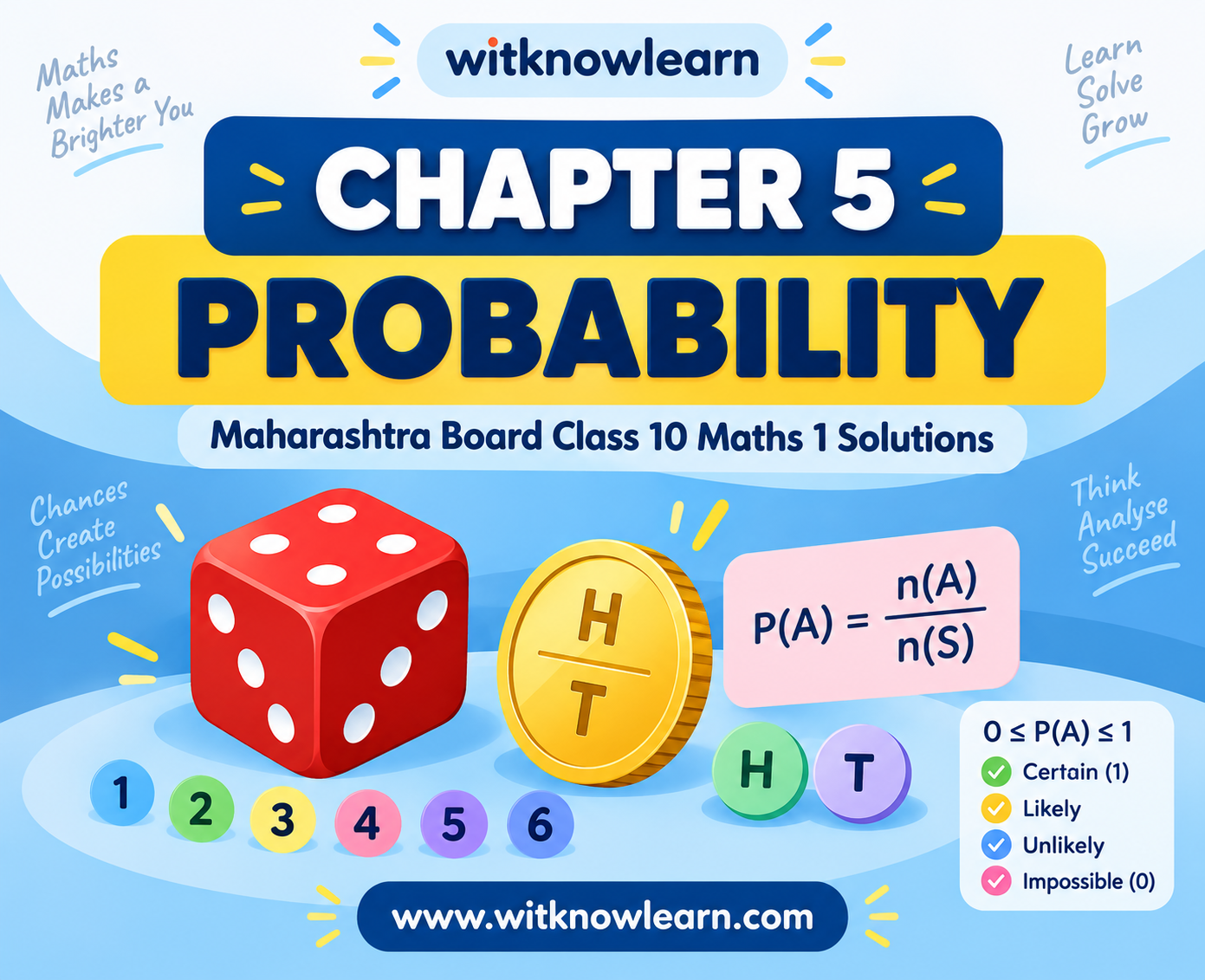
Maharashtra Board Class 10 Maths 1 Chapter 5 Solutions help students understand experiments, outcomes, events, sample spaces and theoretical probability. This page contains step-by-step solutions for Practice Sets 5.1 and 5.2 and Problem Set 5.
The complete sample space and favourable outcomes are shown before applying the probability formula. All solutions follow the Maharashtra State Board Balbharati textbook order.
Chapter 5 Probability Overview
Probability describes the possibility of an event occurring. Students learn how to write a sample space, identify favourable outcomes and calculate the probability of an event when all outcomes are equally likely.
Topics Covered
- Random experiments and outcomes
- Sample space
- Events and favourable outcomes
- Equally likely outcomes
- Theoretical probability
- Complementary events
- Systematic listing of outcomes
Important Formulas for Probability
- P(E) = Number of outcomes favourable to E/Total number of equally likely outcomes
- 0 ≤ P(E) ≤ 1
- P(impossible event) = 0
- P(certain event) = 1
- P(not E) = 1 − P(E)
Common Mistakes in Probability
- Writing only favourable outcomes instead of the complete sample space.
- Omitting or counting an outcome twice.
- Using the formula without checking that outcomes are equally likely.
- Writing a probability greater than 1.
- Confusing “at least one” with “exactly one.”
Frequently Asked Questions about Probability
What is a sample space?
A sample space is the set of all possible outcomes of a random experiment.
What is an event?
An event is one outcome or a selected set of outcomes from the sample space.
Can probability be greater than 1?
No. Probability always lies between 0 and 1, inclusive.
How is the complement of an event calculated?
If E is an event, then P(not E) = 1 − P(E).
 Download