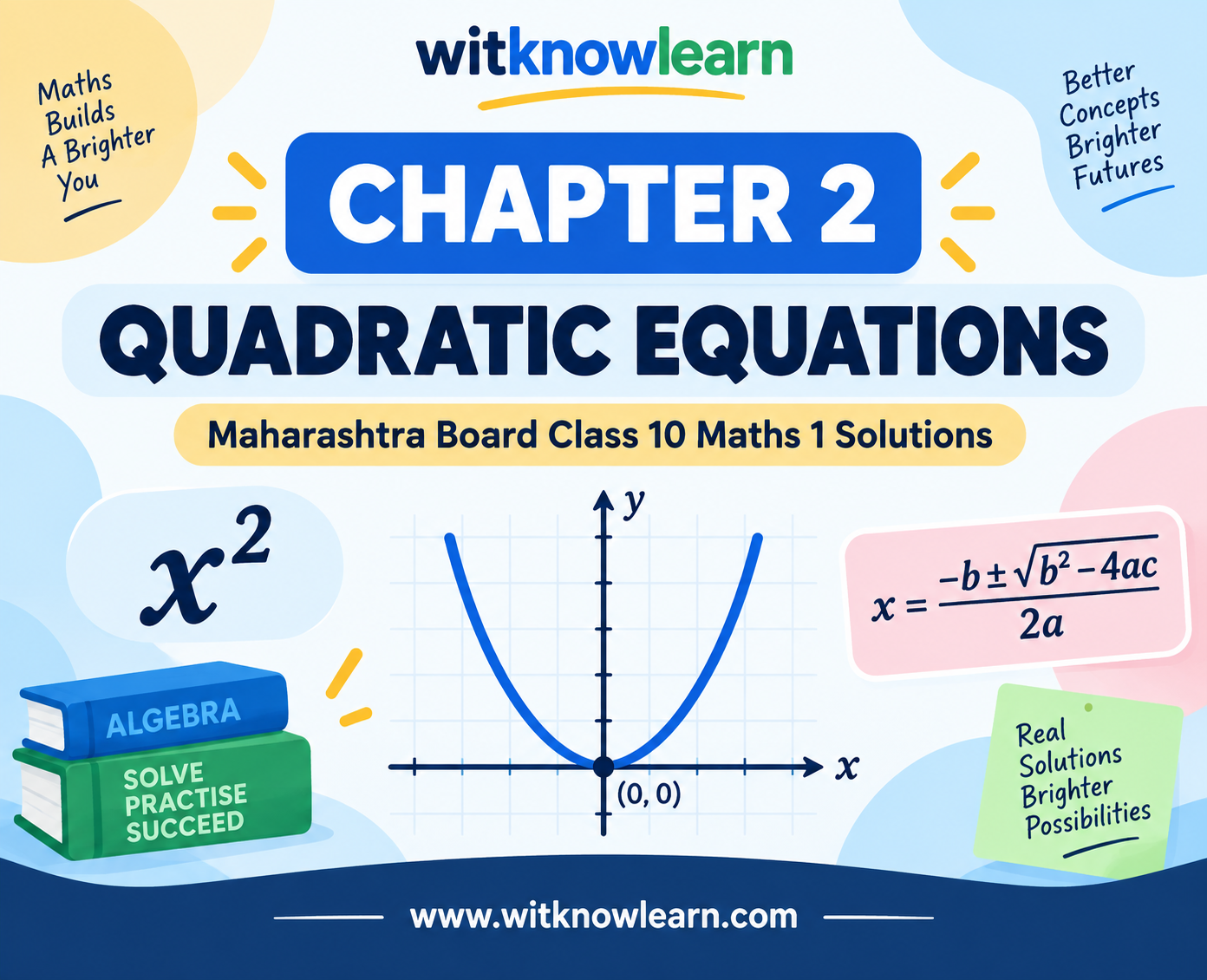
Maharashtra Board Class 10 Maths 1 Chapter 2 Solutions help students understand and solve Quadratic Equations using factorisation, completing the square and the quadratic formula. This page includes complete step-by-step solutions for Practice Sets 2.1 to 2.6 and Problem Set 2.
The solutions follow the Maharashtra State Board Balbharati textbook order. Each mathematical calculation is presented clearly, with one step on each line, so students can understand the method and verify their answers.
Chapter 2 Quadratic Equations Overview
In this chapter, students learn how to identify a quadratic equation, convert it into standard form and find its roots using different methods. They also learn about the discriminant, nature of roots, relations between roots and coefficients and practical applications.
Topics Covered
- Standard form of a quadratic equation
- Factorisation method
- Completing the square method
- Quadratic formula
- Discriminant and nature of roots
- Relations between roots and coefficients
- Formation of quadratic equations
- Word problems based on quadratic equations
Important Formulas for Quadratic Equations
- Standard form: ax² + bx + c = 0, where a ≠ 0
- Discriminant: Δ = b² − 4ac
- Quadratic formula: x = (−b ± √Δ)/(2a)
- Sum of roots: α + β = −b/a
- Product of roots: αβ = c/a
- Equation from roots: x² − (α + β)x + αβ = 0
Common Mistakes in Quadratic Equations
- Not writing the equation in standard form.
- Using the wrong sign for the coefficient of x.
- Forgetting the ± sign in the quadratic formula.
- Not using brackets while substituting negative values.
- Accepting a root that is not meaningful in a word problem.
Frequently Asked Questions about Quadratic Equations
What is the standard form of a quadratic equation?
The standard form is ax² + bx + c = 0, where a is not zero.
What does the discriminant tell us?
If Δ is positive, the roots are real and distinct. If Δ is zero, the roots are real and equal. If Δ is negative, there are no real roots.
Which method should be used to solve a quadratic equation?
Factorisation is suitable when factors are easy to identify. Completing the square may be used when specifically required, while the quadratic formula provides a systematic method.
Are all roots accepted in word problems?
No. A root must satisfy the original equation and the practical conditions of the problem.
 Download