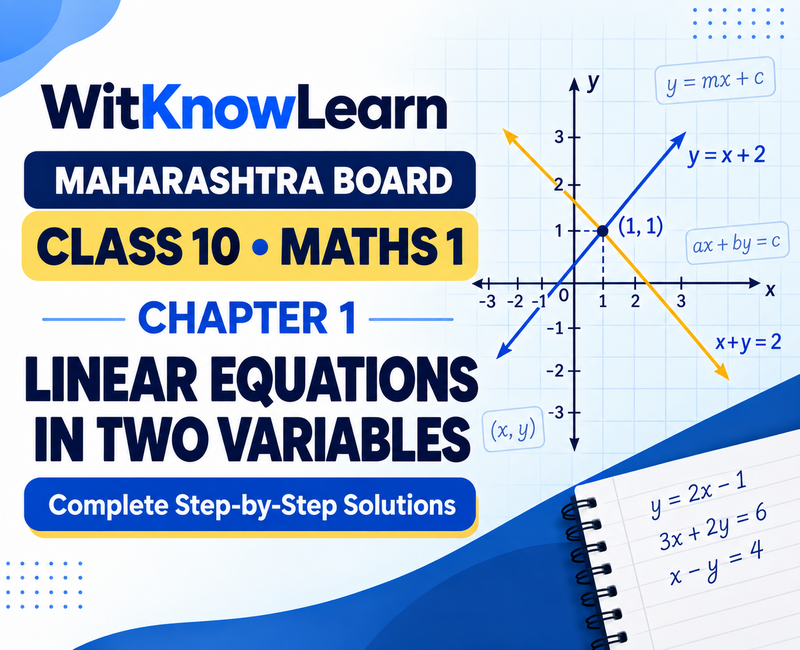
Maharashtra Board Class 10 Maths 1 Chapter 1 Solutions for Linear Equations in Two Variables are provided here with clear and complete step-by-step explanations.
Students can use these Class 10 Maths 1 Chapter 1 solutions to understand how linear equations represent practical situations and how two unknown values can be calculated accurately. Each calculation is shown separately so that students can understand the method, identify sign changes and verify their final answers.
The chapter covers graphical methods, simultaneous linear equations, substitution, elimination, determinants, Cramer’s rule and word problems. Instead of providing only final answers, the solutions explain how to select a suitable method, form equations from the given information and present the working correctly in the SSC Board examination.
What Students Learn in Chapter 1
In Chapter 1, students learn:
- The meaning of a linear equation in two variables
- The standard form of a linear equation
- How to draw the graph of a linear equation
- How to prepare a plotting table
- Simultaneous linear equations
- Elimination method
- Substitution method
- Determinants and Cramer’s rule
- Interpretation of graphical solutions
- Formation of equations from word problems
- Verification of the final solution
This chapter includes detailed answers for:
- Practice Set 1.1
- Practice Set 1.2
- Practice Set 1.3
- Practice Set 1.4
- Practice Set 1.5
- Problem Set 1
Study the complete chapter solutions online or download the PDF for offline practice and revision.
How to Solve Linear Equations in Two Variables
Begin by identifying the two unknown quantities. Assign suitable variables, such as x and y, and form one equation for each condition given in the question. Keep the variables in the same order in both equations.
Use the elimination method when one variable can be cancelled easily. Use the substitution method when one variable is already isolated or can be isolated without complicated calculations. Cramer’s rule provides a systematic determinant-based method when the main determinant is not zero.
For a graphical question, prepare a value table for both equations. Plot the points accurately, join the points to form straight lines and identify their point of intersection. The coordinates of the intersection give the solution of the pair of equations.
Always substitute the calculated values into both original equations to verify the answer.
Common Mistakes to Avoid
Students should avoid the following mistakes:
- Changing a sign incorrectly while transposing a term
- Subtracting the equations incorrectly
- Writing the variables in a different order
- Using incorrect coefficients in the determinants
- Forgetting to calculate D, Dₓ and Dᵧ separately
- Drawing a graph without mentioning the scale
- Forgetting to label the coordinate axes
- Plotting points inaccurately
- Writing only the values of x and y without answering the word problem
- Forgetting to include the correct units in the final answer
SSC Board Examination Tips
For word problems, define the variables clearly before forming the equations. Write both equations separately and show every elimination, substitution or determinant step. After finding the values, write a proper concluding statement based on the question.
For graphical questions, include:
- A suitable scale
- A plotting table
- Properly labelled axes
- Accurately plotted points
- Straight lines for both equations
- Coordinates of the point of intersection
Neat and complete working helps students avoid calculation errors and secure marks for the method.
Important Formulas
The general form of a linear equation in two variables is:
ax + by + c = 0
A pair of simultaneous linear equations can be written as:
a₁x + b₁y = c₁
a₂x + b₂y = c₂
For Cramer’s rule:
D = a₁b₂ − a₂b₁
Dₓ = c₁b₂ − c₂b₁
Dᵧ = a₁c₂ − a₂c₁
When D ≠ 0:
x = Dₓ ÷ D
y = Dᵧ ÷ D
Frequently Asked Questions
1. What is a linear equation in two variables?
A linear equation in two variables is an equation that can be written in the form ax + by + c = 0, where a and b are not both zero. Its graph is a straight line.
2. How can simultaneous linear equations be solved?
Simultaneous linear equations can be solved using graphical, elimination, substitution or determinant methods.
3. What does the graphical solution represent?
The graphical solution is the ordered pair represented by the point at which the two straight lines intersect.
4. When can Cramer’s rule be used?
Cramer’s rule can be used to obtain a unique solution when the main determinant D is not zero.
5. Why should the final answer be verified?
The values should be substituted into both original equations to confirm that they satisfy all the given conditions.
6. Are all Chapter 1 practice sets included?
Yes. These solutions include Practice Sets 1.1 to 1.5 and Problem Set 1 in the same order as the Maharashtra State Board textbook.
7. Are these solutions useful for SSC Board preparation?
Yes. The solutions help students understand the required methods, practise textbook questions and revise Chapter 1 for the Maharashtra SSC Board examination.
 Download