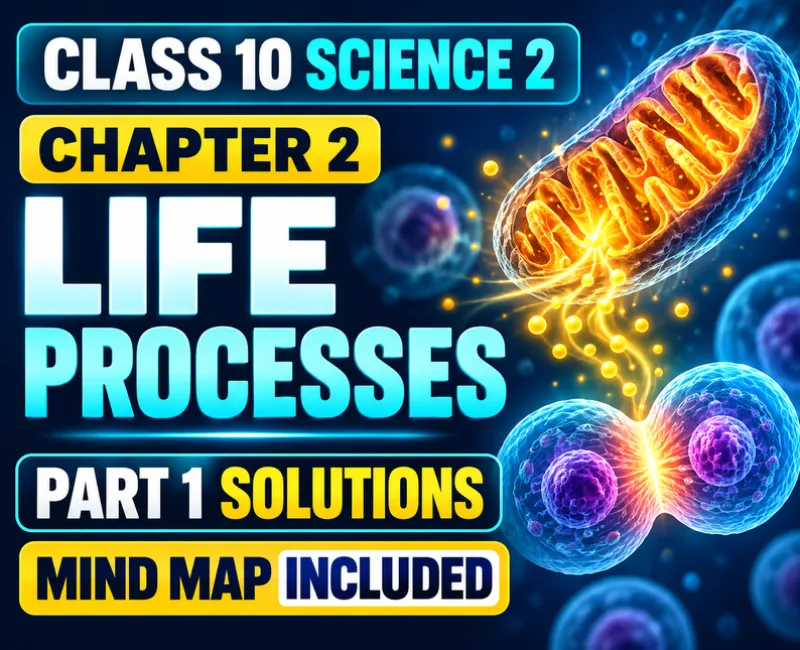
Chapter 2 Life Processes in Living Organisms Part 1 Solutions
Study Maharashtra Board Class 10 Science and Technology Part 2 Chapter 2 Life Processes in Living Organisms Part 1 with complete textbook solutions. Learn nutrition, energy production, aerobic and anaerobic respiration, vitamins, mitosis and meiosis through clear explanations. The mind map on the last PDF page supports quick revision.
What Is Included in These Chapter 2 Solutions?
These Class 10 Science 2 Chapter 2 solutions cover all major concepts and end-of-chapter question types from the Maharashtra Board textbook. Students can revise fill-in-the-blanks, scientific definitions, differences, scientific reasons and detailed answers. The material explains glycolysis, the Krebs cycle, aerobic and anaerobic respiration, nutrients, vitamins and cell division in connected steps.
The chapter links processes that may appear separate at first. Food supplies carbohydrates, proteins and fats. Cells break down these nutrients to release energy in the form of ATP. Cell division then supports growth, wound healing and reproduction. For example, muscle cells may perform anaerobic respiration during vigorous exercise when the oxygen supply is temporarily insufficient, whereas most complete oxidation of glucose occurs through aerobic pathways.
Class 10 Science 2 Chapter 2: Main Topics
Energy Production
Follow glucose through glycolysis, acetyl-CoA and the Krebs cycle to understand cellular respiration.
Nutrients
Connect carbohydrates, proteins, fats, vitamins, minerals, water and fibre with their roles in the body.
Cell Division
Compare mitosis and meiosis and learn why both divisions are essential to living organisms.
Important Life-Process Concepts
Nutrition and Nutrients
Nutrition is the process by which organisms obtain and use food. Carbohydrates and fats supply energy, proteins support growth and repair, and vitamins and minerals help regulate body functions. Fibre supports proper movement of food through the digestive tract, while water is essential for transport and chemical reactions.
Aerobic and Anaerobic Respiration
Aerobic respiration uses oxygen and releases more energy through complete oxidation of glucose. Anaerobic respiration occurs without oxygen and releases less energy. Yeast can produce alcohol and carbon dioxide, while active muscle cells may temporarily form lactic acid during strenuous exercise.
Glycolysis and the Krebs Cycle
Glycolysis occurs in the cytoplasm and converts glucose into pyruvic acid. With oxygen available, further reactions occur in mitochondria. Acetyl-CoA enters the Krebs cycle, also called the citric acid or TCA cycle, where oxidation continues and energy-rich molecules are produced.
Mitosis
Mitosis includes prophase, metaphase, anaphase and telophase, followed by cytokinesis. It produces two daughter cells with the same chromosome number as the parent cell. This division supports body growth, wound healing and replacement of worn-out cells.
Meiosis
Meiosis occurs in germ cells and includes two successive divisions. Crossing over during prophase I creates new combinations of genetic material. Four haploid cells are formed, helping maintain the chromosome number of a species after fertilisation and producing variation.
How to Use the Chapter 2 Solutions
- Attempt every textbook question before opening the corresponding solution.
- Learn each respiration pathway as a sequence instead of isolated terms.
- Prepare a comparison table for glycolysis and the TCA cycle, aerobic and anaerobic respiration, and mitosis and meiosis.
- Practise labelled diagrams of mitosis and the stages of prophase I in meiosis.
- Use the mind map on the last PDF page for a complete chapter recap.
Chapter 2 Mind Map for Quick Revision
The final page of the PDF contains a mind map connecting nutrients, energy production, respiration, glycolysis, the Krebs cycle, mitosis and meiosis. Review it after reading the detailed solutions, then try to reproduce the main branches without looking.
Frequently Asked Questions
Select a question to read a brief explanation with an example.
Why is oxygen necessary for complete oxidation of glucose?
What happens during glycolysis?
Why is the Krebs cycle called the citric acid cycle?
Why are fibres important in our diet?
What is the difference between mitosis and meiosis?
How does mitosis help in wound healing?
Why are gametes haploid?
Where is the Chapter 2 mind map?
 Download