Chapter 6 Animal Classification Solutions
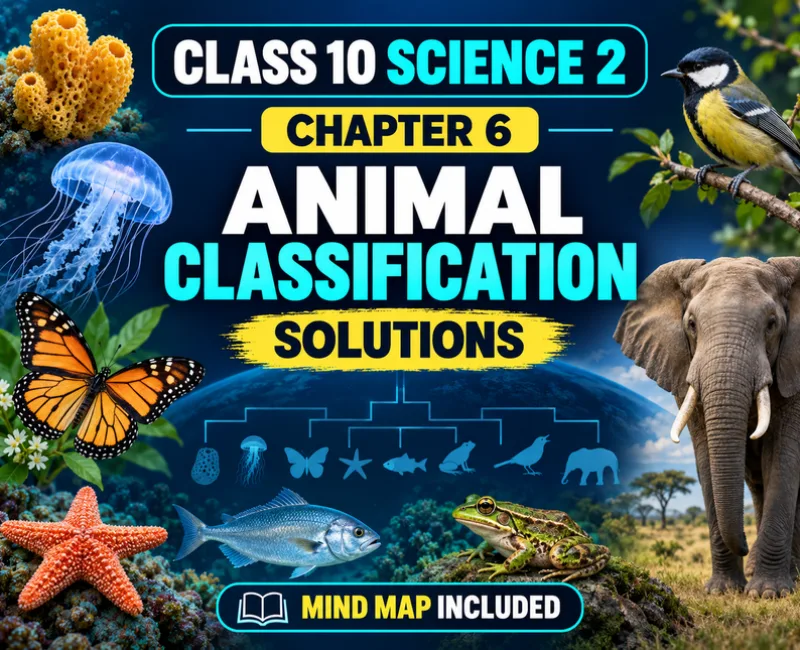
Study Maharashtra Board Class 10 Science and Technology Part 2 Chapter 6 Animal Classification with complete textbook exercise solutions. Understand the basis of classification, invertebrate phyla, chordates and vertebrate classes through distinguishing characteristics and familiar examples. The PDF also includes a chapter mind map on its final page.
What Is Included in These Animal Classification Solutions?
These Class 10 Science 2 Chapter 6 solutions follow the Maharashtra Board textbook exercise and cover identification questions, classification charts, distinguishing characteristics, scientific reasons, labelled diagrams and examples. Students can revise Porifera, Cnidaria, Platyhelminthes, Aschelminthes, Annelida, Arthropoda, Mollusca, Echinodermata, Hemichordata and Chordata.
The solutions focus on using evidence rather than remembering only animal names. For example, jointed appendages and a segmented body support classification in Arthropoda, while a water vascular system and tube feet indicate Echinodermata. Among chordates, the presence of a notochord, dorsal tubular nerve cord and pharyngeal gill slits provides the basic classification clues.
Class 10 Science 2 Chapter 6: Main Topics
Basis of Classification
Compare levels of organisation, symmetry, germ layers, body cavities and segmentation.
Non-chordates
Identify the ten major groups using body features and representative animals.
Chordates
Study the chordate plan and compare important vertebrate classes from fishes to mammals.
Important Animal Classification Concepts
Organisation, Symmetry and Body Cavity
Animals may show cellular, tissue, organ or organ-system organisation. Their bodies may be asymmetrical, radially symmetrical or bilaterally symmetrical. Triploblastic animals may be acoelomate, pseudocoelomate or eucoelomate depending on the presence and lining of the body cavity.
Major Non-chordate Phyla
Porifera have pores and collar cells. Cnidarians possess stinging cells. Platyhelminthes are flat and acoelomate, while Aschelminthes are cylindrical pseudocoelomates. Annelids show true segmentation; arthropods have jointed appendages; molluscs have soft bodies; echinoderms possess tube feet; and hemichordates have a body divided into proboscis, collar and trunk.
Chordata
Chordates show a notochord, pharyngeal gill slits and a dorsal tubular nerve cord during at least some developmental stage. Their heart lies ventrally. Urochordates have a notochord mainly in the larval tail, cephalochordates retain it along the body, and vertebrates replace it with a vertebral column.
Vertebrate Classes
Cyclostomes are jawless. Pisces breathe with gills and use fins. Amphibians live in water during the larval stage and can live on land as adults. Reptiles have dry, scaly skin; birds have feathers and wings; mammals have hair and mammary glands. These features help distinguish animals that may share the same habitat.
Classification Through Examples
A shark belongs to Pisces because it is aquatic, breathes with gills and has fins. A bat is a mammal rather than a bird because it has hair and mammary glands, while a butterfly is an arthropod with a chitinous exoskeleton and jointed appendages. Scientific classification depends on several stable characters, not one visible similarity.
How to Use the Chapter 6 Solutions
- Identify the body plan before trying to name the phylum or class.
- Underline two or more distinguishing features in each answer.
- Learn every major group with at least two representative examples.
- Practise the textbook charts, labels and classification diagrams.
- Use the mind map on the final PDF page to revise the hierarchy.
Chapter 6 Mind Map for Quick Revision
The last page of the solutions PDF contains a mind map connecting classification criteria, non-chordate phyla, chordate subphyla and vertebrate classes. Use it to move from a visible feature to the correct group and example.
Frequently Asked Questions
Select a question to read a brief explanation with an example.
Why is animal classification necessary?
What is the difference between radial and bilateral symmetry?
Why is a sponge included in Porifera?
Why does contact with a jellyfish cause irritation?
Why is Arthropoda the largest animal phylum?
Why is a starfish not a true fish?
Why is a tortoise not classified as an amphibian?
Are all chordates vertebrates?
Where is the Chapter 6 mind map?
 Download