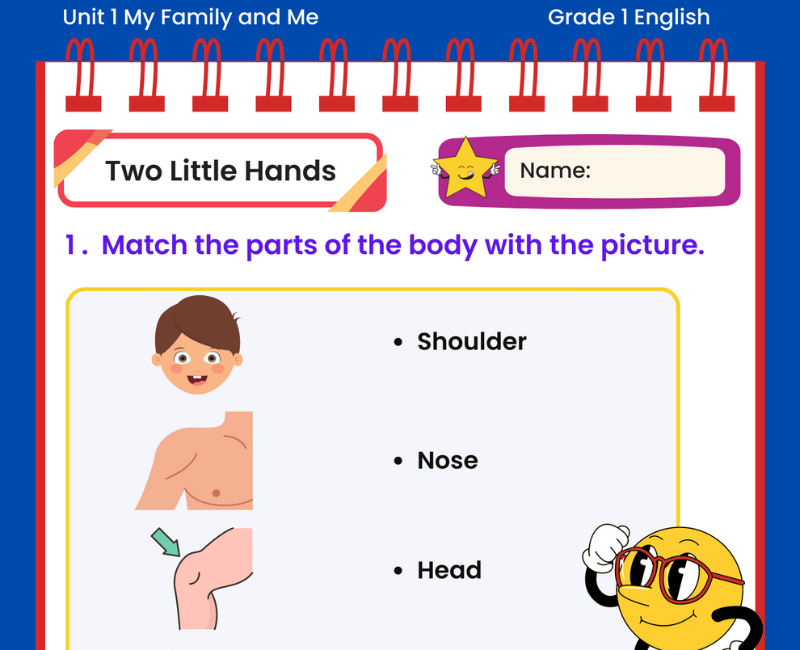
👐 Two Little Hands Worksheet for Class 1
Read, point, build and create with this Two Little Hands Class 1 worksheet based on NCERT Mridang Unit 1 Chapter 1. Explore body words, action words, initial sounds and short English sentences.
Enjoy a 20-question online quiz, 10 online games and activities, and five practice tasks. Follow an action-card pattern, deliver sound mail, rebuild words and decorate an illustrated hand.
📝 Two Little Hands Online Quiz for Class 1
Questions and explanations can change language. English answer choices stay in English for reading practice. Games and activities are in English.
Question 1/20 • Easy • 0/20 answered
Which body word appears in the lesson title?
🎮 Two Little Hands Online Games for Class 1
Match words, copy an action-card pattern and sort familiar beginning sounds. Pointing or choosing a card can replace a physical action.
1. 📮 Deliver the Picture Labels
Tap an English word, then its matching picture card. Deliver all four labels.
Choose a word label.
Ready to try!
2. 🎵 Copy the Action-Card Pattern
Study the four-card pattern, hide it if you wish, then copy it using the buttons. No physical movement is required.
clap → tap → tap → clap
Your pattern is empty.
Ready to try!
3. 🧩 Build a Plural Sentence
Arrange the original practice sentence. The picture card shows two feet.
Build here.
Ready to try!
4. 🔊 Pack the Beginning-Sound Boxes
An adult can say each word aloud. Deliver it by its beginning sound: /h/, /m/ or /n/.
Choose a word.
Ready to try!
5. 🏷️ Give the Picture Cards Sentence Labels
Choose the correct sentence starter for each labelled picture card.
Ready to try!
🧩 Two Little Hands Online Activities for Class 1
Build spellings, repair words, find rhymes and create a hand picture with an English caption.
6. 🔤 Build SHOULDERS
Use the word model to arrange the letters. This is a supported spelling challenge.
SHOULDERS
Build here.
Ready to try!
7. 🔧 Repair the Body-Word Labels
Type one missing letter in each label.
Ready to try!
8. 🃏 Find Rhyming Word Pairs
Match words with the same ending sound. An adult can read them aloud.
Find three rhyming pairs.
9. 💬 Build a Picture Conversation
Choose a picture card, then match the question and answer to it. This is original speaking practice.
Ready to try!
10. ✏️ Decorate a Hand Picture
Trace the pale illustrated outline or make your own marks. Use a finger, mouse or stylus. This creative activity does not grade drawing accuracy.
Ready to try!
✏️ Two Little Hands English Practice for Class 1
1. 🏷️ Match Singular and Plural
Match each singular word with its plural form.
Ready to try!
2. 🔤 Build a Short Action Sentence
Arrange this original sentence. Start with the capital letter.
Build here.
Ready to try!
3. 🔎 Listen for the Same Beginning
An adult can say the words. Match each pair by its shared beginning sound.
Ready to try!
4. 📝 Write the Number Words
Use the numeral clues to write the English number words.
Ready to try!
5. 💬 Create a Personal Speaking Card
Choose a comfortable way to join a lesson and make an original sentence. Every listed choice is accepted.
Ready to try!
📖 Two Little Hands Class 1 Mridang Learning Guide
Read the chapter guide and English practice ideas
Two Little Hands opens Unit 1, My Family and Me, in NCERT’s Class 1 English textbook Mridang. It introduces familiar body vocabulary through rhythm, actions, speaking and reading. The lesson also includes early letter and sound practice.
A Two Little Hands worksheet for Class 1 should help children understand and use English rather than only recall body functions. Begin with a picture and a spoken word. Invite children to point, choose a matching card or use the word in a short response.
Body words provide useful naming-word practice. Action words help children describe something happening. Compare a name such as hand with an action such as wave. Use clear examples and avoid expecting a child to explain formal grammar terminology before they can use the words.
Number words and small sentence words need separate attention. One and two tell us a number, while to has a different job in a sentence. Two and to sound alike in ordinary pronunciation, so children need the sentence meaning rather than sound alone to choose between them.
Practise singular and plural forms in manageable steps. One arm becomes two arms, while one foot becomes two feet. This and these help children talk about one thing or more than one. Use the illustrated examples to practise language without suggesting that everyone’s body looks or works the same.
Initial-sound games should focus on what children hear at the start of a word. Say the whole word naturally, then draw attention to its beginning. Letter names and sounds are related but different. Use familiar words and allow an adult to read labels when needed.
The online games extend the lesson through original patterns, word puzzles, conversation cards and drawing. They do not reproduce the full poem or replace reading it with a teacher. A child may join by speaking, pointing, selecting or using an adapted movement.
Use the existing worksheet download option on this page for paper practice. Keep sessions short, revisit tricky words and praise a useful explanation or careful attempt. For creative hand pictures, compare details respectfully rather than judging which child’s body or drawing is better.
👨👩👧 Tips for Parent and Teacher
- Read the NCERT lesson together before the quiz.
- Let children point or choose cards instead of performing movements.
- Model a word before asking a child to spell it.
- Distinguish letter names from beginning sounds.
- Use inclusive examples and respect differences between bodies.
🌟 Tips for Students
- Look closely at the picture or printed word.
- Say a word slowly before building it.
- Check whether a sentence means one or more than one.
- Use the whole sentence to choose two or to.
- Try Undo when word tiles need a change.
- Choose a comfortable way to join an action activity.
- Ask an adult to help with a new word.
❓ Two Little Hands Class 1 Worksheet FAQs
Which textbook contains Two Little Hands?
It is Chapter 1 in Unit 1, My Family and Me, of NCERT’s Class 1 English textbook Mridang.
What can children learn from Two Little Hands?
They can practise familiar body words, action words, speaking, early reading, number words and initial sounds.
What does little mean?
Little can mean small. The intended meaning depends on the sentence.
What is the difference between two and to?
Two names the number 2. To is a small sentence word used in phrases such as “to draw”. They sound alike, so context matters.
When should children use this and these?
Use this for one nearby thing and these for more than one nearby thing.
What is the plural of hand?
The plural is hands.
What is the plural of foot?
The plural is feet.
How can an adult teach the poem through actions?
Read from the textbook and invite comfortable movements, pointing or matching cards. Children do not have to perform every movement to participate.
Are the games the same as the quiz?
No. The games include sorting, pattern copying, sentence building, memory, word repair and drawing.
How can I use the worksheet with a child who is beginning to read?
Read instructions aloud, use picture clues and accept spoken or pointing responses before asking for independent writing.
👐 Online Two Little Hands Quiz for Class 1
Read a word, build a sentence and try a new activity.
Return to Two Little Hands Quiz ↑ Download