CBSE Class 10 Mathematics • NCERT Chapter 1
Real Numbers Class 10 Worksheet with Online Quiz
Strengthen your reasoning with Real Numbers Class 10 questions on prime factorisation, HCF and LCM, irrationality proofs and multistep applications. Attempt the 20-question online quiz, ten interactive challenges and five additional practice sets.
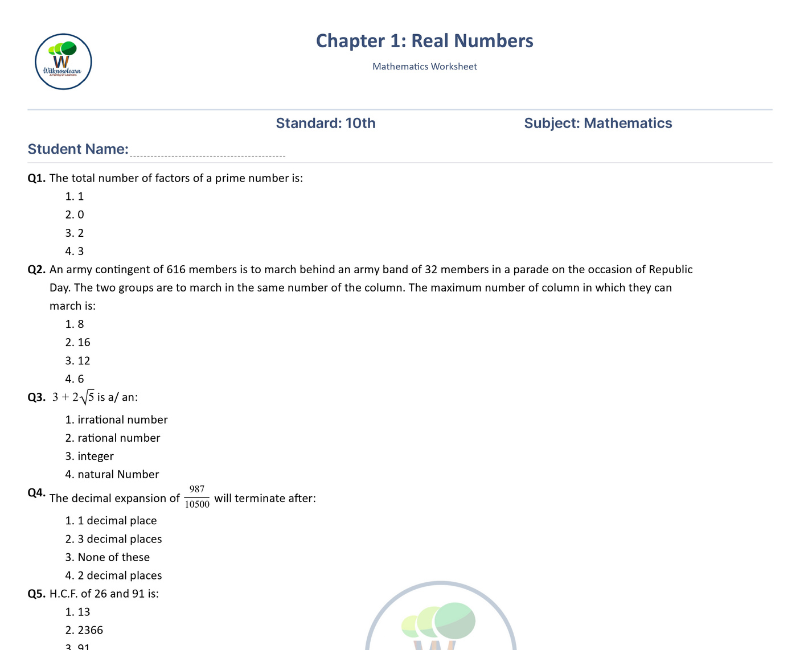
Use the existing worksheet download option on this page for written practice. Revise concepts using the Real Numbers Notes and Mind Map.
Real Numbers Class 10 Online Quiz
Question 1 of 20 • Core reasoning • Answered 0/20
A = 2⁴ × 3² × 5 and B = 2³ × 3³ × 7. Find HCF(A,B).
Real Numbers Class 10 Interactive Games and Labs
Investigate prime exponents, reconstruct a proof and solve optimisation problems. Write your reasoning before checking.
1. Prime Exponent Lab
For each pair, enter the six prime exponents. An absent prime has exponent zero.
2. Reconstruct an Irrationality Proof
Arrange the proof that √5 is irrational. Select each statement in logical order.
3. Factorisation Error Detective
A student claims 432 = 2³ × 3² is its complete prime factorisation. Correct both exponents and find the missing multiplicative factor.
4. Identical Kit Planner
A workshop has 144 sensors, 216 wires and 288 clips. Form the greatest number of identical kits using every item. Enter the kit count and the contents of one kit.
5. Synchronisation Timeline
Three devices repeat every 36, 54 and 90 seconds, starting together. Find the repeat interval and the number of further coincidences within 30 minutes.
Real Numbers HOTS Activities for Class 10
Construct counterexamples, recover number pairs and test the limits of familiar mathematical rules.
6. Build an Irrational Counterexample
Test “the sum of two irrational numbers is always irrational”. Choose non-zero integer coefficients a,b for a√3 and b√3, and construct a rational sum.
7. Recover All Number Pairs
Find every unordered positive-integer pair with HCF 18 and LCM 630. Enter each pair in either order.
8. Square and Cube Multiplier Lab
756 = 2² × 3³ × 7. Find the least positive multiplier making it a perfect square and the least positive multiplier making it a perfect cube.
9. Repair the Irrationality Argument
Assume r = 7 − 4√5 is rational. Complete the rearrangement and the reason for the contradiction.
10. Test a Three-Number Conjecture
Test HCF(a,b,c) × LCM(a,b,c) = abc. Enter integers a,b,c from 2 to 30 and find a counterexample.
Real Numbers Class 10 Worksheet Guide
Read the Chapter 1 practice guide
A Real Numbers Class 10 worksheet should develop justification as well as calculation. In NCERT Class 10 Maths Chapter 1, prime factorisation connects divisibility, HCF, LCM and irrationality proofs.
Record each prime exponent accurately. Use the minimum exponents for HCF and the maximum exponents for LCM. An absent prime has exponent zero. Check the original factorisation before using either rule.
Translate an application into a mathematical condition. A greatest equal unit must divide every quantity exactly. An earliest shared repetition must be a common multiple of all the periods. Decide whether the answer represents a group size, a number of groups or a total.
When practising Real Numbers Class 10 questions with solutions, locate the first faulty step rather than copying the final answer. A product identity may produce a candidate pair, but the candidate must satisfy both the stated HCF and LCM.
An irrationality proof needs an assumption in lowest terms, a valid divisibility argument and a stated contradiction. Explain where a divisor being prime is necessary. Do not extend prime-divisibility properties to every composite divisor.
Use this Chapter 1 Class 10 Maths worksheet for active practice and the separate notes and mind map for revision. The online tasks are original practice questions, not claimed past-paper questions or predictions.
Key results and conditions
| Result | Condition |
|---|---|
| Prime factorisation is unique | For a composite positive integer, apart from factor order. |
| HCF uses minimum prime exponents | Include exponent zero when a prime is absent. |
| LCM uses maximum prime exponents | Include every prime appearing in any integer. |
| HCF(a,b) × LCM(a,b) = ab | For two positive integers. |
| a = hx and b = hy | If h = HCF(a,b), then HCF(x,y) = 1. |
| LCM(a,b) = hxy | For the same co-prime normalised pair x,y. |
| p ∣ a² ⇒ p ∣ a | The general implication requires p to be prime. |
Worked reasoning example
Question: Two positive integers have HCF 15 and LCM 420. Can one integer be 45?
45b = 15 × 420 ⇒ b = 140
But HCF(45,140) = 5, not 15. Therefore the conditions are inconsistent.
Conclusion: The product identity alone does not validate a proposed pair.
Real Numbers Class 10 Practice Questions
Complete five additional tasks. Record the method on paper before checking.
1. HCF Calculation
Find HCF(342,456). Show your method on paper.
2. Recover a Missing Integer
HCF(a,b) = 21, LCM(a,b) = 1260 and a = 84. Find b and verify both conditions.
3. Simplify a Radical Difference
Write √98 − √8 as k√2. Enter k.
4. Least Square Multiplier
Find the least positive integer multiplying 560 to make a perfect square.
5. Greatest Square Divisor
Find the greatest perfect-square divisor of 1944.
Revision Tips for Class 10 Maths Chapter 1
For Parent and Teacher
- Ask students to justify choosing HCF or LCM.
- Discuss why one counterexample disproves a universal claim.
- Require mathematical reasons in proof steps.
- Use feedback to diagnose errors before repeating a task.
- Combine interactive work with complete written solutions.
For Students
- State the domain when applying a result.
- Check every prime exponent.
- Distinguish group size from the number of groups.
- Verify both HCF and LCM for a candidate pair.
- Use lowest terms in contradiction proofs.
- Explain where primality is required.
- Test claims with carefully chosen examples.
- Include units and interpret the result.
Real Numbers Class 10 Worksheet FAQs
What should I practise in Real Numbers Class 10?
Practise prime factorisation, HCF and LCM applications, the two-number product relationship and valid irrationality proofs. Follow your prescribed syllabus for assessed coverage.
How do I choose HCF or LCM in a word problem?
Identify the divisibility condition. A greatest common unit divides each quantity; an earliest shared repetition is a common multiple of the periods.
Does the HCF–LCM product identity apply to three numbers?
The identity HCF(a,b) × LCM(a,b) = ab is for two positive integers. Replacing ab by abc is not generally valid.
Is matching the product enough to validate a number pair?
No. Check that its actual HCF and LCM equal the stated values.
How can I recover numbers from their HCF and LCM?
Write them as hx and hy, with x,y co-prime. Their product xy equals LCM divided by h. Find the suitable factor pairs.
How do I find a least perfect-square multiplier?
Supply one factor of each prime whose exponent is odd. The final exponents must all be even.
What changes for a perfect cube?
Every final prime exponent must be a multiple of three.
Why is co-primality important in an irrationality proof?
It lets a common prime divisor of the assumed numerator and denominator create a contradiction.
Can irrational numbers have a rational sum or product?
Yes. For example, √13 and −√13 have sum 0 and product −13.
Where are the worksheet and revision notes?
Use the existing worksheet download option on this page. The matching notes and mind map are linked above.
Real Numbers Online Quiz for Class 10
Review a proof, test a conjecture and retry a challenging question.
Return to the Real Numbers Quiz ↑ Download