CLASS 10 SCIENCE • EXPLORE HOW LIFE CONTINUES
How Do Organisms Reproduce Worksheet
with Online Quiz and Activities
Follow a dividing cell, explore a flower and connect reproductive structures with their functions. Build clear explanations through diagrams, virtual models and scientific reasoning.
Explore the Process
Trace fission, pollination and development through interactive models.
◎Connect the Structures
Study flower, seed and human reproductive-system diagrams.
✓Reason with Evidence
Compare methods, repair misconceptions and calculate chromosome counts.
How Do Organisms Reproduce Class 10 Online Quiz
Question 1 of 20 • Easy • Answered 0/20
Why is reproduction important for a species?
Quiz instructions
Attempt 10 easy, five average and five HOTS questions in 20 minutes. The timer starts with your first answer or navigation. An answer advances to the next question except at the end. Revisit answers using Previous or the numbered buttons. One mark per correct answer and no negative marking. Submission or timeout reveals your score and every explanation.
Interactive Reproduction Games
Reproduction Diagram Detective
Tap a numbered feature or its label button.
Find the part that produces pollen.
Simplified biological schematic • not to scale
Flower Human Reproduction and Development Activities
How to use these activities
Tap a raised selector to change topics. The question, model and answer controls share one frame. Games and learning activities share one active workspace; extra practice is independent. Entries remain while the page stays open. The diagrams show selected structures schematically and are not drawn to scale.
Reproduction Extra Questions and Case Practice
Compare Reproduction Concepts
Choose the distinction that explains each pair.
Asexual and sexual reproduction.
Explore five games, five learning activities and five extra practice sets, each containing five tasks. Use Reset options to restart a question or a complete set.
Eight Revision Tips for Students
- Learn the reproductive method with a correct organism example.
- Separate pollen transfer from gamete fusion.
- Connect ovule with seed and ovary with fruit in the standard flower pathway.
- Label reproductive organs and explain one function for each.
- Distinguish fertilisation in an oviduct from implantation in uterine lining.
- Use n + n = 2n for normal gamete and zygote chromosome questions.
- Remember that menstrual cycle timing varies.
- Distinguish pregnancy prevention from protection against infections.
Five Teaching Tips for Parents and Teachers
- Use biological terms calmly and accurately.
- Ask students to trace pathways before memorising labels.
- Compare models with observations and state their assumptions.
- Avoid treating reproductive maturity as the same as readiness for parenthood.
- Use the virtual pollination model to discuss controlled variables and missing conditions.
How Do Organisms Reproduce Class 10 Notes Important Questions and Solutions
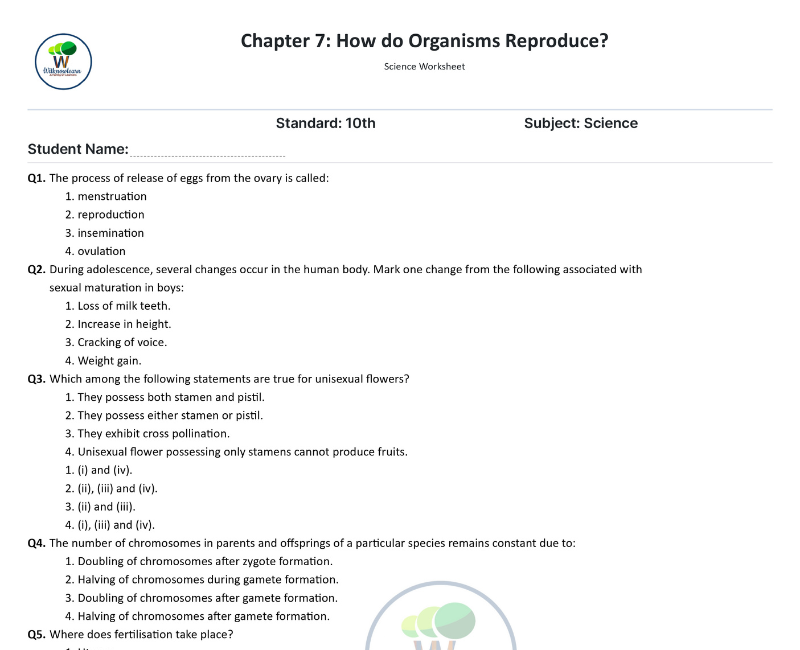
This How Do Organisms Reproduce Class 10 worksheet page combines written practice with an online quiz, labelled diagrams and interactive activities. Revise DNA copying, variation, asexual methods, sexual reproduction in flowering plants, human reproduction and reproductive health. Use the existing worksheet download for written answers, then explain the processes using the tasks above.
How Do Organisms Reproduce Class 10 Important Questions
Practise diagram labels, methods with examples, pollination versus fertilisation, reproductive-organ functions, placenta and implantation, menstrual changes, contraception comparisons and normal gamete chromosome counts. The worked explanations below support short answers, case-based questions and assertion–reason practice.
DNA Copying and Importance of Variation
DNA carries inherited information. Copying helps preserve an organism's basic body design, while copying differences can introduce variation. Sexual reproduction combines genetic information through gamete fusion. Variation can help some members of a population survive changed conditions, but every variation is not beneficial to every individual.
Asexual Reproduction Methods with Examples
| Method | Main idea | Example |
|---|---|---|
| Binary fission | One parent divides into two daughter individuals | Amoeba and Leishmania |
| Multiple fission | Many daughter individuals form in one event | Plasmodium |
| Budding | An outgrowth develops into a new individual | Yeast and Hydra |
| Fragmentation | Fragments grow into individuals in suitable organisms | Spirogyra |
| Vegetative propagation | New plants arise from vegetative parts | Potato eyes and Bryophyllum leaf buds |
| Spore formation | Reproductive spores can grow in suitable conditions | Rhizopus |
Regeneration can replace damaged parts. Some organisms can form whole individuals from suitable fragments, but repairing a wound is not automatically reproduction. A potato is a stem tuber, and its eyes contain buds.
Sexual and Asexual Reproduction Difference
Asexual reproduction does not involve gamete fusion and generally produces genetically very similar offspring. Sexual reproduction involves gamete fusion and new genetic combinations. It is better defined by this mechanism than by a rigid rule of two separate parent organisms, because self-fertilisation occurs in some organisms.
Flower Diagram Pollination and Fertilisation
The stamen consists of an anther and filament. The pistil includes stigma, style and ovary. Ovules occur inside the ovary and contain egg cells. A pollen grain produces and carries male reproductive cells; it is not itself the gamete that fuses with the egg.
Pollen is transferred from an anther to a stigma.
Suitable compatible pollen germinates.
A pollen tube grows through the style toward an ovule.
A male gamete fuses with the egg to form a zygote.
The embryo develops within the developing seed.
The ovule becomes a seed and the ovary usually develops into fruit.
Self-pollination can involve the same flower or another flower on the same plant. Cross-pollination involves different plants of the same species. Pollination alone does not guarantee fertilisation.
Pollination Experiment Case Based Question with Solution
Anthers are removed before they mature.
The flower is bagged and no pollen is supplied.
Its own pollen source is removed and outside pollen is excluded.
In the standard sexual-reproduction model, fertilisation cannot proceed.
If compatible pollen is deliberately supplied later, fertilisation can become possible.
This controlled school model assumes viable female structures and excludes special pathways such as apomixis.
Human Male Reproductive System Functions
The testes produce sperm and testosterone. Sperm mature in the epididymal region and travel through the vas deferens. Seminal-vesicle and prostate secretions contribute fluid to semen. The urethra carries semen to the outside. The scrotum helps maintain a temperature suitable for sperm production. A sperm duct is different from a ureter, which carries urine from a kidney.
Human Female Reproductive System Functions
Ovaries contain developing egg cells and produce hormones. An egg released at ovulation can enter an oviduct. Human fertilisation usually occurs in an oviduct, whereas the developing embryo later implants in the uterine lining. The cervix is the lower narrow region of the uterus, leading to the vagina.
Fertilisation Implantation and Placenta Difference
Fertilisation produces a zygote through gamete fusion.
Cell divisions produce a developing embryo.
The embryo reaches the uterus.
Implantation embeds it in the uterine lining.
The lining is maintained to support development.
The placenta supports exchange between maternal and fetal circulations.
Oxygen and nutrients pass toward the developing offspring, while carbon dioxide and metabolic wastes pass toward maternal circulation. Maternal and fetal blood normally remain separate across an exchange barrier.
Menstruation and Puberty Class 10
Puberty involves reproductive maturation and hormonal changes, with timing that varies between individuals. When no pregnancy is established, hormonal changes lead to shedding of the uterine lining with blood and tissue. Menstruation is not simply the loss of an egg and is not a disease. A 28-day cycle is a teaching average rather than a fixed schedule for everyone.
Chromosome Count Questions with Solutions
A normal gamete contains 17 chromosomes.
A normal gamete of the other sex in the same species also contains 17.
17 + 17 = 34.
The resulting diploid zygote contains 34 chromosomes.
The usual diploid body cells also contain 34.
For these standard problems, normal gametes carry n chromosomes and a usual diploid zygote carries 2n. Do not confuse chromosome number with the amount of DNA at every stage of a cell cycle.
Contraception and Reproductive Health Questions
| Method group | School-level mechanism |
|---|---|
| Barrier methods such as condoms | Help prevent sperm reaching the egg |
| Hormonal methods | Can inhibit ovulation and alter other reproductive processes |
| Copper intrauterine device | Interferes with sperm function and fertilisation |
| Vasectomy | Interrupts sperm transport through the vas deferens |
| Tubal surgery | Interrupts the normal meeting of egg and sperm |
Condoms reduce the risk of many sexually transmitted infections when used correctly and consistently. Pills, IUDs and surgical contraception do not provide STI protection. HIV is a virus; AIDS is an advanced stage of HIV infection. Contraception prevents pregnancy and is different from ending an established pregnancy.
How Do Organisms Reproduce Extra Questions with Answers
- Why are asexual offspring not guaranteed to be genetically identical? DNA copying can introduce differences.
- Why is the pollen tube important? It provides a route for male reproductive cells to reach the ovule.
- Why are ovary and ovule not interchangeable? An ovary contains ovules; their later developmental outcomes differ.
- Why does blocking a reproductive duct not necessarily stop hormone secretion? Transport pathways and hormone-producing tissues have different roles.
- What does a cotyledon do in the illustrated dicot seed? It stores food used during early development.
Current Syllabus and Sample Paper Update
The CBSE Science syllabus for 2026–27 includes asexual and sexual reproduction, reproductive health, family planning and STI prevention. The official sample paper includes anther-removal and bagging, surgical contraception, gamete chromosome counts and uterine changes after implantation. These are sample-paper themes rather than claims of repeated actual board questions.
References NCERT How do Organisms Reproduce, WHO condom information and WHO HIV and AIDS information. Reviewed on 22 October 2026. Interactive questions here are original practice material.
Related Class 10 Science Resources
Frequently Asked Questions
Why is reproduction important for a species?
It produces new individuals and supports continuity across generations. It has a different role from processes that maintain the daily life of an individual.
What are the main asexual reproduction methods?
Class 10 examples include binary and multiple fission, budding, fragmentation, vegetative propagation and spore formation. Regeneration can restore parts and can produce whole individuals in some organisms.
Are asexual offspring always genetically identical?
They are generally very similar, but copying differences and mutations can introduce variation.
Does sexual reproduction always require two separate parent organisms?
Sexual reproduction involves gamete fusion. In some organisms, including certain flowering plants, self-fertilisation can occur.
How are pollination and fertilisation different?
Pollination transfers pollen to a stigma. Fertilisation is fusion of a male gamete with an egg. Pollen arrival alone does not guarantee successful fusion.
What happens to the ovule and ovary after fertilisation?
In the standard sexual flower pathway, the ovule develops into a seed and the ovary usually develops into fruit.
Where does fertilisation occur in humans?
It usually occurs in an oviduct or fallopian tube. The developing embryo later implants in the lining of the uterus.
What is the role of the placenta?
It supports transfer of oxygen and nutrients toward the developing offspring and transfer of carbon dioxide and wastes toward maternal circulation. The two blood supplies normally remain separate.
Why does menstruation occur?
When pregnancy is not established, hormonal changes lead to shedding of the uterine lining with blood and tissue. Timing varies among individuals and cycles.
How are gamete and zygote chromosome counts related?
In the standard diploid life-cycle model, each normal gamete carries n chromosomes. Fusion restores 2n in the zygote.
Does every contraceptive protect against STIs?
No. Condoms reduce the risk of many STIs when used correctly and consistently. Pills, IUDs and surgical contraception do not provide STI protection.
Which important questions should I practise?
Practise reproductive methods with examples, flower and human diagrams, pollination experiments, organ functions, implantation, placenta, menstruation, contraception comparisons and normal chromosome counts. Use official past papers for genuine previous-year questions.
 Download