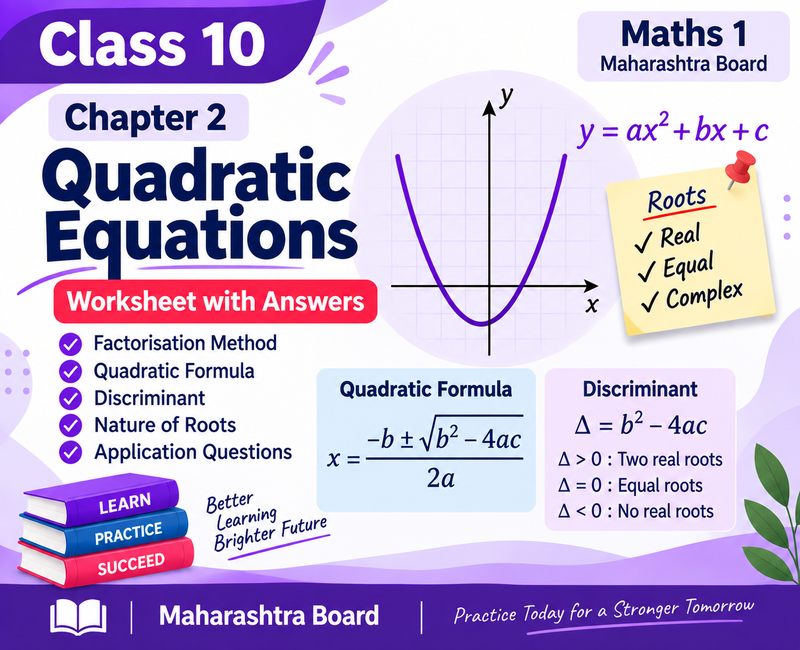
Class 10 Maths 1 Chapter 2 Quadratic Equations Worksheet
Practice Maharashtra State Board Class 10 Maths 1 Chapter 2 – Quadratic Equations with this chapter-wise worksheet with answers. The worksheet provides additional practice and helps students understand different methods of solving quadratic equations.
This Class 10 Maths 1 Chapter 2 worksheet is useful for homework, classroom practice, revision, class tests, prelims and Maharashtra SSC Board exam preparation. Students can use it after completing the Balbharati textbook Practice Sets for additional chapter-wise practice.
Chapter 2 Worksheet Contents
The worksheet includes questions on identifying quadratic equations, factorisation, quadratic formula, discriminant, nature of roots, relation between roots and coefficients and application-based problems.
Chapter Overview
A quadratic equation is an equation of degree two. In this chapter, students learn different methods of solving quadratic equations and use the discriminant to determine the nature of their roots.
Topics Covered in the Worksheet
- Standard form of a quadratic equation
- Factorisation method
- Quadratic formula
- Discriminant
- Nature of roots
- Relation between roots and coefficients
- Application-based problems
Important Formulas
Standard form:
ax² + bx + c = 0, where a ≠ 0
Quadratic formula:
x = (−b ± √(b² − 4ac)) / 2a
Discriminant:
Δ = b² − 4ac
Sum of roots:
α + β = −b/a
Product of roots:
αβ = c/a
Common Mistakes to Avoid
- Identifying the values of a, b and c incorrectly.
- Forgetting the ± sign in the quadratic formula.
- Making sign errors while calculating the discriminant.
- Factorising the quadratic expression incorrectly.
- Writing only one root when two roots are obtained.
- Using the wrong conclusion for the nature of roots.
Why Practice This Chapter 2 Worksheet?
- Provides additional practice beyond textbook questions.
- Strengthens factorisation skills.
- Improves accuracy while using the quadratic formula.
- Helps revise the discriminant and nature of roots.
- Useful for school tests, prelims and SSC exam revision.
- Answers allow students to check their work independently.
Study Chapter 2 Before Solving the Worksheet
If you need help understanding the chapter, revise the Class 10 Maths 1 Chapter 2 Quadratic Equations Solutions on WitKnowLearn before attempting this worksheet.
Frequently Asked Questions about Quadratic Equations Worksheet
What is a quadratic equation?
A quadratic equation is an equation of degree two that can be written in the form ax² + bx + c = 0, where a ≠ 0.
What is the quadratic formula?
The quadratic formula is x = (−b ± √(b² − 4ac)) / 2a.
What is the discriminant?
The discriminant is Δ = b² − 4ac. It helps determine the nature of the roots of a quadratic equation.
When does a quadratic equation have two distinct real roots?
A quadratic equation has two distinct real roots when its discriminant is greater than zero.
When does a quadratic equation have equal roots?
A quadratic equation has equal real roots when its discriminant is zero.
Does this Quadratic Equations worksheet include answers?
Yes. Answers are provided so students can check their solutions after completing the worksheet.
Is this worksheet useful for Maharashtra SSC exam preparation?
Yes. It provides additional chapter-wise practice for Class 10 Maharashtra State Board Maths 1 and is useful for revision, prelims and SSC Board exam preparation.
 Download